
15 Rainy Day Toddler Activities: Easy Screen-Free Indoor Ideas
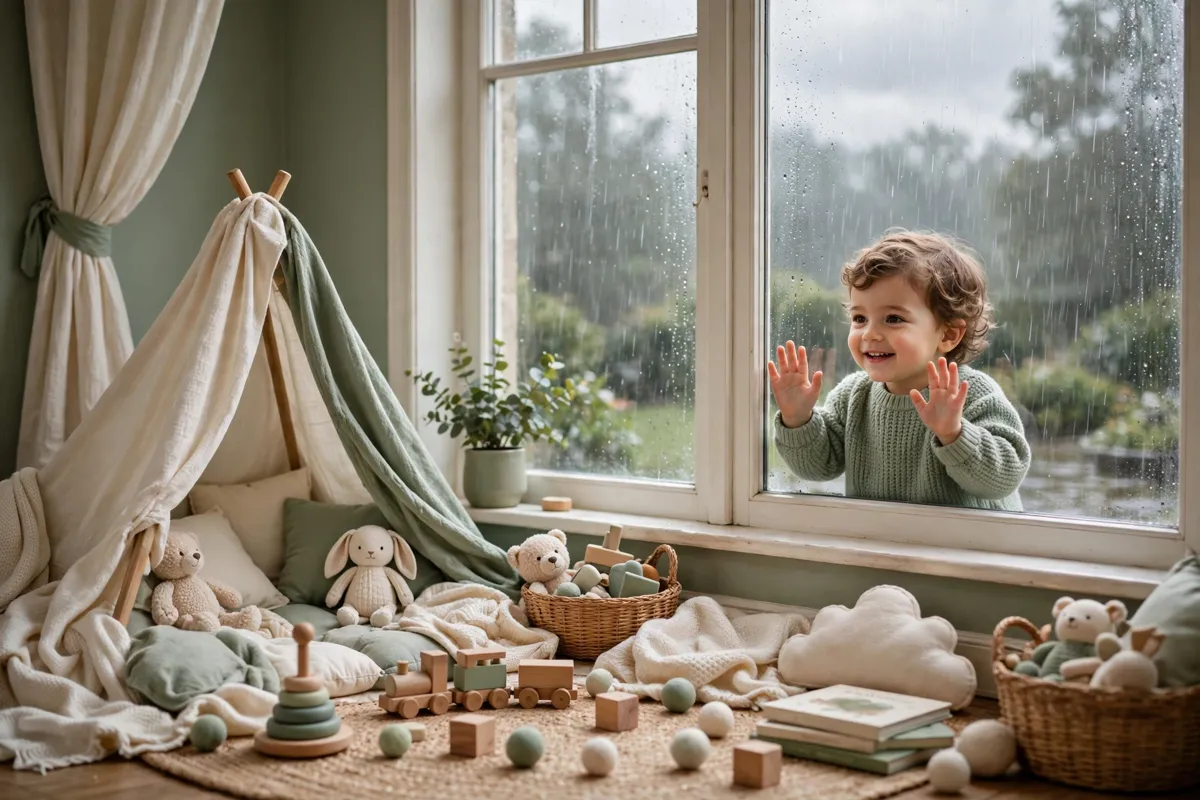
Rainy days can make a normal toddler day feel surprisingly long. The playground is off the table, everyone is inside, and “I’m bored” can arrive before lunch. These rainy day toddler activities give you simple screen-free options for ages 2 to 5, using things you may already have at home.

Save a rainy-day backup plan
The No-Screen Toddler Rescue Kit gives you 115 screen-free activities for ages 2 to 5, so you have options ready when outdoor plans disappear.
See the No-Screen Toddler Rescue Kit →Why rainy days are a good time for simple play
When outdoor plans disappear, it helps to have a few indoor play ideas that are easy to start and easy to stop. The American Academy of Pediatrics notes that simple materials such as boxes and basic toys can support imaginative play, while UNICEF shares screen-free and indoor play ideas that use familiar household materials. HealthyChildren.org and UNICEF Parenting are useful places to explore more.
This list is not about keeping a toddler entertained for hours or creating a Pinterest-perfect activity station. It is about having a few realistic starting points for a wet afternoon, especially when you want an alternative to immediately reaching for a screen.
Some activities may last five minutes. Others may be repeated for much longer. Let your child decide when possible, and feel free to simplify any idea to fit your home and your toddler.
15 rainy day toddler activities
Rain Sound Listening Game
Sit near a window and listen to the rain together. Ask your toddler what they can hear: soft drops, heavy rain, wind, water running down a drain, or cars passing outside.
Make it playful: Take turns making a quiet “drip drip” sound and a loud “whoosh” sound. Let your child copy you.
Raindrop Race at the Window
Choose two visible raindrops on a window and watch them travel downward. Pick a starting point and see which one reaches the bottom first.
Try: Count slowly while you watch, or choose a new pair of drops each round.
Indoor Umbrella Picnic
Open an umbrella in a safe, uncluttered indoor spot or use a pretend umbrella if you have one. Spread a small blanket nearby and create a pretend rainy-day picnic with cups, plates, stuffed animals, and toy food.
Parent prompt: “Who is coming to our picnic?” Let your toddler decide what happens next.
Rainy Window Art
Use washable window crayons or markers that are specifically designed for glass, and let your toddler draw clouds, umbrellas, raindrops, boots, or a rainbow on an appropriate window surface.
Keep it easy: Give them only a few colors and one simple theme instead of setting up a full craft station.
Paper Puddle Jump Path
Cut or tear several large pieces of paper into simple “puddles” and place them on the floor in a clear, safe area. Your toddler can step, hop, or carefully move from puddle to puddle.
Variation: Call out “big puddle” or “tiny puddle” and let your child choose how to move.
Weather Sock Puppet Show
Use a clean sock as a simple puppet and turn it into a weather character. The puppet can be a cloud, a rainy-day friend, or someone looking for a sunny spot.
Ask: “What does the cloud want to do today?” Follow your toddler's answer instead of planning a full story.
Bathroom Tile Water Painting
Give your toddler a clean, larger paintbrush and a small container with a little plain water. Let them “paint” a suitable tiled surface and watch the wet marks disappear as the water dries.
Safety: Keep the floor as dry as possible, stay with your child, and avoid slippery setups.
Rainy-Day Cardboard House
Turn a cardboard box into a tiny rainy-day house, bus, shop, or animal shelter. No decorating is required. Add one blanket and a couple of stuffed animals and let your toddler decide what the box becomes.
Keep it flexible: If the house suddenly becomes a train, go with it. The pretend-play idea can change as your child plays.
Indoor Weather Scavenger Hunt
Choose a few simple things for your toddler to find around one safe room: something blue, something soft, something that keeps you dry, or something shaped like a circle.
For younger toddlers: Use one clue at a time and point out examples when needed.
Puddle Road for Toy Cars
Use painter's tape to make a simple road on the floor. Add a few large toy vehicles and create paper “puddles” beside the road. Your toddler can drive around the puddles, park, and make up destinations.
Try: “The fire truck needs to get home before the rain gets bigger.”
Cozy Rainy-Day Reading Den
Make a small reading spot with a blanket, a few cushions, and two or three favorite books. Add a stuffed animal as the “reading buddy.”
Let your child choose: They can look at pictures, listen to you read, or retell a familiar story in their own way.
Rain Rhythm Band
Use a few safe household objects such as wooden spoons and sturdy plastic containers to make gentle rain sounds. Tap softly for drizzle and more firmly for a pretend downpour.
Then switch: Let your toddler become the “weather conductor” and decide whether the rain is quiet or loud.
Rainy-Day Laundry Sort
Turn a small pile of clean laundry into a simple helper game. Match socks, separate towels from shirts, or make piles by color.
Why it works for rainy days: You are using an ordinary household task as the play invitation, so there is very little extra setup or cleanup.
Teddy's Rainy-Day Rescue
Give a stuffed animal a simple problem: Teddy wants to go outside, but it is raining. Your toddler can make a blanket shelter, find a pretend raincoat, pack a bag, or create a cozy place for Teddy to wait.
Ask one question: “What does Teddy need?” Then let your child solve the problem through pretend play.
Design Your Perfect Rainy Day
Put a large sheet of paper on the table and invite your toddler to draw what they would like to do on a rainy day. It can be a house, a blanket fort, puddles, animals, snacks, or anything else they imagine.
Make it conversational: Ask, “Where are you?” or “Who is with you?” rather than correcting the drawing.
A practical note
Rain itself can become part of the play: listen for different sounds, draw what your toddler sees through the window, or turn a toy-car road into a pretend puddle route. For a long indoor stretch, alternate movement with quieter play instead of expecting one activity to last all afternoon. A simple rainy-day basket with paper, crayons, cardboard, tape and a few toys can remove the “what do we do now?” decision when the weather changes your plans.
Need more options for this exact moment?
The Rescue Kit gives you a larger activity rotation so you can choose an idea that fits the time, energy and situation you actually have.
Explore the 115-Activity Kit →Which rainy day activity should you pick?
- Your toddler is bouncing off the walls: try the paper puddle jump path or toy-car road.
- You need something calm: try the reading den, rain listening game, or rainy window art.
- Your child wants pretend play: try the umbrella picnic, cardboard house, or Teddy's rainy-day rescue.
- You have almost no supplies: try rain listening, window watching, a scavenger hunt, or laundry sorting.
- You want to use a normal household task: try laundry sorting or setting up the cardboard house.
- You have five minutes to prepare: pick one activity and put away everything else. A smaller setup is often easier to start.
How to make rainy day play easier on you
1. Match the activity to your toddler's energy
A child who has been stuck inside all morning may need movement before they are ready for a quiet activity. A child who is already settled may be perfectly happy with books, drawing, or pretend play.
2. Start with one invitation
You do not need to build a whole rainy-day schedule. Put out one activity, show your toddler how to begin, and see what happens. If it works, stay with it. If it does not, switch.
3. Use ordinary things first
Boxes, paper, blankets, cups, laundry, books, and safe household objects can become play materials. The American Academy of Pediatrics highlights simple, inexpensive materials as useful for imaginative play, and UNICEF similarly shares activities that can be created with familiar things at home. Read more at HealthyChildren.org and UNICEF Parenting.
4. Let the activity change
Your “rainy-day house” may become a bus. Your drawing may become a restaurant. Your laundry sort may become a pretend shop. That is not failure. Play can move in a different direction once your child starts adding their own ideas.
5. Keep the goal realistic
You are not trying to create a perfect screen-free day. You are simply giving your child another option for this moment. Some rainy-day activities will last five minutes, some will last longer, and some will be abandoned immediately. Keep a few reliable ideas and rotate them when needed.
What if my toddler still wants a screen?
That can happen. Screen-free activities are an option, not a test of parenting. If your toddler loses interest in an activity, you can simplify it, offer two choices, join for a few minutes, or try something completely different.
The American Academy of Pediatrics recommends balancing screen use with active play and other parts of a child's daily routine. Families can make choices that fit their own circumstances. The point of this page is simply to make screen-free play easier to reach for when you want it.
Keep the ideas ready before you need them
The No-Screen Toddler Rescue Kit gives you 115 screen-free ideas for ages 2 to 5, built around everyday materials and real-life moments.
Get the No-Screen Toddler Rescue Kit →How we choose these activities
We prioritize everyday materials, simple setup and flexible play that caregivers can adapt to a child’s age and abilities. We avoid activities that depend on small loose parts and encourage active adult supervision whenever safety requires it.
Rainy day is a theme, not just a location
Every indoor guide on this site will fill a wet day, but a rainy day deserves to be treated as an event in itself, because toddlers experience it as one: the sound, the dark at noon, the water running down the glass. This page builds the day around the rain, watching it, going out in it once properly dressed, then coming in to dry land activities. For general stuck inside play with no weather angle, the indoor activities guide is the parent page; for the calmest end of the day, the quiet activities list is your landing.
Frequently Asked Questions
What are the best rainy day activities for toddlers?
Start with the rain itself: window watching with spotting games, one dressed-up puddle outing if you have the gear, then indoor waves: a movement circuit, water play in the sink or bath, a den with books and a torch, and baking or pretend cooking in the warm kitchen. Structure the day in loud and calm blocks and it stops feeling endless.
How do I burn toddler energy on a rainy day without going out?
Circuits: cushion climbing, tunnel crawling, tape line balancing, star jumps, repeated in laps. Dance freeze, hallway bowling and stairs games under supervision add variety. Two or three twenty minute burns across the day, plus one bath play session, covers most toddlers' movement needs on a housebound day.
Is it OK to take my toddler out in the rain?
Yes, and it is often the highlight. With waterproofs and wellies, twenty minutes of puddle stomping and dripping watching transforms the day, and children who have been out in it settle indoors far better afterwards. Keep it short, warm them up when you come in, and treat the getting dressed as part of the adventure rather than a tax on it.
What rainy day activities need no preparation?
Window spotting games, den building from sofa cushions and blankets, sink play with cups, dance freeze, sock bowling, drawing the rain, and a bath in the middle of the day purely for play. None of these need a supply run, which matters, because on a rainy day nobody is going to the shops for googly eyes.
How do I stop a rainy day becoming an all day screen day?
Give the day a skeleton: window time, outing, lunch, movement circuit, quiet block, bath play, cosy finish. Screens fit, if you use them, as one named chapter, ideally not the first one, because the first activity of a housebound day tends to set its terms. The plan carries the day; the screen just visits it.
What are good rainy day activities for a 2 year old?
Simpler and more physical: puddle suits and short outings, water pouring at the sink, cushion climbing, dancing, big cardboard boxes, and very short spotting games at the window. Two year olds need the loud blocks shorter and more frequent, and the cosy blocks heavier on laps and books.
What do I do when we are on day three of rain?
Novelty, in any tiny form: move the den to a different room, rotate toys (the toy rotation guide explains the system), invite the bath earlier, make one meal a floor picnic, and get out once a day in the rain regardless. By day three it is not activities the house lacks; it is difference. Engineer difference cheaply.
For a more specific situation, explore sick-day activities for toddlers at home.
Sources and further reading
- UNICEF Parenting, “Screen-free activities for children”
- UNICEF Parenting, “21 learning activities for babies and toddlers”
- American Academy of Pediatrics / HealthyChildren.org, “10 No-Cost, Screen-Free Activities to Play with Your Preschooler”
- American Academy of Pediatrics / HealthyChildren.org, “Toddler Activity”