
15 Easy Toddler Activities at Home: Simple Screen-Free Ideas
These no-prep toddler activities are for parents who want something their child can do with what is already in the house, without shopping for supplies or setting up a special project. For ages 2 to 5, the ideas below use ordinary household materials such as cups, paper, books, socks, blocks, stuffed animals, and familiar toys, so you can start without a shopping list.
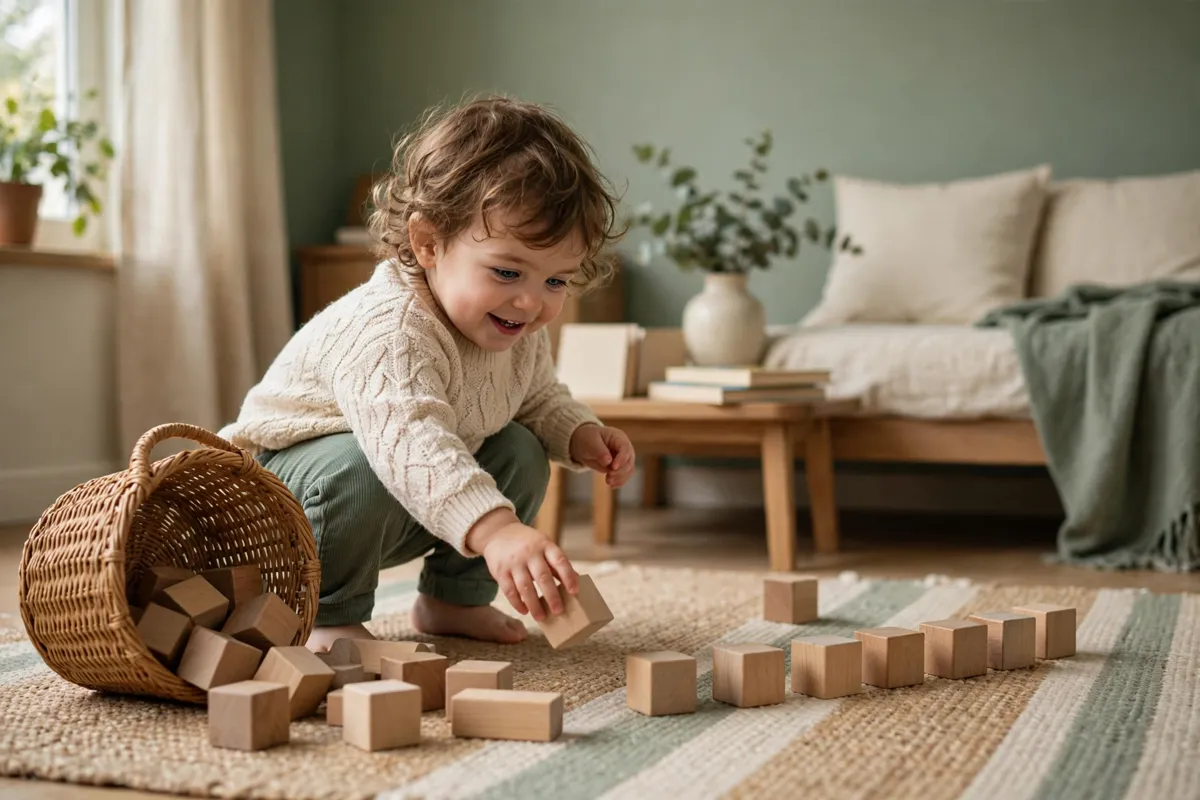
Use what you have, then give it a new job
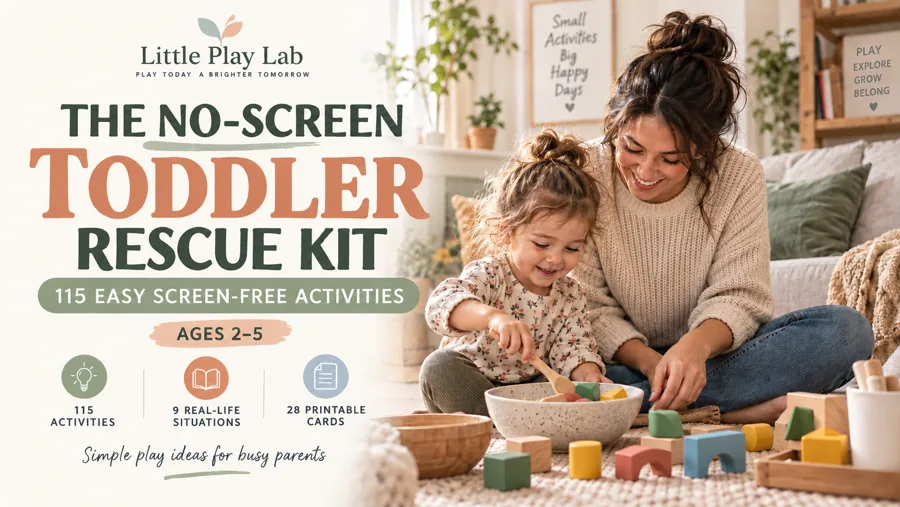
The No-Screen Toddler Rescue Kit gives you 115 screen-free ideas for ages 2 to 5, built around everyday materials and real-life moments.
See the No-Screen Toddler Rescue Kit →Why simple activities often work
Toddlers generally do not need elaborate toys or complicated instructions to explore. A familiar object can become part of a sorting game, pretend scene, building challenge or simple household task.
The American Academy of Pediatrics describes play as an important way for young children to learn and interact with the world. ZERO TO THREE also emphasizes simple, everyday play experiences that encourage toddlers to explore and interact. That means “easy” does not have to mean meaningless. A very basic activity can still give a toddler something interesting to do.
15 easy toddler activities at home
1. Build a Cup Tower
Give your toddler several sturdy plastic cups and let them stack, knock down and rebuild towers. Try making a tall tower together first, then let them experiment with their own designs.
2. Sort a Basket of Socks
Place clean socks in a basket and ask your toddler to find matching pairs. They can put pairs together, make piles or simply explore the different colors and patterns.
3. Pick Three Favorite Books
Put three familiar books on the floor and let your toddler choose which one to look through. They can point at pictures, name objects, retell parts of the story or make up their own version.
4. Big Paper Drawing
Tape a large sheet of paper to a suitable surface and provide a few chunky crayons. Invite your toddler to draw roads, circles, faces, houses or anything else they want.
5. Stuffed Animal Picnic
Put a blanket on the floor and invite your toddler to bring a few stuffed animals for a pretend picnic. They can arrange the animals, serve pretend food and decide who sits where.
6. Toy Matching Game
Choose a few familiar toys and make simple paper drawings or picture cards that represent them. Your toddler can place each toy beside its matching picture.
7. Safe Kitchen Helper Sort
When you are not handling hot, sharp or unsafe items, give your toddler a small group of safe household objects to sort by type or size. Keep the child in a clearly defined safe area away from kitchen hazards.
8. Pillow Path
Place a few firm cushions or pillows on the floor to create a simple path. Your toddler can step from one to another while you supervise and adjust the setup for safety.
9. Make a Toy Garage
Use a cardboard box as a simple garage for toy cars. Your toddler can park cars, drive them in and out, or add paper roads around the box.
10. Window Watch
Look outside together and name things you can see. Try prompts such as “Can you find a tree?” or “Tell me when you see a red car.” Keep the activity relaxed and follow your child's interest.
11. Make a Paper Shape Hunt
Draw a few large shapes on paper, then ask your toddler to find similar shapes around the room. Keep the examples simple, such as circles, rectangles and triangles.
12. Big Spoon Transfer
Use large, safe household objects that your child cannot easily swallow and let them move the objects between two larger containers using a spoon. Stay close and choose materials appropriate for your child's age and abilities.
13. Find Something That...
Give your toddler simple clues: “Find something soft,” “Find something blue,” or “Find a toy with wheels.” Let them bring the object to a designated spot and then give another clue.
14. Toy Shop
Arrange a few toys as a pretend shop. Your toddler can choose an item, carry it to you, put it back or pretend to buy it. You can model one round and then let them take over.
15. Cardboard Box House
Give your toddler a large empty cardboard box and let them turn it into a simple house, garage or pretend hiding place. Add paper drawings or a blanket if they want to decorate it.
A practical note
A familiar object can become a new activity without buying anything. A cup can be a building material, socks can become a matching game, a box can become a garage, and paper can become a road or pretend menu. When you are stuck, ask: can we sort it, build with it, draw around it, match it or pretend with it? Reusable activity patterns make home play easier because the setup can stay familiar while the actual play changes.
Need more options for this exact moment?
The Rescue Kit gives you a larger activity rotation so you can choose an idea that fits the time, energy and situation you actually have.
Explore the 115-Activity Kit →How to choose the right activity
You do not need to prepare a new activity every time your toddler says they are bored. Match the activity to the moment.
- Need something calm? Try books, drawing, matching or sorting.
- Need a little movement? Try a pillow path or toy delivery game.
- Need to cook nearby? Use a clearly separated safe play area with an activity that does not involve kitchen hazards.
- Need very little setup? Start with books, cups, socks, blocks or a toy search.
- Your toddler is bored? Offer two choices instead of presenting a whole room full of toys.
How to make home activities easier for parents
- Create a small activity basket. Keep a few familiar materials together so you do not have to search for supplies.
- Use what is already available. Cups, cardboard boxes, paper, books and safe household objects can provide plenty of play possibilities.
- Give one instruction at a time. Toddlers often respond better to a simple starting point than a long explanation.
- Let your child change the activity. If a cup tower becomes a pretend restaurant, there is no need to bring it back to the original plan.
- Rotate materials. Put some toys away and bring them back later rather than constantly adding new things.
Screen-free does not have to mean screen-shaming
These ideas are simply another set of options for families. Screens can have a place in many households. If you want a screen-free stretch during a particular part of the day, having a few easy activities ready can make that choice easier.
For more ideas, UNICEF's parenting resources include practical screen-free activities that can be adapted to everyday family routines.
Safety notes
Choose materials based on your child's age, abilities and mouthing habits. Avoid small loose parts for children who still put objects in their mouths. Activities involving water, glue, scissors, household tools or movement equipment should be supervised appropriately.
When using the kitchen as the setting for play, keep toddlers away from hot surfaces, knives, appliances and other hazards. A separate safe play area is preferable while an adult is cooking.
Keep the ideas ready before you need them
The No-Screen Toddler Rescue Kit gives you 115 screen-free ideas for ages 2 to 5, built around everyday materials and real-life moments.
Get the No-Screen Toddler Rescue Kit →How we choose these activities
We prioritize everyday materials, simple setup and flexible play that caregivers can adapt to a child’s age and abilities. We avoid activities that depend on small loose parts and encourage active adult supervision whenever safety requires it.
The simplest page on this site, on purpose
This is the zero prep list. Other guides organise play by situation: the indoor guide for burning energy inside, the 15 minute guide for short windows of time. This page organises by effort, and the allowed effort is almost none. Everything here comes out of a kitchen drawer, a laundry basket or a toy box you already own, and most of it is play your toddler can start while you are still finishing your sentence.
Five easy ideas parents here reach for most
The laundry basket sort. Clean washing, two baskets, one toddler employed as head of distribution. Socks to one basket, everything else to the other. It is a real job, it lasts as long as the laundry does, and it teaches matching without a single flashcard.
The cupboard drawer. One low kitchen drawer designated theirs, holding containers, lids, wooden spoons and a funnel. While you cook or tidy, the drawer empties and refills. The cooking guide on this site builds a whole system around this drawer.
Water, a bowl, a cloth. Washing anything washable: toys, shells, their own hands, the table. Water is the highest attention-per-effort substance in the house, and a bowl on a towel keeps it easy.
The big box. Any large cardboard box is a house, car, boat, bed and cave across a single day. Crayons for decorating it are the only addition. When it collapses, it has earned the recycling.
Follow the leader, house edition. You walk, they copy: tiptoe past the sleeping dragon (the cat), stomp over the bridge (the rug), freeze at the door. Two minutes of this resets a flat patch better than most toys.
Frequently Asked Questions
What are the easiest toddler activities at home?
The ones with a one-step start: tipping and sorting anything safe, water in the sink with cups, a cardboard box, drawing on big paper, helping jobs with real cloths and water, and books in a basket. If you have to gather more than two things or explain rules, it has left easy territory.
What can my toddler do at home with no supplies?
Carry and deliver games with soft toys, cushion climbing, sock matching from the laundry, dancing, window spotting, den building, washing their toys in a bowl, and drawing on the inside of any box heading for recycling. A house is full of play equipment; it is only labelled as furniture.
How do I keep a toddler busy at home while I do housework?
Work in the same room and hand them the parallel job: their cloth while you wipe, their socks while you fold, their bowl while you wash up. Toddlers would rather do the real thing badly beside you than a perfect activity alone. Rotate rooms as you move and the whole house becomes the activity trail.
What are easy activities for a 2 year old at home?
Posting lids into a tub, nesting cups, big sticker pages, water pouring in the sink with you nearby, pushing cars along a tape line, and emptying and filling anything. Two year olds are connoisseurs of repetition: the easier the loop, the longer it holds them.
How do I make at home days less boring without buying anything?
Change the location and the container, not the toys: blocks in the bath (dry), books in a den, lunch on a picnic blanket on the floor, the same puzzle in a different room. Novelty is mostly geography at this age. The toy rotation guide on this site turns that trick into a system.
What are easy quiet activities for at home?
Books, drawing, sticker work, playdough with two tools, threading big beads, and looking at family photos. The quiet activities guide has the full low volume list for sleeping babies, thin walls and early mornings.
How long should easy activities hold my toddler's attention?
Five to twenty minutes is the honest range, shorter at two, longer at four and five. Easy activities are used in strings: three simple things across an hour is a good hour. Chasing one activity that fills a morning leads to overcomplicated setups, which is exactly what this page exists to avoid.
For a more specific situation, explore independent activities for 2-year-olds.
For a more specific situation, explore toddler bored of all their toys? try toy rotation.
Sources and further reading
- HealthyChildren.org, The Power of Play
- ZERO TO THREE, Why Play Is Important
- UNICEF Parenting, Screen-free activities for children
- UNICEF Parenting, “21 learning activities for babies and toddlers”
- American Academy of Pediatrics / HealthyChildren.org, “10 No-Cost, Screen-Free Activities to Play with Your Preschooler”
- American Academy of Pediatrics / HealthyChildren.org, “Toddler Activity”