
15 Independent Play Activities for Toddlers That Don't Need a Screen
Independent play does not mean leaving your toddler alone and hoping they figure it out. It means creating a simple, age-appropriate activity your child can lead while you stay nearby and handle a small task of your own. These screen-free ideas are designed for realistic moments when you need to cook, fold laundry, answer a message, or simply have a few minutes to breathe.
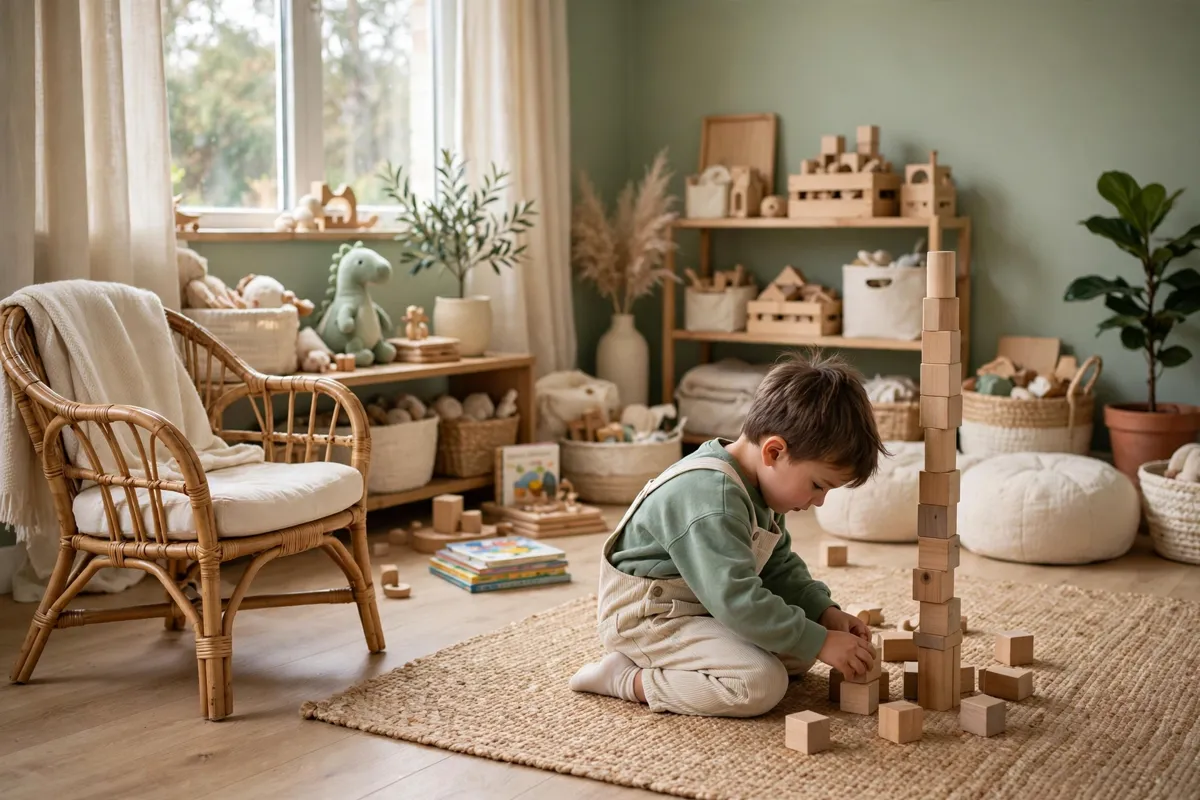
The best independent play activities are familiar, simple, and easy to understand. Start with one activity, show your toddler what to do, and then give them room to explore it in their own way.
15 Independent Play Activities for Toddlers
1. Small Block Building Challenge
Put out a small basket of large blocks and give one simple prompt: build a tower, garage, or house. After showing the idea once, let your toddler decide what to build next.
2. Sock Matching Basket
Give your toddler several pairs of clean, large socks and a basket. Start by matching one pair, then let them find the others.
3. Sticker Picture
Give your toddler large age-appropriate stickers and paper. They can make a road, garden, picture, or simply cover the page.
4. Book Basket
Choose a few familiar board books and place them in a low basket. Let your toddler choose, turn pages, point at pictures, and tell the story their own way.
5. Toy Color Sort
Choose two or three colors and collect a few large matching toys. Put one example into each group, then let your toddler continue sorting.
6. Stuffed Animal Care Station
Give your toddler a stuffed animal, blanket, brush, and pretend cup. Let them feed the toy, put it to bed, or take it for a pretend appointment.
7. Simple Puzzle Basket
Put out one or two familiar chunky puzzles rather than an entire collection. Demonstrate one piece if needed, then step back.
8. Big Paper Drawing
Tape large paper to a safe surface and offer a few chunky crayons. Give a simple starting idea such as roads, circles, rain, or a house.
9. Mini Grocery Store
Place a few empty, clean food containers and a small basket together. Your toddler can shop, pay, unpack, and start again.
10. Cardboard Box House
A large cardboard box can become a house, bus, shop, or animal home. Add a blanket or stuffed animals and let your toddler decide.
11. Toy-to-Book Match
Choose toys that appear in familiar books, such as animals or vehicles. Ask your toddler to find the matching object.
12. Laundry Helper
Give your toddler a small basket of clean, large clothing items. They can move clothes between baskets or match large socks.
13. Indoor Delivery Game
Put two or three safe household objects in a basket. Ask your toddler to deliver each item from one safe spot to another.
14. Cup Stacking
Give your toddler a few sturdy plastic cups and let them build towers, rows, or pretend houses.
15. Blanket Picnic
Put a small blanket on the floor with a stuffed animal and pretend food. Let your toddler arrange the picnic and decide what happens next.
A practical note
Putting toys in a room and saying “go play” leaves many decisions for the child. A clearer invitation gives them a starting line: blocks beside a picture, toy animals near a cardboard barn, or cars beside a hand-drawn road. Once play begins, step back instead of constantly adding instructions. If help is needed, solve the part the child cannot reasonably do alone and return the next choice to them. A smaller intentional setup can also be easier to enter than an entire toy shelf dumped onto the floor.
Need more options for this exact moment?
The Rescue Kit gives you a larger activity rotation so you can choose an idea that fits the time, energy and situation you actually have.
Explore the 115-Activity Kit →How to Encourage Independent Play
The goal is not to suddenly make your toddler play alone for thirty minutes. Start with an activity your child already enjoys, spend a little time playing together, and then tell them what you are going to do next.
For example: “I'm going to fold these clothes. You can keep building your tower. I'll be right here.” Staying nearby can make the transition easier than disappearing from the room.
If your toddler plays independently for five minutes and then asks you to join, that is not a failure. Five focused minutes is a useful starting point.
What Makes an Independent Play Activity Work?
A good activity gives your toddler something they can understand without constant instructions. The materials should be familiar, the goal should be simple, and there should be room for the child to make choices.
Do not turn independent play into a test of how long your toddler can stay quiet. The point is child-led exploration while a responsible adult remains appropriately available.
Independent Play for Different Real-Life Moments
When you need to cook
Try contained activities such as cup stacking, stickers, drawing, sorting, or pretend play. See toddler activities while cooking.
When you need a calmer stretch
Books, matching, puzzles, drawing, and simple pretend play are good starting points. See quiet activities for toddlers.
When your toddler is bored
Give one concrete choice instead of an open-ended question. See toddler activities for when they're bored.
When you only have a short window
Use activities with almost no setup. See 15-minute toddler activities.
Keep the ideas ready before you need them
The No-Screen Toddler Rescue Kit gives you 115 screen-free ideas for ages 2 to 5, built around everyday materials and real-life moments.
How we choose these activities
We prioritize everyday materials, simple setup and flexible play that caregivers can adapt to a child’s age and abilities. We avoid activities that depend on small loose parts and encourage active adult supervision whenever safety requires it.
Get the No-Screen Toddler Rescue Kit →Keep 115 practical activity ideas ready for the next tricky moment.
The hub for independent play
This page covers the whole skill for ages 2 to 5: the method, the setup, and the fifteen activities below. Two situations have their own deep guides. For the very beginning, independent activities for 2 year olds tunes everything to first solo play at two, shorter bursts, bigger loops, more audience. And when independence specifically collapses right after a screen goes off, that pattern has its own page: the TV off transition guide, built around the bridge routine. Start here for the system; go there for the moments.
How the skill grows, age by age
At two, independent play is mostly parallel: your child plays beside you, checking in constantly, in bursts of a few minutes. Loops rule: posting, stacking, filling, emptying. Your presence is the equipment; the toys are almost incidental.
At three, pretend arrives with plots, and play stretches. A three year old runs a shop, a kitchen, a building site for fifteen minutes if the invitation is right. They still anchor to you, but the check-ins space out, and language does more of the holding: they narrate their own play now.
At four and five, projects appear: constructions that take all morning, games with rules they invent and enforce, drawings with intentions. Half hour stretches are realistic, and the fade can become a genuine other room, in a safe house, with check-ins they initiate. This is the age where the early practice pays its dividend all at once, and parents of five year olds who started at two are quietly insufferable about it. They have earned it.
Independent play grows faster with a stocked bench
The No-Screen Toddler Rescue Kit holds 115 print-and-go activities in 89 pages plus 28 printable activity cards, sorted by moment and age, so the next invitation is always ready. Made for ages 2 to 5.
Instant download. Print it once, use it every day.
Frequently Asked Questions
How do I get my toddler to play independently?
Build it like a skill: fill their connection cup first, start the activity with them for a minute or two, then fade, stop directing, sit nearby with your own task, answer check-ins briefly and warmly, end on a success. Daily short practice at their freshest time grows the bursts week by week. The full method is laid out on this page.
How long should a toddler play independently?
At two, bursts of about 3 to 10 minutes are normal, growing to 15 to 20 on favourite activities. By three, many children reach 15 to 25 minutes; by four and five, half an hour or more on absorbing play is common. Variation is wide and normal. Judge progress against your child's own last month.
What are the best activities for independent play?
Loops and open ended invitations: posting boxes, blocks with figures, playdough, sticker pages, water play with you in the room, a play kitchen or shop, drawing, puzzles at their level, and real jobs. If it restarts itself and cannot really be finished or failed, it will hold a child without you.
Why does my toddler follow me instead of playing?
Usually the connection cup is empty, the activity was offered but never started, or there are too many toys fragmenting attention. Fill up first, start together, fade gradually, and cut the toy count with rotation. Following is information about the setup, rarely about the child's character.
Is independent play good for toddlers?
Yes, it is where concentration, problem solving and imagination are practised in their purest form, and child development sources such as ZERO TO THREE describe self directed play as core learning. It is equally good for parents: a child who can play alone for twenty minutes changes what a day at home feels like.
Should I praise my toddler for playing alone?
Warmly, briefly, and mostly afterwards. Interrupting deep play with praise breaks the very absorption you want, and constant commentary makes your attention the point again. A quiet smile when they check in, and a proper admiring conversation at the end, reward the play without colonising it.
What if independent play only lasts two minutes?
Shrink the target and check the ingredients: fresher time of day, a loop activity, fewer toys, connection first, and you seated visibly with a task of your own. Two minutes that ends happily is a successful rep. Skills at this age grow in weeks of small reps, not in one heroic afternoon.
For a more specific situation, explore independent activities for 2-year-olds.
For a more specific situation, explore quiet time activities for 2-year-olds.
For a more specific situation, explore working from home with a toddler: screen-free ideas.
For a more specific situation, explore how to entertain a toddler while caring for a baby.
Sources and further reading
- UNICEF Parenting, “Screen-free activities for children”
- UNICEF Parenting, “21 learning activities for babies and toddlers”
- American Academy of Pediatrics / HealthyChildren.org, “10 No-Cost, Screen-Free Activities to Play with Your Preschooler”
- American Academy of Pediatrics / HealthyChildren.org, “Toddler Activity”
How do I choose an activity for my toddler?
Start with familiar, age-appropriate materials and a clear first step. Adjust the activity to your child's energy and interests, and stay nearby to supervise.
What if my toddler loses interest quickly?
That is normal. Try changing one detail, offering a different choice or putting the activity away and trying again later. No activity can guarantee a fixed amount of attention.
How can I keep toddler activities safe?
Use materials suited to your child's age, remove choking hazards and supervise closely. Never leave a toddler alone around water, cooking equipment or materials they may put in their mouth.
Do screen-free activities have to be elaborate?
No. Familiar books, large blocks, pretend play and everyday helper tasks can be enough. Choose what fits your household rather than aiming for a perfect setup.