
Working From Home With a Toddler
Working from home with a toddler is not one job done badly. It is two jobs, and the day only works when you stop running them both at full intensity at the same time. Parents who manage this well are not more patient than you. They run a system: the day is built in blocks, meetings get their own special kit, the toddler has a workspace beside yours, and the deep work waits for the nap. This page gives you that system, honestly, including what a two year old can and cannot do while you are on a call.
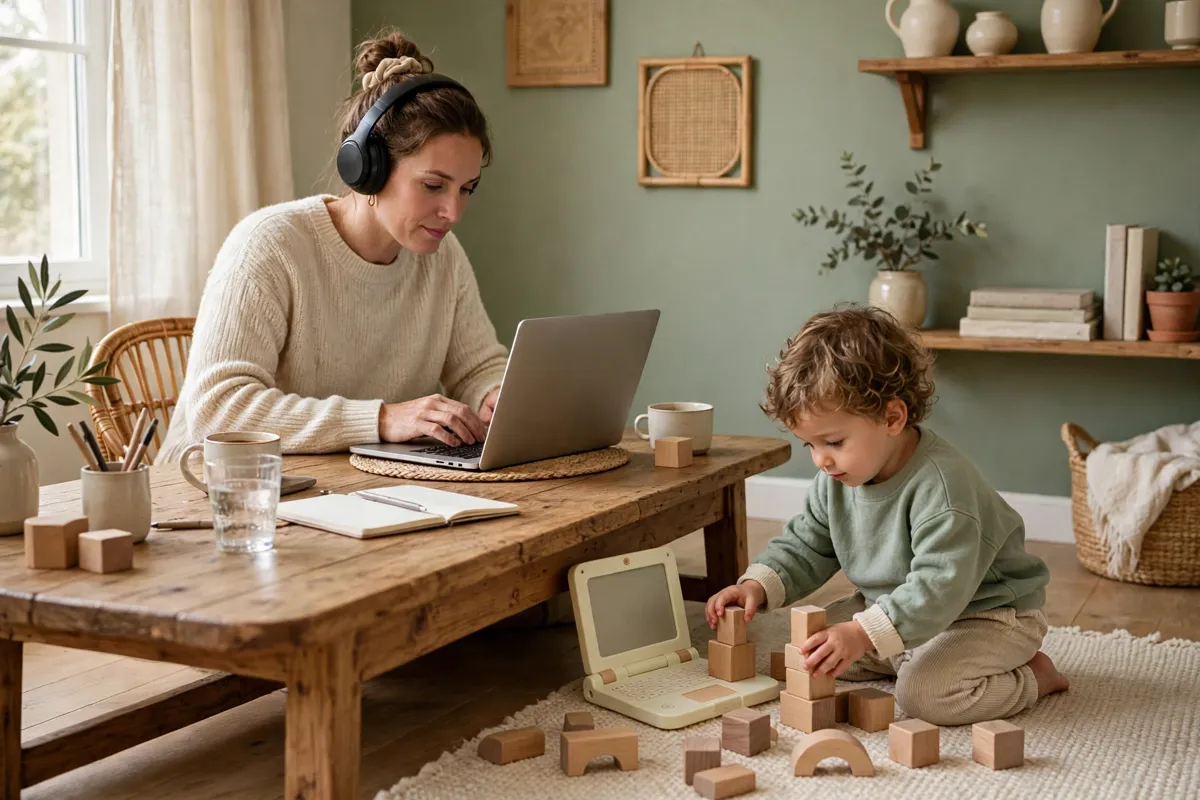
Quick answer: Build the day in blocks instead of battling hour by hour: a connection block first, then short independent play blocks, snack, movement, and your hardest work saved for the nap. Set up a toddler office beside your desk, keep a meeting-only kit that appears just for calls, teach one clear signal (headphones on means tap my arm and wait), and prep tomorrow's two activities and snacks the night before.

Your meeting kit, already thought out
The No-Screen Toddler Rescue Kit holds 115 print-and-go activities in 89 pages plus 28 printable activity cards, sorted by the moments parents actually face. Pull two cards before a call and you have a meeting plan in ten seconds. Made for ages 2 to 5.
Instant download. Print it once, use it every day.
The honest starting point: what is actually possible
A toddler cannot play independently for a whole workday, and any guide that implies otherwise is selling you guilt. What is possible, and genuinely workable, looks like this. A two year old can usually manage five to fifteen minutes of absorbed play at a stretch with the right setup, and that stamina grows with practice across the weeks. A three year old often reaches fifteen to twenty five minutes. Four and five year olds can go longer, especially with a play invitation that has a purpose, like building a zoo or running a shop. Your day will be a patchwork of those stretches, glued together with snacks, cuddles, movement and the nap. That is not a failed workday. That is the real shape of every work from home toddler day, including the ones that look serene on social media.
The second honest point: you cannot do your most demanding work while supervising. Nobody can. The system below works because it stops pretending otherwise. Meetings and light tasks happen while your toddler is awake. Anything that needs your whole brain waits for the nap, the early morning, or a partner's shift. Protect those windows ruthlessly and the rest of the day gets much less frantic.
Build the day in blocks
Toddlers interrupt less when they know what comes next, and you work better when you stop deciding every ten minutes. A simple block rhythm, roughly the same each day, does most of the heavy lifting. Adapt the times to your child; keep the order.
| Block | What happens | Your work |
|---|---|---|
| Arrival (15 to 20 min) | Breakfast together, then play WITH your toddler properly, full attention, phone away | Nothing. This block buys the next one. |
| Work block 1 | Toddler office play: the morning activity you laid out last night | Emails and light tasks |
| Snack and move | Snack, then big movement: dancing, cushions, a walk around the block | Stand up, reset, quick messages |
| Work block 2 | Fresh activity or the meeting kit if a call lands here | Meetings and calls |
| Lunch and wind down | Lunch together, stories, quieter play | Light admin only |
| Nap or quiet time | Sleep, or books and soft toys in a safe cosy spot | Your hardest, deepest work. Guard it. |
| Afternoon stretch | Outdoor play if possible, water play, the second laid-out activity | Light tasks beside them, or finish-up work |
The arrival block deserves emphasis because it feels backwards. Twenty minutes of undivided attention first thing makes the following independent block dramatically more likely to work. A toddler whose connection cup is full goes off to play. A toddler who has been shooed away since waking spends the morning bidding for you, usually at the exact moment your meeting starts.
The toddler office: their workspace beside yours
Your toddler does not want to be somewhere else. They want to be with you, doing what you are doing. So give them a version of it. A small table or a mat corner right beside your desk becomes their office: a toy laptop or an old keyboard, their own notebook and crayons, a phone that does not work anymore, an important stack of paper to scribble on. Many toddlers will sit and "work" beside a parent with surprising seriousness, tapping keys and taking imaginary calls.
Stock the office with two activities a day, no more, laid out the night before. Too many choices end play faster than too few. Good office stock: a puzzle, a sticker book, magnetic tiles, a posting box, playdough with two tools, a small world tray of animals or cars. When play dies, resist inventing something new on the spot. First try a reset: a drink, a two minute cuddle, a look out of the window together. Often the same activity restarts happily after a tiny reconnection.
The meeting kit: your secret weapon
Meetings are the sharpest problem, so they get their own tool. A meeting kit is a small box or bag of items that come out only when you are on a call, and go away the moment the call ends. Because it appears rarely, it keeps its magic for months. Water colouring books are the classic for a reason: colour with no mess and no dried out pens. Add a fresh sticker sheet, a snack that takes time to eat, and one toy that only exists in the kit.
Bring the kit out two minutes before the call starts, not during the first hello. Seat your toddler in their office with it, say the script below, and start. When the call ends, the kit closes, even if they are happily mid-sticker. That discipline is exactly why it still works in month three.
The signals and the script
Toddlers cannot read "I am busy" from your face, but they can learn one visible signal. Experienced work from home parents often use the headphones rule: headphones on means tap my arm and wait. Practise it outside work time as a game, praise even five seconds of waiting like it is a triumph, and keep your side of the bargain by actually responding when the tap comes and the call allows. Pair it with one sentence, used every time: "I am on a call. I will help you in two minutes." Then, when you can, set a visual timer slightly longer than the meeting, so it always rings before you finish rather than after. A child who learns that the timer lies in their favour trusts it.
Prep tonight, thank yourself at 9 AM
The Rescue Kit's 28 printable activity cards were made for exactly this: one card on the desk tonight is tomorrow's first work block, no Pinterest spiral required. 115 activities, 89 pages, ages 2 to 5, printed once and used daily.
Instant download. Print it once, use it every day.
When the call goes wrong anyway
It will, some days. Your toddler will shout for a biscuit during a client presentation, produce a nappy situation of legend mid-sentence, or simply climb you like furniture. Have a protocol so it is a moment, not a spiral. Mute first. Use the script once, calmly. Hand over the meeting kit item or the snack without negotiating extras. If your child is genuinely distressed, excuse yourself for two minutes and reset them properly; a real reset beats ten minutes of shushing. Colleagues and clients are far more understanding than parents fear, especially when you have been upfront in ordinary times about the small colleague who shares your office. Toddlers have appeared in far more board meetings than anyone admits.
The night-before prep that changes mornings
Fifteen minutes in the evening replaces an hour of scrambling. Lay out tomorrow's two activities on the desk or mat. Portion two snacks into cups with lids and set out a filled water bottle, ideally where your toddler can reach them safely, because a child who can get their own snack does not need to interrupt you to eat. Check the meeting calendar and place the meeting kit beside your laptop if a call lands in a play block. Charge everything. Then stop. A prepped parent walks into the morning already winning.
Screens while you work: an honest word
Many work from home parents use a show as one block of the day, often for the most important meeting, and this page will not pretend otherwise. If you do, treat it like the meeting kit: a defined show with a real ending, at a predictable time, rather than an all day background stream. When the show ends, expect the gear change protest and use the same bridge you would use any other time. Our guide to getting play going again after the TV goes off covers that transition in detail, and the screen time meltdowns page covers the storm version. What matters for your workday is that screens stay one block among several, so the whole day never depends on them.
The guilt, and when you need real help
"Not right now" feels awful, and it is also a normal, healthy thing for a child to hear from a loving parent who then keeps their word. The repair is in the pairing: not now, plus a named yes later. "Not right now. At half past ten we will read two books." Then keep it, visibly. Children relax into boundaries that come with follow-through.
And be honest with yourself about the ceiling of this system. If your job needs four unbroken hours of calls daily, if deadlines are routinely missed, or if you feel your toddler is not safely supervised, that is not a productivity problem. It is a childcare gap, and closing it with a part time helper, a nursery place, a partner shift swap or family support is not failure. Even two predictable covered hours a day, protected for meetings and deep work, transform the whole week. Many families run exactly that hybrid: the system on this page for most of the day, real help for the sharpest hours.
How we choose these activities
Every activity suggested for work hours passes three tests: it starts without an adult's hands, it is safe for a child playing within sight but not under constant direction, and it can be abandoned instantly without mess or tears when the block ends. Setups follow general child development guidance from sources such as the American Academy of Pediatrics' HealthyChildren.org and UNICEF parenting, adjusted for the reality that the supervising adult is also in a meeting.
Safety note: Independent play during work hours means nearby and in sight or easy earshot, in a properly childproofed space, never behind a locked door. Water play, small parts and snacks all need the level of supervision their usual safety guidance requires; if an activity needs your eyes, it does not belong in a work block.
Two jobs. One plan.
115 activities sorted by real parent moments, 28 printable cards for tonight's prep, and ideas matched to short work blocks and long meetings alike. The No-Screen Toddler Rescue Kit, $9.99, instant download, made for ages 2 to 5.
Instant download. Print it once, use it every day.
Frequently asked questions
How do I stop my toddler interrupting every work call?
Give calls their own system: a meeting-only kit that appears just for calls, a seat in their toddler office beside you, one practised signal (headphones on means tap my arm and wait), and the same calm sentence every time. Interruptions drop sharply when the call routine is identical every day and your toddler knows exactly what a call means for them.
How long can a 2 year old play independently while I work?
Usually five to fifteen minutes per stretch at first, growing with practice over the weeks. Plan your toddler's day as a string of those stretches separated by snacks, cuddles and movement, and save focused work for naps. Expecting an hour from a two year old sets you both up to fail.
How do I keep my toddler quiet during a meeting?
Quiet is the wrong target; absorbed is the right one. A water colouring book, a slow snack and a special meeting-only toy, started two minutes before the call, keep most toddlers happily occupied at normal toddler volume. Use headphones with a good microphone, mute when you are not speaking, and warn colleagues in advance.
Is it OK to use TV or a tablet while I work from home?
Used as one defined block with a show that actually ends, at a predictable time, it is a tool many parents rely on for their biggest meeting. Problems grow when screens become the all day default. Keep the ending routine the same as any other transition and keep other blocks screen free.
What does a realistic work from home toddler schedule look like?
Blocks, not hours: full attention play first, a short independent block, snack and movement, a second block or meeting, lunch, then the nap as your deep work window, and a lighter afternoon with outdoor or water play. The order matters more than exact times, and rough consistency beats a perfect timetable.
What if I have no partner or family to tag team with?
Then the blocks and the prep matter even more, and your deep work windows are the nap, early morning or evening. Be strategic about which meetings you accept and when, and seriously consider even a few hours of paid help for call-heavy days. Solo parents run this system too; they just guard the nap window harder.
Should I tell my employer I have a toddler at home?
In most workplaces, yes, briefly and professionally: your working hours, the times of day you are most available for calls, and how to reach you urgently. Parents consistently report that colleagues are more flexible when the situation is named early than when it is discovered mid-crisis.
For the afternoons when your toddler is calm but clingy, the quiet activities for toddlers guide is full of low voice options that work beside a desk. When you are the one running on empty, low energy toddler activities were chosen for exactly that parent. And for the "I am bored" moments between blocks, keep instant boredom fixes in reach.