
Why Won't My Toddler Play Independently After I Turn the TV Off?
While the TV is on, your toddler seems fine: settled, quiet, almost independent. The second it goes off, they are stuck to your leg, announcing they are bored, asking for the TV back, melting down when you say no. Parents describe this exact pattern constantly, including in Reddit's toddler communities: a child who "plays independently" beautifully beside a running screen, then cannot play at all in the silence after it. Here is what is actually going on, and the bridge routine that gets a toddler from screen-off to playing again.
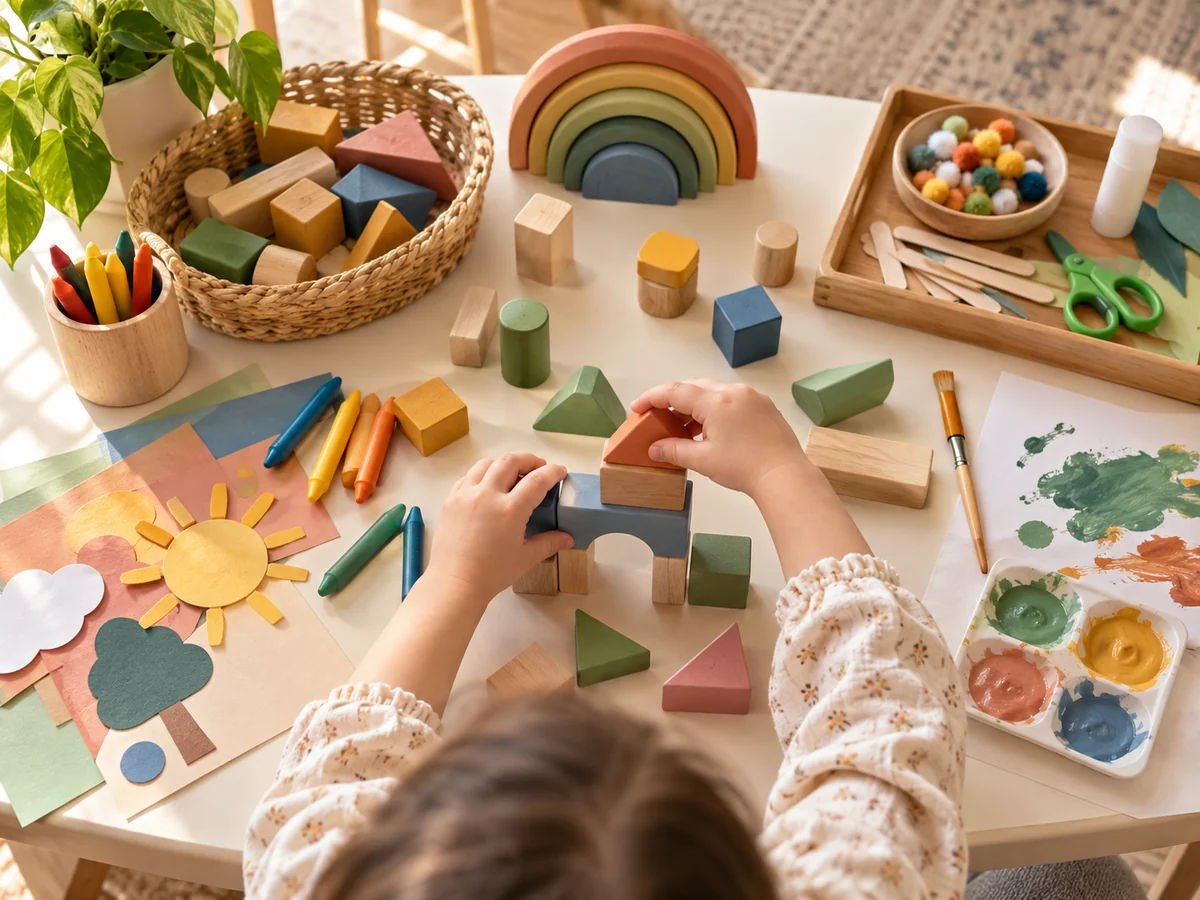
The bridge is easier with ideas ready

The No-Screen Toddler Rescue Kit holds 115 screen-free activities and 28 printable cards for ages 2 to 5, so the "what now?" after the screen always has an answer ready. Several sections are built for exactly this: bored moments, quiet play and independent play.
Get the Rescue Kit · $9.99Why the TV-off moment is so hard (it is not defiance)
The stimulation gap is real. A screen delivers a new image, sound, joke or character every few seconds, and your toddler does nothing but receive it. Open-ended play runs the other way: nothing happens until your child makes it happen. Going from full supply to full invention in one second is like stepping off a moving walkway. The wobble afterwards is physics, not bad behaviour.
Transitions themselves are the toddler weak point. Adults struggle to leave a gripping show mid-episode; toddlers must do it with a fraction of the emotional regulation, often mid-story, at a moment chosen by someone else. Research and child development guidance on technology transitions keeps landing on the same supports: prepare the child, make the ending visible, and give them a say where you can.
The timing is usually terrible. Screens most often go off right before dinner, bath or leaving the house, when your toddler is hungry and tired and you are busiest. If screen time in your house ends at 5 PM, you are fighting the witching hour and the screen-off crash at the same time. That is two problems wearing one coat.
And "I'm bored" often means "I can't start." Starting is the executive skill toddlers have least of. Once play is underway they are frequently fine, which is why so much of this page is about the start, not the playing.
The bridge routine: six steps from screen-off to playing
- Warn, and make the ending real. "Two more episodes" or "five more minutes" said early, then repeated once. End at the end of an episode, not mid-scene, and turn autoplay off in your streaming settings so the next episode does not start the argument for you. A visual timer helps children who cannot feel what five minutes is.
- Give them the button. Let your toddler press the off button or hand you the remote. It sounds trivial. Control over the ending changes how the ending feels, and parents report it as one of the simplest wins there is.
- Connect for two minutes. Before expecting play, fill the tank: sit together, talk about what you watched, cuddle if they want it. Screens often stand in for us; coming back to us is the natural first step off them.
- Move. Send the restlessness through the body before asking for quiet play: a race to the kitchen, cushion jumps, an animal stomp to the bathroom. Two minutes of movement does more for the next twenty than any toy.
- Start the play yourself, then fade. Do not offer a decision to a brain that just lost its entertainment: at this age a choice is mostly a chance to say no. Sit down, start building the tower or open the book, let them join, then drift back a step at a time: playing alongside, then watching nearby, then busy yourself in the same room.
- Let the empty stretch be empty. After you fade, there is often a flat, drifting, slightly whiny ten minutes where nothing catches. This is the part parents mistake for failure and rescue with the remote. Wait it out. Boredom tolerated is where play restarts from, and it gets shorter across a week or two of the same routine.
One more scheduling trick that changes everything: place screen time where the landing is soft. Ending screens right before a snack, a bath, going outside or dinner gives the bridge a destination. The worst placement is right before you need your toddler to play alone, because that is precisely what the post-screen brain is worst at. If the screen-to-solo-play crash is your daily battle, consider moving the screen, not fighting the crash.
12 bridge activities that work right after a screen
The best bridge activities borrow energy from the screen instead of fighting it. They are grouped by how they work, so you can pick by what your toddler just watched and how wired they are.
First, use the body
One-song dance-off
Put on one song from the show they just watched and dance it out together. The screen's own music becomes the bridge off the screen. When the song ends, screens and songs are both finished.
Race you to the kitchen
Or to the bathroom, the front door, the cat. Short races, ridiculous handicaps (you hop, they run), repeated until the fizz is gone. Movement first is the rule after any long sit.
Cushion jumps
Cushions on the floor, jump from one to the next, or dive onto the pile. Two minutes. Big body input settles the buzzing that screens leave behind.
Scarf float
Toss a light scarf or muslin in the air and keep it floating with waves and blows. Slow, floaty and quietly absorbing: the perfect speed between a cartoon and a book.
Then, play the show in real life
Act it out
Whatever they watched, do it badly in the living room. Dig like the truck, fly like the hero, cook like the chef. Children move from watching a story to being in one far more easily than from a story to nothing.
Draw the characters
Paper and crayons, one job: draw who was in the episode. Stick figures count. The show supplies the idea, so the starting problem never appears.
Build what they watched
Blocks become the show's house, vehicle or castle. Start it yourself ("here is the door") and hand over the walls. Building gives hands the job the remote used to do.
Feed the characters
The soft toys get a snack, served on real plates, with the episode retold as table talk. Pretend food plus a story they already know is the gentlest landing there is.
Hands busy, brain quiet
Build-a-snack
Your toddler assembles their own snack: crackers and cheese, fruit on a plate, yoghurt with toppings they sprinkle. Eating something is also the fastest fix for the hungry half of the post-screen mood.
Playdough pinch pots
One colour, a rolling pin, things to poke. Playdough asks nothing and absorbs everything, which is why it has outlived every screen ever made.
The sticker page
One page, one strip of stickers. Small, finite, completable: the opposite shape of an endless video feed, in the best way.
Pouring station
A jug, two cups, a towel and water at the table or sink. Pouring is toddler meditation. Give it ten minutes and watch the post-screen static drain away.
A ready answer for "what now?"
115 activities and 28 printable cards, sorted by situation, so the bridge off the screen is a grab, not a brainstorm. Includes dedicated sections for bored moments and independent play, plus the ideas in this page in card form.
Get the Rescue Kit · $9.99Set up the room so play can win
Fewer toys out beats more toys out. A wall of toys after a screen is a second overwhelming menu. Keep a small set available and rotate the rest away; our toy rotation guide covers the system, and it is the single change parents cite when boredom complaints drop.
Kill the background screen. A TV murmuring in the background during play keeps pulling attention back like a magnet. Off means off, for the room, not just for the show.
Make a yes corner. One defined place with open-ended things only: blocks, animals, books, drawing. No batteries, no instructions, nothing that performs by itself. You want toys that wait for your child, not toys that entertain them.
Stay reachable, not involved. Independent play grows fastest when you are visibly nearby doing your own thing: folding washing, prepping dinner, reading. Our full independent play activities guide builds the skill week by week if this is the bigger project at your house.
What to say when you hear "I'm bored"
- Instead of "You're bored again?" try "You've got some creative time. What will you try first?"
- Instead of "Go and play" try "Blocks or books? You pick, I'll start it with you."
- Instead of producing a new idea every minute, try starting one thing yourself on the floor and saying nothing at all.
- And when it is genuine starting trouble: "Let's start the puzzle together. You can finish it."
Boredom is not an emergency to be solved in under a minute. Treated calmly ("boring is where ideas come from"), it becomes the doorway to exactly the independent play you are trying to build. Rescued instantly, it stays a door your toddler will never walk through alone.
When the switch-off still ends in a meltdown
Expect the first three to five days of any new boundary to be the loudest. That is the pattern recalibrating, not the plan failing. In the moment: fewer words, calm voice, hold the line kindly ("I know. It is hard to stop. TV is finished, and snack is next"), and wait for the wave to pass before offering play. One warning comes up in every parent forum: if screaming reliably brings the screen back, screaming becomes the strategy. Peace bought with the remote today is charged back tomorrow, with interest.
If the explosion itself, not the play after it, is your main problem, our guide to toddler screen time meltdowns goes deeper on that half. And if mornings start with the same battle over a tablet, see the morning tablet guide.
When to ask for advice: talk to your child's doctor if screen use is the only thing that ever calms your child, if meltdowns are long and intense most days, or if sleep, eating or family life are being seriously disrupted. That is a pattern worth a professional eye, and bringing a simple log (when screens happen, how they end, how sleep goes) makes the conversation much more useful.
How we choose these activities
We prioritise everyday materials, simple setup and flexible play that caregivers can adapt to a child's age and abilities. For this page we added one more test: the activity has to be easier to start than the screen was to watch, or it will lose every time.
Quick safety reminder
Choose activities and materials that are appropriate for your child's age and abilities. Keep small objects and potential choking hazards away from young children, supervise water play, and make sure the play area is safe. Independent play does not mean unsupervised play.
This article provides general parenting and activity ideas. It is not medical, developmental or therapeutic advice.
Keep the ideas ready before you need them
The No-Screen Toddler Rescue Kit gives you 115 screen-free ideas for ages 2 to 5, built around everyday materials and real-life moments.
Get the No-Screen Toddler Rescue Kit · $9.99Frequently Asked Questions
Why does my toddler play independently with the TV on but not when it is off?
Because they are not really playing in the first case; the screen is doing the work. Television supplies a constant stream of new sights and sounds, while play asks your child to generate the next thing themselves. The gap between the two is widest in the first ten minutes after switch-off, which is why the bridge routine on this page focuses there.
How long should a toddler play independently?
It builds slowly and varies hugely by child and by time of day. Many 2 year olds manage 5 to 10 focused minutes near you; by 4 and 5, stretches of 20 to 30 minutes are common for an absorbed activity. Measure against your child's own last week, not against anyone else's child, and expect the post-screen window to be their shortest stretch of the day.
Should I use a timer for screen time endings?
For many families, yes. A visual timer makes the end visible and removes you as the villain: the timer ends screen time, not mum or dad. Combine it with episode endings and warnings at five minutes and one minute, and keep the script boring and identical every day.
Should we quit screens cold turkey?
There is no single right answer, and families land in different places. What matters more than the method is what comes after the screen: a predictable next step, a bridge activity, and consistency for at least a week before you judge it. If you reduce gradually, protect the hour after screens most; that is where the habit is actually won or lost.
Why does my toddler ask for the TV all day long?
Often because asking sometimes works. If screen time is negotiable in the moment, campaigning for it becomes the most rewarding activity in the house. A fixed, boring, predictable screen slot (same time, same length, decided in advance) removes the game, and most children stop campaigning within days.
What if my toddler says they are bored the second the TV goes off?
Treat it as "I cannot start" rather than "there is nothing to do." Offer two choices or, better, start something yourself on the floor and let them join. Then tolerate the flat ten minutes without rescuing. Boredom that is allowed to sit is where independent play grows.
What should my toddler do right after the TV goes off?
Move first, connect, then play something familiar with an easy start: a snack they assemble, acting out the show, building with blocks, playdough, drawing the characters. Save new or complicated activities for any other time of day. Right after a screen is the worst audition slot a new activity can get.
For a more specific situation, explore independent activities for 2-year-olds.
For broader ideas, explore toddler activities for when they're bored.
Sources and further reading
- UNICEF Parenting, "Screen-free activities for children"
- UNICEF Parenting, "21 learning activities for babies and toddlers"
- American Academy of Pediatrics / HealthyChildren.org, "10 No-Cost, Screen-Free Activities to Play with Your Preschooler"
- American Academy of Pediatrics / HealthyChildren.org, "Toddler Activity"