
15 Quiet Activities for Toddlers: Calm Screen-Free Ideas
Need a calmer stretch without handing over a screen? These quiet activities for toddlers ages 2 to 5 use simple materials such as books, paper, blocks, cups and stuffed animals. They are designed for moments when you want play to feel calmer, lower-mess and easier to set up.
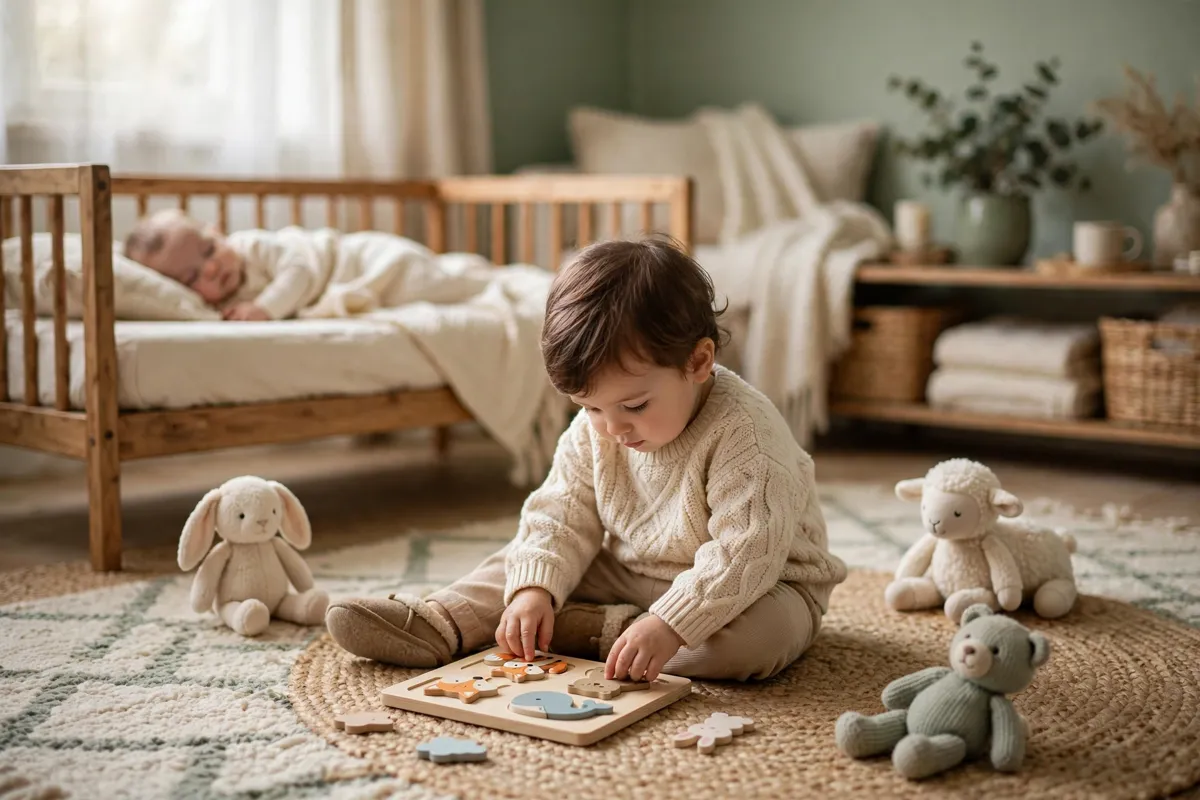
Calmer play does not have to mean perfect silence
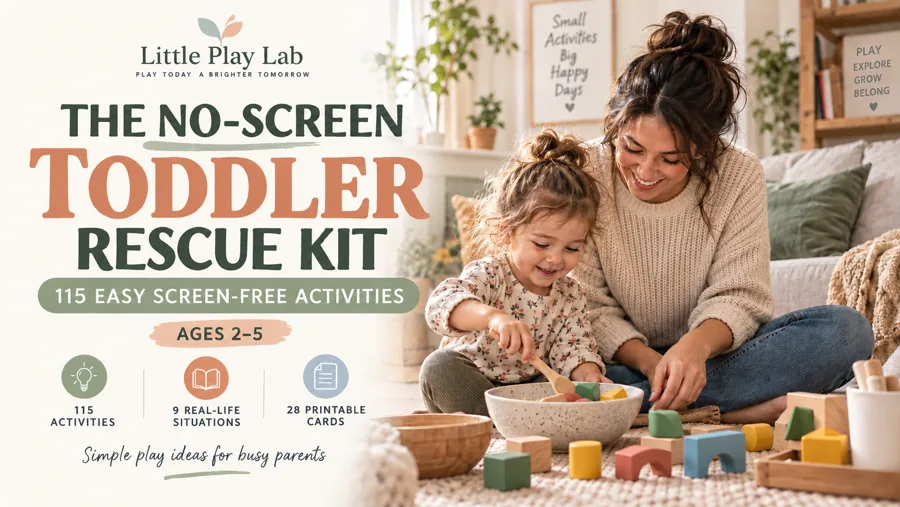
The No-Screen Toddler Rescue Kit includes 115 activities for ages 2 to 5, with many options that can be adapted for quieter stretches.
See the No-Screen Toddler Rescue Kit →What makes a quiet activity work?
Toddlers do not need a complicated activity to stay interested. A quiet option often works best when the child can see what to do quickly, repeat the action, and make choices without needing a long explanation.
ZERO TO THREE includes quiet play ideas such as simple transfer games and pretend play in its toddler activity guidance. HealthyChildren.org also lists activities such as building with blocks, simple large-piece puzzles and coloring among quiet-time activities for preschoolers. These examples point toward a useful principle: calm play can still be active, hands-on and meaningful.
15 quiet activities for toddlers
1. Picture Book Basket
Put three to five familiar board or picture books in a small basket. Let your toddler choose one, flip through the pages, point at pictures or tell the story in their own way. You do not need to turn it into a reading lesson.
2. Big Paper Scribble Station
Tape a sheet of large paper to a table or floor and offer a few chunky crayons. Invite your toddler to make lines, circles, roads or whatever they want. Keeping the paper large makes the activity easier for little hands.
3. Block Building Challenge
Set out a small number of large blocks and give one simple prompt: “Can you make a tall tower?” After the first tower, let your toddler rebuild it or invent something else. Familiar building materials can be revisited many times.
4. Toy-to-Picture Match
Place a few familiar toy animals, vehicles or objects beside simple drawings or printed pictures of the same things. Your toddler can place each object beside its matching picture. Keep the set small so it feels manageable.
5. Color Sorting With Cups
Use a few large, safe household objects in two or three colors, then provide matching cups or paper areas. Ask your toddler to group the objects. Avoid tiny items, especially if your child still mouths objects.
6. Sticker Picture
Give your toddler a sheet of large age-appropriate stickers and a piece of paper. They can place stickers anywhere, make a pretend road, decorate a simple shape or create a picture. This is especially useful when you want a seated activity.
7. Stuffed Animal Bedtime
Give your toddler a stuffed animal, small blanket and safe open floor space. The “baby” can go to bed, wake up, have a pretend snack or get tucked in. Familiar routines often give toddlers an easy starting point for pretend play.
8. Tear-and-Stick Collage
Offer larger pieces of scrap paper and a glue stick with supervision. Your toddler can tear or crumple paper and stick pieces onto a larger sheet. If glue is not a good fit for your child, simply make a paper arrangement instead.
9. Sock Pairing
Put several clean socks in a small basket and invite your toddler to find matching pairs. They can place each pair together or make little piles. This turns an ordinary household task into a simple sorting game.
10. Cup Stacking
Use a few sturdy plastic cups. Your toddler can stack them into towers, make a pyramid or nest them inside one another. The activity is simple enough to repeat and change without much setup.
11. Window Watching
Find a safe place near a window and look outside together. Talk about cars, clouds, trees, birds or people. If your toddler wants to continue alone, give them a simple prompt such as “Tell me when you see a red car.”
12. Large-Piece Puzzle Time
Choose a simple puzzle with large pieces appropriate for your child's age and abilities. Start with a familiar puzzle if your toddler gets frustrated easily. The goal is relaxed exploration, not finishing it perfectly.
13. Toy Shop
Place a few familiar toys on the floor as a pretend shop. Your toddler can “buy” a stuffed animal, deliver a toy or arrange the items. You can demonstrate the first round, then step back and see where their imagination goes.
14. Draw a Road for Cars
Draw a few wide roads on paper with a crayon or marker, then let your toddler drive toy cars along them. Add a “garage,” parking area or bridge with a cardboard box if they want more to do.
15. Find-and-Place Game
Ask your toddler to find a few familiar objects and place each one in a basket. Try prompts such as “Find something soft,” “Find a blue toy,” or “Find a book.” Keep the search area small and make the clues easy.
A practical note
Parents often need a calmer room, not a completely silent toddler. Reduce stimulation by offering fewer choices and a small visual setup: a book basket, a few blocks, a matching tray, paper and crayons or a simple pretend scene. If the room is already busy, change the environment as well as the activity, turn off background audio, clear extra toys and give the child one obvious place to play. A useful quiet activity should lower friction, not create another performance goal.
Need more options for this exact moment?
The Rescue Kit gives you a larger activity rotation so you can choose an idea that fits the time, energy and situation you actually have.
Explore the 115-Activity Kit →How to make quiet time easier
- Start small. A few calm minutes can be useful. There is no need to expect a toddler to stay with one activity for a long stretch.
- Use familiar activities. A child who already knows how an activity works may need less adult help.
- Offer a small choice. Two or three options are often easier to manage than a whole shelf of toys.
- Keep the setup visible. Put the materials in a tray, basket or defined play area so the invitation to play is obvious.
- Let quiet mean calm, not silent. Talking, humming and normal toddler movement are still compatible with a calmer play period.
- Rotate instead of constantly buying. Put a few activities away and bring them back later. Familiar materials can feel interesting again after a break.
Quiet activities for different moments
When you need to answer a few emails: try a picture-book basket, stickers, a simple puzzle or cup stacking.
When the house needs to stay calm: choose books, drawing, matching or stuffed-animal pretend play.
When your toddler is tired but not ready for sleep: offer a familiar activity with low setup, such as books, coloring or simple sorting.
When you are cooking nearby: choose a quiet activity in a safe area away from the stove, hot surfaces, knives and other kitchen hazards. Supervision should match your child's age and the activity.
Safety notes for quiet toddler activities
“Quiet” does not automatically mean “safe to leave unsupervised.” Choose materials that are appropriate for your child's age and abilities. Avoid small loose parts for children who still mouth objects, and keep activities involving scissors, glue, water or other potentially hazardous materials supervised.
For additional child-safety guidance, see the American Academy of Pediatrics guidance on hand and finger skills and ZERO TO THREE's toddler play activity guidance.
Screen-free does not have to mean screen-shaming
The goal of these ideas is simply to give families more options. Screens can be part of many families' routines. If you want a screen-free activity during a particular moment, having a few easy alternatives ready can make that choice much simpler.
UNICEF also offers screen-free play ideas for toddlers and preschool-age children, including simple pretend, movement and observation activities. You can browse its screen-free activities for children resource for additional ideas.
Keep the ideas ready before you need them
The No-Screen Toddler Rescue Kit gives you 115 screen-free ideas for ages 2 to 5, built around everyday materials and real-life moments.
Get the No-Screen Toddler Rescue Kit →How we choose these activities
We prioritize everyday materials, simple setup and flexible play that caregivers can adapt to a child’s age and abilities. We avoid activities that depend on small loose parts and encourage active adult supervision whenever safety requires it.
Quiet play is not the same as quiet time
These two get mixed up, so here is the line. Quiet activities, this page, are for any moment that needs the volume down: a baby asleep next door, a 6 AM start, neighbours below, a long wait somewhere hushed. Quiet time is different: it is the scheduled daily rest period that replaces the nap for 2 year olds, same time, same cosy spot, every day. Use this list whenever the house needs to be calm; use quiet time to protect the middle of the day itself. And on the days when the person who needs the low energy is you, the low energy activities guide runs everything from the sofa.
Frequently Asked Questions
What are the best quiet activities for toddlers?
The reliable ones are seated, soft and absorbing: a puzzle at their level, sticker pages, water reveal books, threading and posting, drawing, felt or magnetic play, looking at books, and tucking soft toys in for naps. Anything that whispers rather than crashes, and anything with a loop, building, filling, sorting, will hold a toddler quietly far longer than a one-off trick.
How do I keep my toddler quiet while the baby sleeps?
Set up before the nap starts, not after: a quiet basket or one chosen activity, positioned near you and away from the nursery door if you can. Practise quiet play at easy times first so the skill exists before you need it. A white noise machine in the baby's room buys everyone forgiveness for the occasional dropped block.
What quiet activities work in an apartment with thin walls?
Stay on the floor and off the furniture: felt boards, magnetic tiles on a rug, drawing, sticker work, playdough at a low table, book piles, and pretend that happens sitting down. Skip jumping games and wooden blocks on hard floors during quiet hours. A thick rug or foam mat under the play spot genuinely changes the sound that travels down.
How do I teach my toddler to play quietly?
Practise in easy moments, name it as its own game (quiet hands, mouse voices), keep early sessions short, and praise the quiet specifically when it happens. Toddlers rise to a noticed skill. Expect volume to leak and return; coaching it back calmly, many times, is the teaching.
What are good quiet activities for early mornings?
A morning basket by the bed or sofa: two books, one fiddly toy, a torch for shadow play in the dim light, and a comfort toy. Early morning is a quiet volume problem with its own shape, and our guide to toddlers who want the tablet first thing in the morning covers the full routine change if screens are the current battle.
Are quiet activities the same as quiet time?
No. Quiet activities are play, used any time the house needs low volume. Quiet time is a scheduled daily rest period, usually replacing the nap at around age two, in a set place at a set time, with rest rather than play as the goal. The two share materials but not purpose, and each has its own guide on this site.
What quiet activities need no setup at all?
Reading each other the pictures in any book, tucking teddies in and shushing them, window spotting (find something red, find a bird), drawing on scrap paper or a box, matching socks from the laundry basket, and whisper story building, one sentence each. Quiet is mostly a mode, not a material.
For a more specific situation, explore quiet time activities for 2-year-olds.
For a more specific situation, explore how to entertain a toddler while caring for a baby.
For a more specific situation, explore sick-day activities for toddlers at home.
Sources and further reading
- UNICEF Parenting, “Screen-free activities for children”
- UNICEF Parenting, “21 learning activities for babies and toddlers”
- American Academy of Pediatrics / HealthyChildren.org, “10 No-Cost, Screen-Free Activities to Play with Your Preschooler”
- American Academy of Pediatrics / HealthyChildren.org, “Toddler Activity”