
15 Toddler Travel Activities: Easy Screen-Free Ideas for Trips
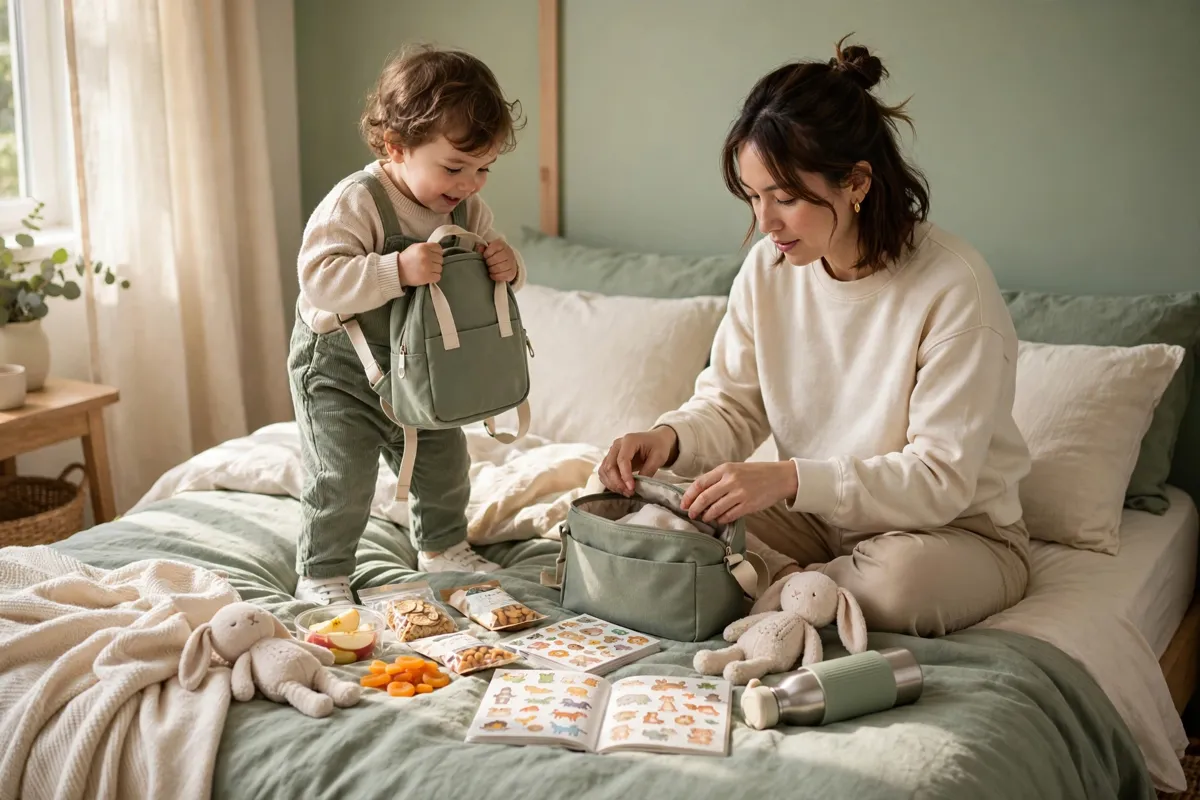
Traveling with a toddler can make even a short wait feel long. Whether you are in an airport, sitting in a car, waiting at a restaurant, or staying somewhere unfamiliar, a few simple screen-free toddler travel activities can give your child something to do without packing an entire playroom.
Build the travel stash before the trip
The No-Screen Toddler Rescue Kit includes 115 screen-free activities for ages 2 to 5 that can be adapted for cars, waiting rooms, hotels and other travel moments.
See the No-Screen Toddler Rescue Kit →What makes a good toddler travel activity?
The best travel activity is usually portable, simple to explain, and easy to put away. It should not require a large table, lots of loose pieces, or a complicated setup. Familiar activities can also be easier during travel because your toddler already knows how they work.
UNICEF's guidance on play emphasizes giving children opportunities to explore and follow their interests in safe environments. The American Academy of Pediatrics also highlights simple, low-cost play materials as useful options for young children. UNICEF Parenting and HealthyChildren.org provide additional ideas.
Travel play does not need to keep a toddler occupied for an entire journey. Five useful minutes is still useful. Expect interests to change, and keep your activity bag flexible.
15 toddler travel activities
Travel Drawing Kit
Pack a small notebook or pad with a few washable crayons. Ask your toddler to draw the car, airplane, hotel, family, or anything they see.
Keep it compact: One small pad and a few crayons are enough.
Travel I Spy
Choose something your toddler can see and give a simple clue: “I see something red.” In a car, use safe things outside the vehicle; in an airport, use visible signs, bags, or colors.
Tip: Keep the game visual and avoid asking your child to move around in busy areas.
Picture Matching Cards
Bring a few large, simple picture cards and make matching pairs. Your toddler can turn them face up and find the same pictures.
Travel trick: Use only a few pairs so the set stays easy to pack and manage.
Mini Book Rotation
Choose two or three small favorite books instead of packing a whole shelf. Let your toddler choose which one to look through.
Make it familiar: A well-loved book can be especially useful during an unfamiliar trip.
Stuffed Animal Travel Buddy
Let your toddler bring one favorite stuffed animal and give it a simple travel story. Teddy needs a seat, a snack, a hotel bed, or a ticket.
Prompt: “Where is Teddy going?” Let your child invent the answer.
Reusable Sticker Scene
Use age-appropriate reusable stickers with a small paper scene or sticker book. Your toddler can place animals, vehicles, houses, or other pictures.
Safety: Choose materials suitable for your child's age and supervise closely with small pieces.
Travel Color Hunt
Pick one color and look for it from your seat or waiting area. Count a few safe, visible examples together.
Example: “How many blue things can we see?”
Make a Tiny Travel Restaurant
Use a few pretend food pieces or simply imaginary food. Your toddler can “serve” Teddy or a parent while waiting at a safe location.
Keep it tiny: This can be completely pretend, with no extra supplies.
Small Building Challenge
Bring a small number of larger building pieces appropriate for your toddler. Ask them to make a house, tower, bridge, or bed for Teddy.
Pack smart: Use a small zip pouch or container and avoid loose tiny pieces.
Three-Thing Travel Story
Choose three things you can see, such as a bag, a toy, and a cup. Make a short story connecting them, then let your toddler decide what happens next.
Example: “The bear found a bag. What was inside?”
Travel Picture Hunt
Give your toddler a simple list of things to spot: a suitcase, a bus, a hat, a bird, a sign, or a window. Use only items that are easy and safe to observe.
For younger toddlers: Use one item at a time.
Hotel Room Pretend Play
Once you arrive, let your toddler pretend the room is a house, shop, restaurant, or animal hotel. A blanket and stuffed animal can start the game.
Keep boundaries clear: Avoid letting the child explore balconies, stairs, bathrooms, or unfamiliar areas unsupervised.
Simple Travel Puzzle
Bring one familiar, age-appropriate chunky or simple puzzle. Choose something your toddler can recognize rather than a difficult new puzzle.
Pack one: A single familiar puzzle is easier to manage than several.
What Can You Hear?
During a safe waiting moment, pause and listen. Ask your toddler what they can hear: an announcement, vehicle, footsteps, birds, or music.
Keep it relaxed: You are noticing sounds together, not testing your child.
Waiting-Time Stretch & Move
When you have a safe, appropriate space, try simple movements such as reaching up, touching toes, marching in place, or stretching arms like an airplane.
Important: Only use movement games where there is enough clear space and it is permitted. Never encourage running in airports, stations, roadsides, or other busy travel areas.
A practical note
Travel play works best when it can be paused and restarted. A small rotation might include one quiet activity, one matching or sorting game, one drawing option and one pretend-play prompt. You do not need four separate toy sets. The same paper, crayons or small figures can support several games. In public places, keep the footprint small; in a hotel room, you can expand onto the floor. Always choose materials that fit the travel environment and your child’s age and abilities.
Need more options for this exact moment?
The Rescue Kit gives you a larger activity rotation so you can choose an idea that fits the time, energy and situation you actually have.
Explore the 115-Activity Kit →Choose the activity for the travel moment
- Waiting in one place: try books, drawing, matching cards, stickers, or a picture hunt.
- Long car ride: use drawing, audio-free observation games, books, or a travel story during appropriate stops or while safely seated.
- Airport or station: choose compact seated activities and visual games. Keep your child close and follow local safety rules.
- Restaurant wait: try pretend play, drawing, picture matching, or a tiny travel story.
- Hotel downtime: use the stuffed-animal game, pretend hotel, books, or a simple puzzle.
How to pack a simple screen-free travel kit
Keep it small
You do not need a huge activity bag. A small pouch can hold a notebook, a few crayons, two or three books, a few large matching cards, and one familiar toy or stuffed animal.
Choose familiar materials
Travel is already full of new sights, sounds, people, and routines. Familiar activities can be easier to start than complicated new crafts.
Rotate instead of dumping everything out
Offer one activity at a time. When your toddler loses interest, put it away before bringing out the next one. This can make the limited travel space much easier to manage.
Think about the destination
What works in a hotel room may not work in an airplane seat. What works on a quiet train platform may not be appropriate in a crowded terminal. Choose activities based on the actual environment and its safety rules.
What if my toddler gets bored anyway?
They probably will at some point. Travel is tiring and unfamiliar, and no activity can guarantee continuous entertainment. Offer a new choice, talk together, look out the window, take an appropriate movement break, or simply acknowledge that waiting is boring.
The goal is not to create a perfect screen-free journey. These activities are simply tools you can reach for when you want another option.
Screen-free travel does not have to be perfect
Families travel differently, and screens can be useful during difficult or unavoidable travel moments. There is no need to turn a trip into a test of whether your toddler stays screen-free for the entire journey.
The American Academy of Pediatrics recommends balancing media use with other parts of a child's life, including play, sleep, family interaction, and physical activity. HealthyChildren.org provides more information about healthy digital media habits.
Keep the ideas ready before you need them
The No-Screen Toddler Rescue Kit gives you 115 screen-free ideas for ages 2 to 5, built around everyday materials and real-life moments.
Get the No-Screen Toddler Rescue Kit →How we choose these activities
We prioritize everyday materials, simple setup and flexible play that caregivers can adapt to a child’s age and abilities. We avoid activities that depend on small loose parts and encourage active adult supervision whenever safety requires it.
Start here, then go age specific
This page is the complete travel system for ages 2 to 5. When you want the version tuned to one age, the travel activities for 3 year olds guide rebuilds the kit around what a three year old can actually do, longer pretend, sticker stories, simple games, and handles car seat and plane seat pacing in detail. For the waits at either end, gates, queues, delays and the tables after you arrive, the restaurants and waiting rooms guide runs the same busy bag system in stationary form.
Frequently Asked Questions
What are the best travel activities for toddlers?
The seat-proof set: a water reveal book, sticker scenes, a small figure world in a tin, magnetic play on a tray, a clipboard with crayons, and slow snacks, revealed one at a time. Add no-prop games for the gaps: I Spy with colours, counting collections, story chains. The kit matters less than the pacing, which this page covers in full.
How do I keep my toddler entertained on a long flight?
Burn energy in the terminal first, keep the bag at your feet, reveal hourly, walk the aisle when allowed, and hold a wrapped surprise and your best activity for the final third. Have a drink or snack ready for descent to help ears. A planned show for one chapter of a long flight is a reasonable tool alongside the kit, not instead of it.
What should I pack in a toddler travel bag?
One activity per hour of journey plus a surprise, slow snacks in compartments, water, a change of clothes for them and a spare top for you, wipes, and any comfort object, which never counts as an activity. Everything lap sized, quiet, and cheap to lose. Pack it the night before and keep it unraided at home so it stays special.
How do I handle travel with a 2 year old versus a 4 year old?
Two year olds need simpler loops, posting, stickers, water reveal, and more movement breaks, and they cannot yet hold games with rules. Four and five year olds add counting games, drawing missions, story chains and simple card games, and can hold a reveal schedule better. The kit shrinks in piece count and grows in imagination as they age.
How often should we stop on a long car journey with a toddler?
Every 60 to 90 minutes for toddlers, with a real run at the stop rather than just a toilet queue. Three good stops beat five rushed ones. Judge by your child: restlessness that no activity touches is the signal, and it arrives on their schedule, not the route planner's.
What if my toddler screams on the plane?
Work the basics in order: ears (offer a drink), hunger, tiredness, boredom, in that order, because the fix differs. Walk if you can, deploy the surprise early if the situation demands it, and remember that every passenger judging you has either forgotten their own flights or never taken a toddler on one. It ends. They all end.
Are travel days a reason to relax our screen rules?
Many families do, deliberately and out loud: a declared plane day exception, with the normal rules named again at the destination. Declared exceptions protect the routine; the quiet creep of travel rules into home rules is the thing to watch. Either way, pack the kit: batteries and downloads fail, sticker books do not.
For a more specific situation, explore travel activities for 3-year-olds.
For a more specific situation, explore toddler activities for restaurants and waiting rooms.
Sources and further reading
- UNICEF Parenting, “Screen-free activities for children”
- UNICEF Parenting, “21 learning activities for babies and toddlers”
- American Academy of Pediatrics / HealthyChildren.org, “10 No-Cost, Screen-Free Activities to Play with Your Preschooler”
- American Academy of Pediatrics / HealthyChildren.org, “Toddler Activity”