
Travel Activities for 3-Year-Olds
Three is a particular travel age. Your child can hold a game, follow a sticker story, and understand "after the next stop," but they still need the toilet at the worst moment, still melt down when tired, and still believe that asking "are we there yet" every ninety seconds is a reasonable strategy. This page is the age three travel kit: what to pack in one small bag, twelve activities tuned to what a three year old can actually do in a car seat or plane seat, and the pacing that gets you to the destination with everyone's humour intact.
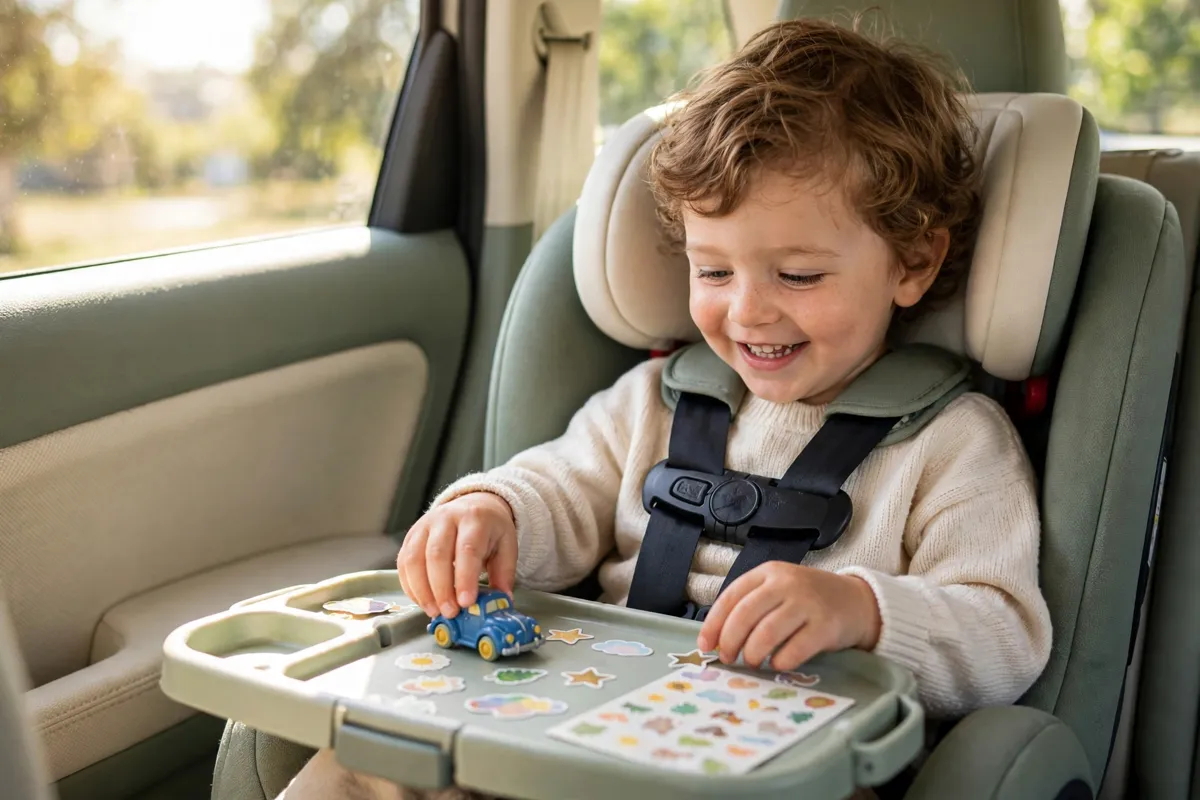
Quick answer: Pack one small bag your three year old can carry: a water reveal book, sticker scenes with the backing peeled, a mini figure world in a tin, a clipboard with three crayons, one wrapped surprise, and slow snacks. Reveal one thing at a time, save the best for the last third of the journey, burn energy before boarding or buckling, and plan movement breaks every 60 to 90 minutes in the car.

Print the travel section before you pack
The No-Screen Toddler Rescue Kit has 115 print-and-go activities in 89 pages plus 28 printable activity cards, sorted by real situations, travel very much included. Tear out a journey's worth and leave the rest of the book at home. Made for ages 2 to 5.
Instant download. Print it once, use it every day.
What changes at three
Compared with a two year old, a three year old brings real upgrades: pretend play with a plot, games with a simple rule, counting, colour spotting, and a memory that makes yesterday's joke funny again today. Use all of it. Compared with a four or five year old, though, a three year old still runs on short fuel: waiting is genuinely hard, transitions ambush them, and tiredness arrives like a cliff rather than a slope. So the kit leans on pretend, spotting games and stories (their new strengths) while the pacing protects against the cliff: food before hunger, movement before restlessness, and the best activity held back for the final stretch when everyone's reserves are lowest. For all ages and the full packing system, our main toddler travel activities guide is the parent page to this one; everything below is tuned to three.
The 3 year old travel kit
One small backpack or pouch, theirs to carry, everything inside it chosen by four rules: it works on a lap, it has no pieces small enough to lose down a seat gap (or few enough that losing one does not end it), it is quiet, and it is not precious. Pack it the night before and, this is the whole trick, do not let your child raid it at home. Travel toys that only travel stay interesting for trip after trip. Keep one item wrapped, paper bag or actual wrapping paper, as the emergency surprise. A wrapped mediocre toy outperforms an unwrapped brilliant one every time, because unwrapping is an activity and anticipation is a drug at three.
12 activities tuned for three
1. Sticker scenes
A background card and stickers to populate it. Peel the backing paper off the sheet before the trip so small fingers can free stickers alone. Ask for the story: who lives here, where is the dog going. Fifteen to twenty minutes is normal.
2. Water reveal book
The plane and car MVP. One water pen, pages that colour and reset. No mess, no pieces, works in dim light, and the drying reset means it survives a whole journey instead of one sitting.
3. Mini figure world in a tin
Three or four small figures and one vehicle in a mint tin or small box. The tin is the world: a house, a boat, a cave. Three year olds stage entire dramas in nine square inches if the characters are right.
4. Magnetic tiles on a metal tray
A small set, eight to twelve pieces, on a cookie sheet or metal tray that catches escapees. Building vertically in a moving car should not work and yet completely does, because the magnets forgive the bumps.
5. Clipboard drawing
Paper clipped down cannot slide away, and three crayons are enough. Draw the journey: the car, the plane, the destination house, what the driver is dreaming about. Keep one page for the map they draw of the whole trip.
6. Colour I Spy
"I spy something red" beats the letter version at three, because the whole world qualifies. Take turns, let them spy too, and accept answers like "the sky, again" with full ceremony.
7. Counting collections
Count red cars, or bridges, or dogs, or planes out of the window, with a tally they mark on the clipboard. A three year old counting to ten, forty times, is in a state close to bliss.
8. Story chain
You start: "Once there was a bear who drove a bus." They add the next bit. You add one. Stories built this way on journeys become family legend, retold on every trip for years, usually getting less coherent and more beloved.
9. Lacing and threading cards
A few sturdy cards with holes and one lace with a stiffened end. Threading is slow, focused, fiddly work, perfectly shaped for the middle hour of a journey when energy is low but sleep will not come.
10. Would you rather, toddler edition
Would you rather swim in jelly or slide down a rainbow? Have a pet dragon or a pet elephant? Three year olds answer with complete seriousness and then demand your answer be justified. No props, endless mileage.
11. The slow snack sequence
Snacks are an activity if you pace them like one: a small box with compartments, opened one at a time, foods that take work. A snack necklace of cereal rings for the car. Announce snack time like an event, because to a three year old, it is one.
12. Audio stories for the tired stretch
When eyes are heavy but sleep will not land, a familiar story in headphones or on the car speakers lowers the whole vehicle's heart rate. Save a favourite for travel only and it becomes part of the ritual of going places.
The last hour needs a plan, not hope
Hold back your best card for the final stretch, literally: the Rescue Kit's 28 printable cards slip into the travel bag one per journey. 115 activities in the full kit, 89 pages, ages 2 to 5.
Instant download. Print it once, use it every day.
Pacing: how the journey is won
Burn energy before you strap in. Fifteen minutes of running, climbing or dancing before a car journey, and a proper play in the airport before boarding, buys more peace than any toy in the bag. A three year old who boards already exercised settles; one scooped from the sofa spends the first hour negotiating with their own legs.
Reveal slowly. One item at a time, everything else invisible in the bag. A child given six activities at once plays with each for two minutes and is done by the motorway. The same six, revealed hourly, structure the whole trip.
Save the best for the last third. The surprise and the water reveal book are closing acts. Judge the journey in thirds and spend your resources accordingly; the most common travel mistake is a brilliant first hour and an empty bag at the hardest point.
Move every 60 to 90 minutes in the car. Three year olds are not built for longer stretches. A stop with actual running, not just a toilet in a services queue, resets the clock properly. On planes, walk the aisle when the seatbelt sign allows, and do seat stretches and silly face games between walks.
Plane notes for three year olds
Takeoff and landing are the pressure moments: ears adjust worst on descent, so have a drink, a snack to chew and swallow, or a water reveal book in hand before the descent begins, not packed overhead. Keep the travel bag at your feet, never in the locker, because the item you need is always the one above row 14. Aisle walks are legitimate entertainment and most passengers prefer a walking toddler to a screaming one. And the neighbour rule that keeps everyone kind: activities stay in your row's airspace; dropped items that roll three rows back are gone until landing, which is why everything in the kit is cheap.
Safety on the move
In a car, anything a three year old holds should be soft or light; hard, heavy objects do not belong in a moving vehicle, and nothing with small parts belongs with a child who still mouths things. Snacks in transit need the usual care: seated, supervised, cut safely, and nothing hard and round for a child eating while the car bounces. On planes, keep small items corralled on the tray or a mat, because the floor of a plane is where toddler possessions go to retire. Never leave a child alone in a car, even briefly, and keep the bag itself free of medication, coins and anything else a three year old explorer should not find at 30,000 feet.
How we choose these activities
Travel activities here pass a seat test: lap sized, quiet, low piece count, cheap to lose, and capable of holding a three year old for at least fifteen minutes. Timing and pacing advice reflects general travel wisdom from family health sources such as the American Academy of Pediatrics' HealthyChildren.org. For travel sickness, ear pain or any health worry about your own child, your clinician's advice outranks anything on this page.
Every journey, handled
115 activities and 28 printable cards covering cars, planes, waiting rooms and the destination itself. The No-Screen Toddler Rescue Kit is $9.99, instant download, made for ages 2 to 5.
Instant download. Print it once, use it every day.
Frequently asked questions
How do I entertain a 3 year old on a long car ride?
Structure beats stuff. Burn energy before you leave, reveal one kit item at a time (sticker scenes, a figure world in a tin, magnetic tiles on a tray), pace slow snacks as events, play colour I Spy and counting games between activities, and stop every 60 to 90 minutes for real running. Save one wrapped surprise and your best activity for the final third.
What are the best plane activities for a 3 year old?
A water reveal book, sticker scenes, a clipboard with three crayons, a mini figure world in a tin, lacing cards, and audio stories for the tired stretch. Everything lap sized, quiet and cheap to lose. Keep the bag at your feet, and have a drink or snack ready for descent to help their ears.
How many activities should I pack for a 3 year old?
Roughly one reveal per hour of journey, plus the surprise, plus snacks. For a three hour trip that is about four activities, not twelve. Too much in the bag tempts you to hand it all over at once; too little leaves the last third bare. Top up with no-prop games: I Spy, counting, story chains and would you rather.
How do I stop the constant "are we there yet?"
Give time a shape a three year old can hold: landmarks instead of minutes ("after the big bridge, then one more story, then we stop"), a simple journey map they mark off, and honest sequencing ("first the surprise, then a sleep, then we land"). Vague answers like "soon" for two hours are what train the repeating.
Should I just use a tablet when travelling with my 3 year old?
Many families do for part of a long journey, and a planned show as one chapter of the trip is a reasonable tool, not a failure. The parents who struggle are the ones whose whole journey plan is the tablet: batteries, downloads and the ending battle all become single points of failure. A packed kit plus pacing carries the day even if a screen joins for an hour.
What if my 3 year old drops everything on the floor?
Assume it will happen and design for it: corral small things on a tray or mat, choose cheap items, keep a spare sticker sheet and the surprise in your bag, not theirs. In the car, adopt the driver-safe rule together before you set off: if it falls, it waits until we stop. Said in advance, it is a rule; invented mid-drop, it is an injustice.
My 3 year old gets travel sick. What helps?
General measures many families use: face them forward with a view of the horizon, fresh air on the face, light plain snacks rather than an empty or very full stomach, and looking at books or screens kept short if they worsen it for your child. This is general information only; for remedies or recurring sickness, ask your pharmacist or clinician what suits your child.
Waiting rooms and restaurants are the other travel-adjacent battlegrounds, and they run on the same reveal system. See toddler activities at restaurants and waiting rooms for the busy bag in full, and quiet activities for toddlers for the low volume shelf of ideas.