Toddler Activities for Restaurants and Waiting Rooms
Updated October 21, 2026
The food is twenty minutes away, the waiting room is running forty minutes late, and your toddler has already finished the one game you brought. Public waiting is its own skill. At home a failed activity costs you nothing. At a restaurant table or in a doctor's waiting room it costs you the whole outing. The fix is not a bigger bag of toys. It is a small bag, packed on purpose, revealed one item at a time, plus a handful of games that need nothing at all.
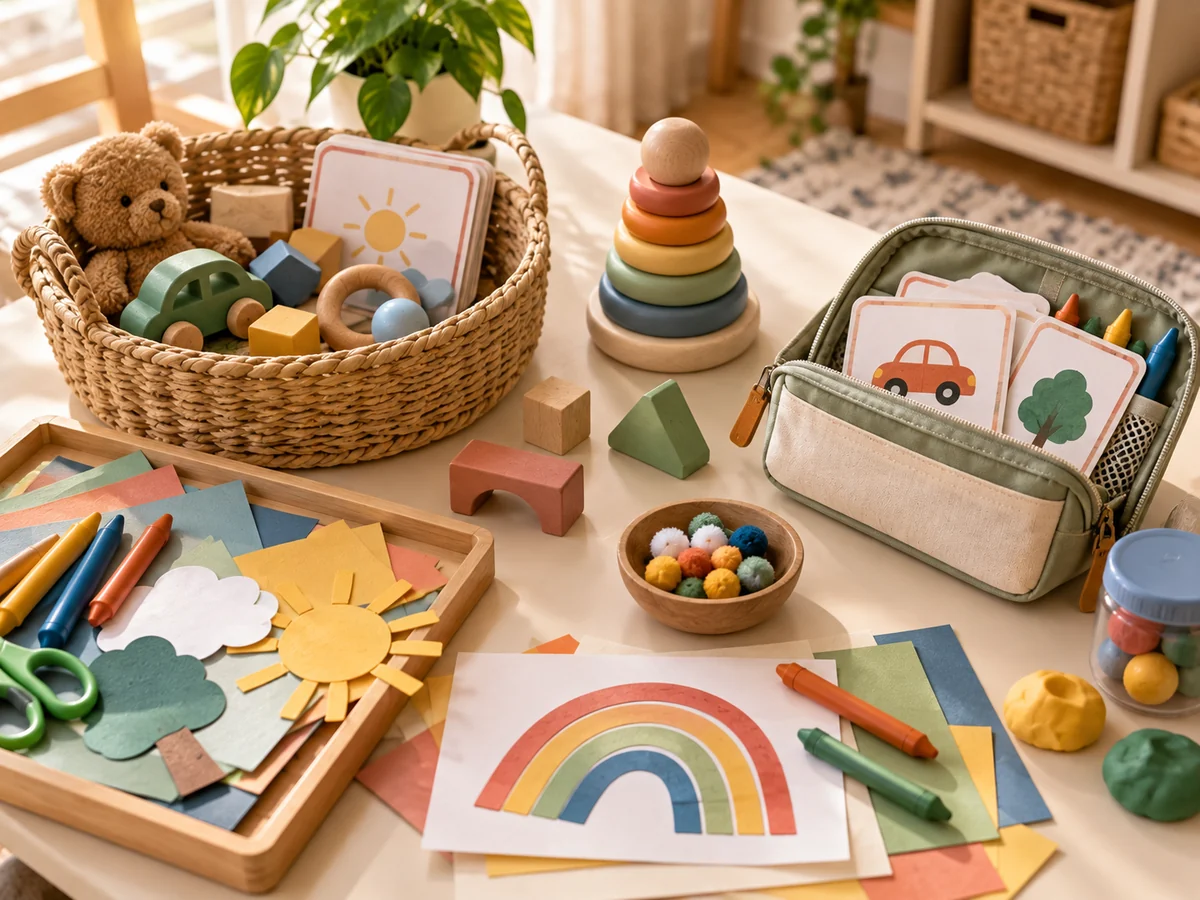
Quick answer: Pack a small busy bag with three or four quiet, low-mess activities and one surprise item, and bring out one thing at a time. Save the best item for the hardest stretch, which at a restaurant is the wait for food and at the doctor is the second wait in the exam room. Between items, use no-equipment games: I Spy, counting, picture hunts. And if your toddler needs a walk or fresh air, take the lap. Leaving the table for two minutes beats a meltdown at it.
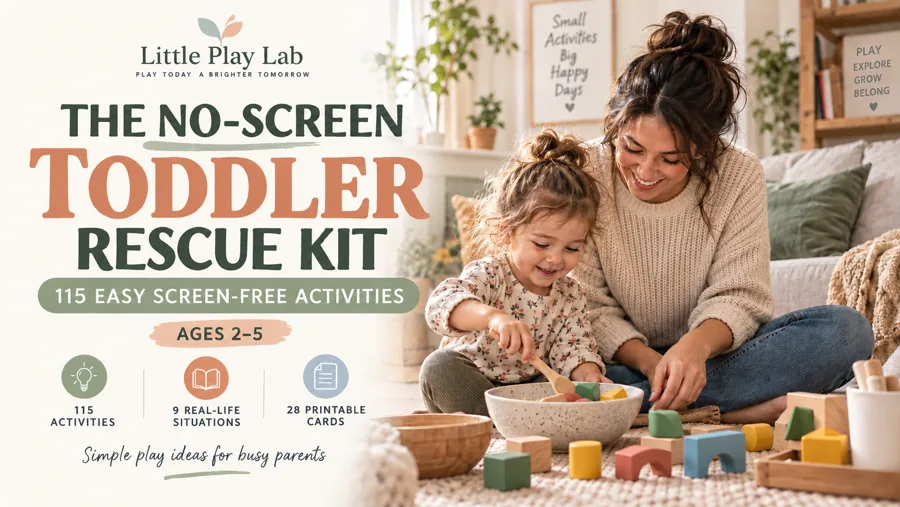
Waiting is one of the nine moments in this kit
The No-Screen Toddler Rescue Kit sorts 115 activities by the real moments parents face, including a full section for waiting rooms and eating out. 89 pages, 28 printable cards, ages 2 to 5.
Instant download. Print the cards once, keep them in your bag.
The four rules of playing in public
Every activity on this page passed the same four tests. If an idea fails one, it stays home.
- Quiet. Nothing with sound effects, nothing that begs to be banged on a table. Other people are eating, waiting and feeling ill in these rooms, and your toddler's fun should not become their headache.
- Contained. If it can roll under a stranger's chair, scatter into forty pieces or pour, it does not come. The best public activities live on one tray, one page or one lap.
- Low mess. No glitter, no glue, no loose water. Water reveal books yes, a cup of water and paintbrushes no.
- Revealed one at a time. This is the rule that makes everything else work. A bag emptied onto the table in minute one leaves you nothing for minute twenty. One item out, everything else invisible.
The busy bag: what to pack (and what to leave)
Parents who are good at restaurants are not more patient than you. They packed the night before. Here is the bag that works, kept small enough to live by the front door or in the car.
| Pack this | Why it earns its place |
|---|---|
| A water reveal book | Colour appears with a water brush, then fades to use again. Zero mess, works at every age on this page. |
| A reusable sticker book | Stickers peel and restick, scenes change. Quiet, flat, endless. |
| A small drawing pad and chunky crayons | Triangular crayons if you can find them: they do not roll off tables. A blank pad beats a crowded colouring sheet. |
| One small familiar book | An old favourite, not a new one. Familiar settles, new excites. |
| A mini photo album of family faces | Toddlers never tire of naming the people they love. Costs nothing, weighs nothing. |
| One wrapped surprise item | A tiny toy or new sticker pack, wrapped. The unwrapping is half the event. Rotate it: a surprise only works once. |
| A comfort item | The small stuffed toy or blanket scrap. Non-negotiable for doctor visits, useful everywhere. |
| A boring backup snack and water | For the wait, not instead of the meal. Check the rules first at clinics, where some waiting rooms ask for no food. |
Two habits matter as much as the contents. Restock the bag when you get home, not as you are leaving, or you will restock it with whatever is near the door. And keep busy bag items only in the busy bag. The same sticker book is boring at home and magical at a restaurant precisely because your toddler has not seen it all week.
The order of play: when to bring out what
A restaurant meal has four stretches, and they are not equally hard. Sitting down and looking around entertains most toddlers for free. Eating is busy time. The brutal stretch is between ordering and food arriving, and the second hardest is the bill-and-coats stage at the end. Waiting rooms have their own pattern: the main room wait is long but spacious, and the exam room wait is shorter but smaller, tenser and harder.
So pace the bag. First stretch: nothing, let them look around and settle. Middle: the familiar items, drawing and stickers. The hardest stretch: the surprise item, or the water reveal book if you only packed one hero. Walking lap goes wherever it is needed most, usually right before food arrives. Parents who dump the whole bag at minute one are the ones with nothing left at minute thirty.
16 activities for restaurants and waiting rooms
From the busy bag
1. Water reveal book
The closest thing to magic in a waiting room. The brush holds a little water, colour blooms on the page, and it all dries clear to start again. No stains on clothes, tables or clinic chairs. If you buy one thing for public waiting, buy this.
2. Reusable sticker scenes
One scene board, a set of restickable stickers. Move the animals, park the cars, put the sun in the wrong place on purpose. Peeling and placing takes real concentration, which is exactly the resource you are spending.
3. Take my order
Your toddler is the waiter, the drawing pad is the order pad. You order ridiculous things (a soup made of socks, a pizza the size of a house), they scribble the order and read it back. At ages 4 and 5 flip it: they practise ordering their own real food, which builds genuine confidence.
4. The family photo album
A small album or a set of printed photos in a pouch. Who is this? Where were we? What is grandma doing in this one? Toddlers treat their own people like the world's best picture book, because for them it is.
5. Two cars and a paper road
One printed road or parking mat and just two toy cars. The mat keeps the driving on the table and the two-car limit keeps it calm. Park them, race them slowly, put them to sleep in the parking spaces when food comes.
6. Bendy stick shapes
Pipe cleaners or bendy sticks for ages 3 and up, with you watching. Bend a letter, a snail, a pair of glasses for teddy. Silent, weightless, and they pack flat. Skip these for children who still mouth everything.
7. A mini pot of playdough
Controversial, effective. One small pot, used on a napkin or the lid as a mat, makes tiny pizzas and sausages while the real food cooks. The etiquette is simple: everything that drops gets picked up before you leave, and if the restaurant is fancy or the floor is carpet, this one stays in the bag.
No bag needed: games with what is already there
8. I Spy, toddler rules
Colours and shapes only. I spy something red, something round, something that lights up. In waiting rooms, look for things on walls, signs and in picture books rather than pointing at other people.
9. Menu picture hunt
Menus are free activity books. Find the burger. Find something green. Find the food you would feed a giant, a mouse, a very fussy king. Works with waiting room magazines and posters too.
10. The counting game
Count chairs, ceiling lights, windows, people wearing hats, red cars going past the window. Quiet voices, big numbers. For 2 year olds, counting to three, repeatedly, with great ceremony, is plenty.
11. Teddy tells the story
One soft toy, one familiar story retold from the pictures or from memory. Your toddler "reads" to teddy in a whisper. At the doctor, teddy has a second career, which is activity 13.
12. The WOAH game
A trick borrowed from a very experienced mother: when restlessness spikes, point at something ordinary (a light, a picture, your own shoe) and gasp "WOAH" in your most amazed voice. Toddlers cannot resist investigating what has amazed you. Buys a reset almost every time.
Made for the doctor's waiting room
13. Teddy gets checked first
Before the appointment, and again in the exam room, the doctor game is played on the comfort toy: listen to teddy's chest, look in teddy's ears, teddy is brave, teddy gets the sticker. Children process worry through play, and a rehearsed appointment is a calmer appointment. Children's hospitals like CHOC recommend exactly this kind of comfort and distraction approach for medical waits.
14. Drawing on the exam room paper
The second wait, in the exam room, is where toddlers crack. The paper sheet on the exam table is a giant drawing canvas in most clinics. Ask first, keep crayons on the paper, and a very long picture can carry the whole wait.
15. Small choices
"Do you want to bring your dinosaur or your drawing pad? Sit here or on my lap? Book first or stickers first?" Waiting strips away all control, and small choices hand some back. Children's health guidance for medical visits leans on exactly this: simple choices, calm explanations in plain words ("the doctor will check you to help you feel better"), and a comfort item within reach.
16. The brave debrief
Afterwards counts as an activity too. On the way home, retell the visit as a story where your toddler was the hero: we waited, you played, the doctor checked, you were brave. It sounds small. It is what makes the next visit easier, and parents of children with regular appointments treat it as part of the appointment itself.
The printable cards were made for your bag
The Rescue Kit includes 28 printable activity cards sized to grab on the way out: waiting games, quiet play, and ideas for every other stuck moment. Laminate a few and they live in the busy bag permanently.
Instant download from Gumroad. Print at home.
The restaurant playbook (the parts nobody tells you)
Order your toddler's food first and fast, ideally the moment you sit down, and ask for it to arrive whenever it is ready rather than with yours. Bread, a starter or a drink buys the first ten minutes at most places, so ask early. Take the walk before the food comes, not after: a lap to look at the fish tank, the kitchen door, the pictures on the wall drains the wiggles before the longest sit. Ask for the bill early when you sense the end is near, because the last five minutes of waiting with coats on is where restaurant meltdowns go to be born. And sit your toddler on the inside, against the wall, where the passing world is entertainment instead of an escape route.
When it still goes wrong
It will, sometimes. A tired, teething, overwhelmed toddler in a strange room is not a parenting report card. Take the lap outside: two minutes of fresh air resets a toddler in a way no toy can. Swap adults if there are two of you, so one meal gets eaten warm. Shorten the outing without shame. Every parent in that restaurant has carried a crying toddler out of somewhere, including, at some point, the ones giving you looks.
Etiquette, briefly
Keep volume at conversation level and materials on your own table. Pick up everything that fell, before you leave. Skip snacks in clinic waiting rooms that ask you not to bring food, and be thoughtful about nuts anywhere other children are close. In shared spaces your toddler can be happily busy and still be a good neighbour; the four rules at the top of this page are mostly that, written down.
How we choose these activities
Everything here is quiet, contained, low mess and quick to pack away mid-sentence, because that is what public spaces demand. We favour things a normal bag already holds, and we test each idea against one question: would this still work in a silent waiting room with a nurse watching? If not, it did not make the page.
Safety note: Supervise toddlers closely. Avoid small parts, magnets, coins, beads, balloons and other choking hazards, and check that stickers and small toys suit your child's age. Keep activities and snacks within the rules of the place you are in.
Never improvise a wait again
115 screen-free activities and 28 printable cards, organised by the moments that actually happen: waiting, eating out, travelling, cooking, sick days and the evening crash.
Instant download. One less thing to think about on the way out of the door.
Shared spaces: Keep your toddler's activities quiet and contained, follow the rules of the restaurant or clinic, and clean up anything that drops. Never rely on an activity to supervise a child.
Frequently asked questions
What should I pack in a toddler busy bag?
Three or four quiet, low-mess activities (a water reveal book, reusable stickers, a drawing pad), one familiar book, a mini photo album, one wrapped surprise item, a comfort toy, and a backup snack where food is allowed. Keep it small, keep it only for outings, and restock it when you get home, not when you leave.
How do I keep my toddler sitting at a restaurant table?
Mostly, you do not: you manage a series of shorter sits. Order their food first, pace out activities one at a time, take a walking lap before the food arrives, and ask for the bill early. A 2 year old sitting happily for a full hour-long meal is not the standard to aim for. Twenty good minutes, a walk, then twenty more is a realistic win.
What do I do with my toddler at the doctor while we wait?
Bring the comfort item, explain in simple words what will happen ("the doctor will check you to help you feel better"), play the doctor game on their toy first, and save a good activity for the second wait in the exam room, which is usually the hardest. Drawing on the exam table paper, with permission, carries that wait surprisingly well.
Is playdough rude to bring to a restaurant?
Opinions vary, including among restaurant staff. A small pot on a napkin, with everything cleaned up afterwards, bothers almost nobody in a family restaurant. In a formal restaurant, a crowded cafe or anywhere with carpet you do not want to pick dough out of, keep it in the bag and use stickers or drawing instead.
Should I just hand my toddler my phone at restaurants?
Plenty of good parents do, and one meal will not decide anything. The reasons families build a busy bag instead: screens can be hard to switch off when food arrives, volume travels in quiet rooms, and the bag skills (drawing, sticking, looking, talking) are the same ones your toddler needs for school waiting later. Many families use both: bag first, phone as the final reserve.
How long should each activity last?
Five to fifteen minutes per item is normal in public. The bag system works because items rotate, not because any single item lasts the whole wait. If an item only lasts four minutes but the next one is ready, you are still winning.
What age do restaurants get easier with a toddler?
Most families feel a real shift somewhere between 3.5 and 4.5, as sitting, waiting and conversation skills grow. It gets easier gradually, not on a birthday. Until then, early dinners, fast ordering and a good bag remain the winning combination.
Sources and further reading
CHOC Children's guidance on keeping kids calm while waiting for care at the doctor or emergency department (comfort items, distraction and reassurance). American Academy of Pediatrics, HealthyChildren.org, on low-cost screen-free play ideas for preschoolers.
For longer waits on the move, our toddler travel activities and travel activities for 3 year olds use the same bag. At home, the quiet activities for toddlers and 15 minute toddler activities cover the same skills without the audience.