
Entertaining a Toddler While Feeding a Newborn
Updated October 21, 2026
A newborn feeds eight to twelve times a day, and every feed asks the same impossible thing of you: sit still, hold the baby, and somehow also occupy the toddler who has just noticed you are unavailable. Most parents of two describe feeding time as the moment the toddler climbs the furniture or cries for the lap that is suddenly taken. It does not have to be a daily ambush. With one small setup by your feeding chair and a handful of stay-put activities, feeding time can become the cosiest, most predictable pocket of your toddler's day.
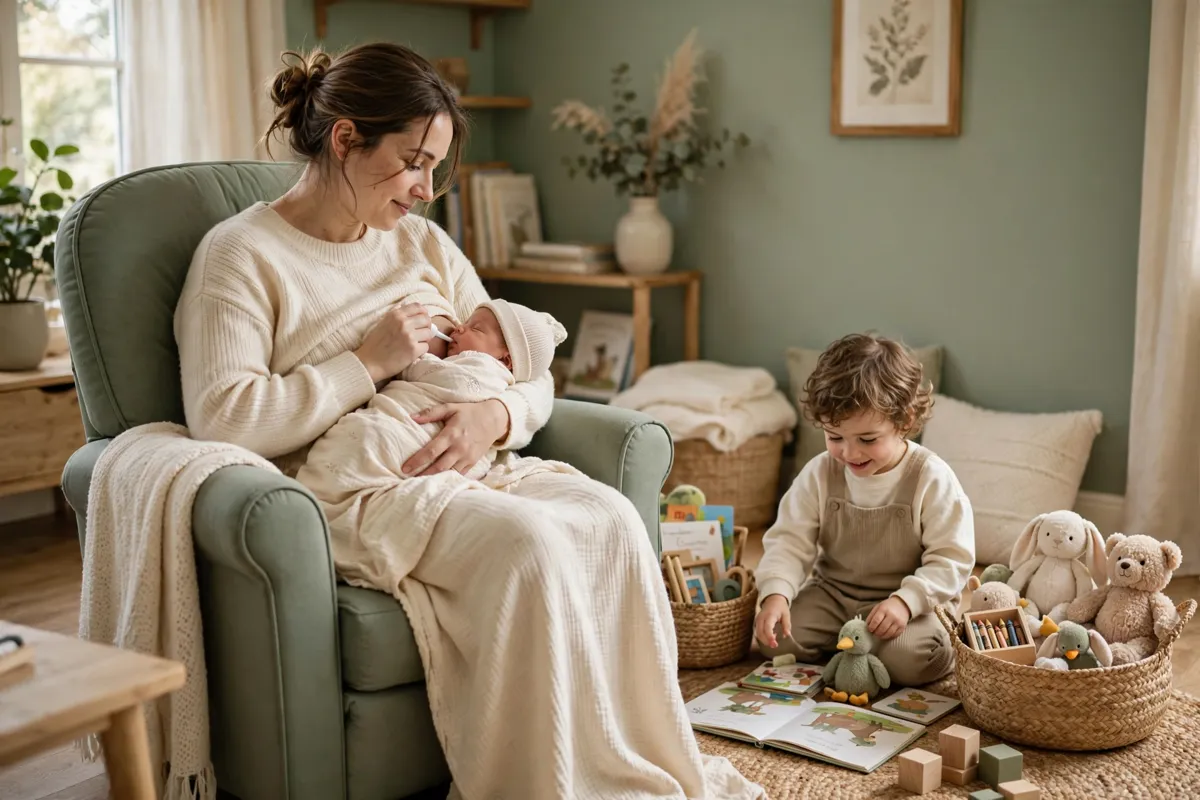
Quick answer: Build a feeding station once, by your usual feeding chair. Put a basket within arm's reach holding toys that live only there, a snack and water for your toddler, and your own drink and phone charger. When the baby feeds, your toddler gets the special basket, a helper job, and you talking to them. Because the toys appear only at feeds, they stay interesting for weeks, and nobody has to get up mid-feed.
Made for the moments your hands are full
The No-Screen Toddler Rescue Kit is an 89 page kit with 115 activities and 28 printable activity cards for ages 2 to 5, sorted by the moments parents struggle with, including new baby days and witching hour. Keep it on your phone, ready for the next feed.
Instant download. Print it once, use it every day.
Why feeding time is the hardest moment of the new baby day
Feeds are frequent, they cannot be paused, and they happen with you sitting down and visibly unavailable. From your toddler's side of the room, the person who used to drop everything is now holding someone else and saying "in a minute" eight times a day. That is a big change, and most toddler behaviour at feeds is that change being announced out loud.
Frequency works in your favour. Anything that happens eight to twelve times a day becomes routine fast. A feed that starts the same way every time, with the same basket and the same first job, stops being an interruption and becomes an appointment your toddler looks forward to. You are covering twenty to forty minutes at a time, in a way that feels like togetherness instead of exile.
Set up the feeding station once
Pick the chair or sofa end where you feed most often and set it up properly, once, instead of improvising every feed. The station has three parts: a basket for your toddler within arm's reach of your seat, a floor cushion or small mat beside you, and a side spot for your own supplies.
In the basket go the stay-put activities from the next section, plus a lidded drink and a small snack cup for your toddler. On your side go the things you always end up needing mid-feed: a big water bottle, a snack for you, the muslins, your phone charger, and something for your own brain. Then restock the station once a day, ideally during the last evening feed or right after bedtime. Two minutes of restocking buys you a whole day of calm starts.
The golden rule: station toys live only at the station
This one rule does most of the work. The basket toys come out when a feed starts and go away when it ends. They are never part of general play. A puzzle available only eight times a day stays fascinating for weeks. The same puzzle left out all day is boring by Wednesday.
It also gives the feed a clear beginning and end your toddler can see. Basket out means cosy club is open. Basket away means the feed is finished and you are free again, which is exactly the message a worried toddler needs. If a station toy escapes into everyday play and loses its shine, swap it out for a week. Rotate one item at a time, so the basket holds familiar friends plus one small surprise.
In the basket: six stay-put activities
Everything in the basket passes three tests: it works sitting in one spot, it needs no setup beyond a one handed handover, and its pieces are too big, too few or too contained to scatter.
1. A chunky puzzle, one board at a time
A chunky knob puzzle lives in the basket, one board only, worked on the floor mat beside you. Five to eight pieces is the sweet spot, so they can finish inside one feed. Swap the board every few days, not every feed, so finishing stays satisfying rather than frantic.
2. A magnetic drawing board
No lids to lose, no marks on the sofa, and the wipe clean slider feels like magic every single time. Draw together in the loosest sense: you name something, they scribble it, you guess wildly and wrong, they fall about laughing.
3. Water reveal books
A brush filled with plain water reveals the colours on the page, then the page dries and resets for the next feed. Because it is only water, a spill is a non-event, which matters when your hands are full. These books survive months of feeds, and the slow reveal suits the pace of a feed.
4. Sticker scenes, with the peel trick
Stickers fail toddlers in one specific way: they cannot get them off the sheet. Fix it before the feed by peeling away the waste border around the stickers, so each sticker lifts with a simple pinch. Reusable sticker scene pads are ideal at the station because the same farm or street scene can be rebuilt at every feed.
5. A baby of their own
A small doll, a toy bottle and a little blanket. When you feed your baby, they feed theirs. This copycat play settles many toddlers faster than any distraction, because they are not being sent away from the interesting thing, they are included in it. Expect the doll to be burped, shushed and put down for naps with great ceremony.
6. Big threading beads
Six to eight chunky wooden beads and a stiff lace with a long tip. Threading takes real concentration, which is why it holds attention so well, and the pieces are big enough to stay findable and keep away from baby mouths later. Count the beads back into the basket together at the end of the feed. Counting is the closing ritual.
One basket, weeks of feeds
The No-Screen Toddler Rescue Kit packs 115 activities and 28 printable activity cards into 89 pages for ages 2 to 5. The cards are perfect station material: pull two or three out before a feed and your toddler has a plan, ready to go.
Instant download. Print it once, use it every day.
Right beside you: the cushion tray set
Some activities work better spread out than held. A firm cushion or a small tray on your toddler's lap makes a table, and it keeps pieces corralled. These four live beside the basket rather than in it.
7. The snack cup challenge
A small lidded cup of cereal loops, raisins or chopped fruit. The lid is half the game: opening, closing, picking out one piece at a time. A station snack buys the first ten minutes of almost any feed, and because it appears only at feeds, it stays a treat.
8. Doctor kit checkups
Teddy patients queue along the sofa arm. Your toddler checks ears, listens to hearts and takes temperatures while you narrate and request a report after each patient. Being the doctor gives them the powerful role for once.
9. Story books they hold themselves
Sturdy board books with a real story arc, not baby flap books. Your toddler holds the book, turns the pages and "reads" to the baby while you prompt, ask questions and supply the voices you know by heart anyway. Their eyes stay on a story and their hands stay busy.
10. Card matching on the tray
Six pairs of big picture cards, face down on the tray. Small set, quick wins. Memory games stretch or shrink with your toddler's mood, and a two year old can play the simpler version: turn them all face up and just find the two that match.
Helper jobs that make them proud
Activities occupy your toddler's hands. Jobs occupy their heart. A toddler with a real job at a feed is a colleague, not a rival. Keep jobs genuinely useful, small enough to succeed at, and thanked by name every time.
- Muslin fetcher. Before you sit down, your toddler brings the muslin. It becomes step one of every feed, and it is theirs.
- Sock chooser. At the morning feed, they pick which socks the baby wears today from two options you offer.
- Burp cloth keeper. After the feed, the burp cloth goes over their shoulder and they are in charge of the pat-pat spot beside you.
- Water monitor. They hold your water bottle and remind you to drink. Toddlers take this duty extremely seriously.
- Song chooser. They pick the feed's song or audio story, from a short list you control.
Cluster feeding marathons
Then there are the evenings when the baby feeds, dozes, feeds again and never quite settles, and the short feed plan has to stretch into a marathon. Plan for the long version. Restock the basket in the late afternoon, add the backup item in reserve, and make your toddler's station snack a bigger one on marathon evenings.
Halfway through, rotate something: swap the puzzle board, bring out the second sticker scene, or switch to an audio story so your voice gets a rest. Dim the room a notch and lower the energy of everything on offer. Marathon evenings feel endless, but most families find they ease off after the early weeks, and the station routine carries straight into ordinary feeds afterwards.
Chosen, not replaced
Underneath every tactic on this page sits one idea: your toddler needs evidence that the baby has not replaced them. When you come home, greet your toddler first when you can, before cooing over the baby. It takes four seconds and it lands like a love letter.
Give feeding time a name that belongs to your toddler, something like "our cosy club" or "snack and story time", so a feed is something they get rather than something they lose you to. Watch your wording too. "I cannot play because of the baby" teaches them who took you. "My hands are busy, and my voice is all yours" teaches them where they stand. And start the feed's first minute together: settle them, launch the activity with them, then fade back. Involve, then release.
Safety rules around a newborn
A few steady rules keep everyone safe while your attention is divided. A toddler is never left alone with the baby, even if both look asleep, even for a moment; if you have to leave the room, one of them comes with you. Toddler hands get washed before baby cuddles, and cuddles happen at floor level with you right there. Keep station toys counted and stored in the basket, away from the baby's blanket and floor space, and teach gentle touch on the doll first. And the baby always sleeps on their back in their own clear sleep space, never propped among the feeding cushions. This is general information, not medical advice; follow your own clinician's guidance for your baby.
The next feed is in twenty minutes. Be ready for it
With 115 activities across 89 pages and 28 printable activity cards, the No-Screen Toddler Rescue Kit gives you a deep bench of feeding time ideas for ages 2 to 5, so the basket never goes stale and neither do you.
Instant download. Print it once, use it every day.
Frequently asked questions
How do I feed my newborn when my toddler is jealous?
Some jealousy is normal, and it is not a sign you have made a sibling mistake. Feed your toddler's need for you in small deliberate ways: greet them first when you can, give them a job and a special basket at feeds, and keep one pocket of the day that is just theirs, even if it is only ten minutes. Jealous behaviour usually softens as feeding becomes routine and your toddler learns that feeds end and you come back.
What is a nursing basket?
A nursing basket, also called a feeding basket, is a small box or basket of toys and activities that comes out only while you feed the baby and goes away when the feed ends. Because the contents appear only at feeds, several times a day, they keep a novelty that everyday toys quickly lose. Typical contents are a chunky puzzle, a sticker pad, a water reveal book, a doll with a toy bottle, and a lidded snack cup.
What activities can I manage with one hand while feeding?
Plenty, if you choose for it. You can hold a board book while your toddler turns the pages, peel sticker backs before handing the sheet over, deal matching cards onto a tray, be the patient for a doctor kit checkup, and press play on an audio story. Pick activities whose setup fits in one handful and whose pieces are too big to roll away, and one handed help is all they ever need.
My toddler climbs on me while I am breastfeeding. What helps?
Climbing is usually a bid to be close, not naughtiness. Give closeness a legal place: a floor cushion pulled tight against your chair, one arm kept free for a lean or a hand hold, and the doll for them to hold the way you hold the baby. Start each feed by settling your toddler in their spot with their first activity before you begin, so the routine starts with them instead of with being moved away.
How long will it take my toddler to adjust to the baby?
Most toddlers need a few weeks to a few months, and it rarely runs in a straight line. Good weeks and rough weeks alternate, especially around illness, growth spurts and changes in the baby's routine. A predictable feeding ritual helps because your toddler stops having to test what a feed means. If difficult behaviour is getting worse rather than slowly better after the early months, talk it through with your health visitor or pediatrician.
How do I keep my toddler and the newborn safe together?
Keep it simple and constant. Your toddler is never alone with the baby, even if both seem asleep. Wash toddler hands before baby cuddles, keep small toys and beads counted in the basket and away from the baby's blanket and floor space, and do cuddles at floor level with you right there. Teach gentle touch on a doll first, and praise it every time you see it used.
My toddler has regressed since the baby arrived. Is that normal?
Very common. A toddler who was dry, sleeping well or talking in full sentences may slide backwards when a baby arrives. It is usually a request for babying, not a loss of skill. Meet it generously where you can: carry them, rock them, let them have the cuddle, and keep their routines steady. Most regressions fade over the following weeks as the new shape of the family starts to feel normal.
Sources and further reading
HealthyChildren.org (American Academy of Pediatrics) guidance on sibling adjustment to a new baby and newborn safety at home. UNICEF parenting resources on play and early learning.
New baby evenings often collide with the hardest hour of the day, so see our toddler witching hour activities for that stretch. On days when you are running on empty yourself, our low energy toddler activities keep everything gentle, and our quiet activities for toddlers suit the hours when the baby is finally asleep.