
Toddler Bored of Their Toys? Toy Rotation That Actually Works
Your toddler is standing in a room full of toys announcing that there is nothing to play with, and they are, in a strange way, telling the truth. When everything is out all the time, toys stop being invitations and start being wallpaper. Toy rotation is the simple system that fixes it: most toys rest in storage, a small chosen set stays out, and every week or two the sets swap, so old toys keep arriving as if they were new. This page gives you the whole system, the sort, the shelf, the rhythm, and the exceptions, without buying a single storage system you do not need.
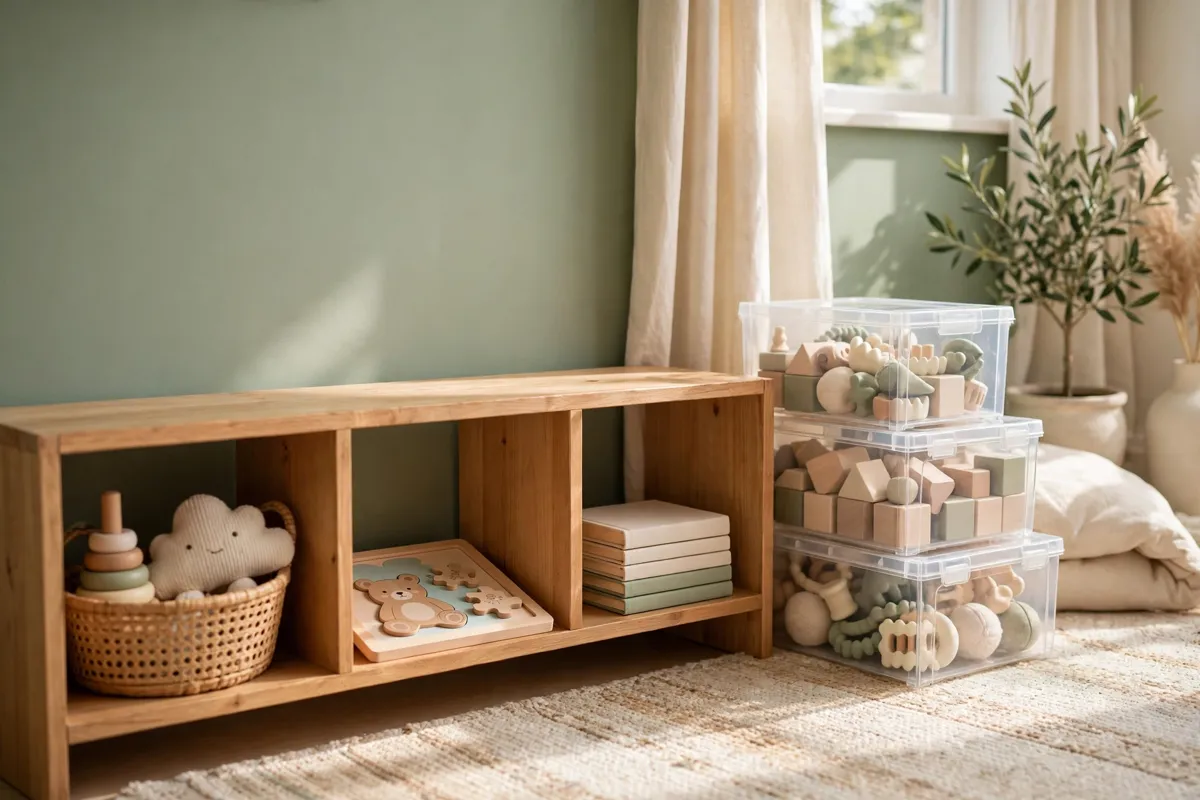
Quick answer: Gather every toy in one go while your toddler is out or asleep. Keep out roughly 8 to 12 play invitations, one per type: building, pretend, vehicles, a puzzle, art, books, movement and a comfort toy. Box the rest by theme, out of sight. Every 1 to 2 weeks, or when play goes flat, swap a third to a half of what is out. Keep true favourites always available, and rotate the rest.
Rotation fixes the toys. The Kit fixes the ideas.
Even a perfect shelf needs fresh things to do on flat days. The No-Screen Toddler Rescue Kit adds 115 print-and-go activities in 89 pages plus 28 printable activity cards, most using the toys and household things you already own. Made for ages 2 to 5.
Instant download. Print it once, use it every day.
Why less works: the toy pile problem
Watch a toddler in a room with forty toys and a toddler with eight. The forty toy child flits: pick up, drop, pick up, drop, then wanders off to pull tissues out of a box, because a tissue box, at least, is one clear idea. The eight toy child builds, pretends, combines. Too many choices do not enrich play, they fragment it. Every toy in sight competes with every other, nothing gets played with long enough to become interesting, and the whole collection fades into background. It is the same reason a restaurant menu of two hundred dishes makes choosing harder, not easier, except your toddler also cannot read.
There is a second effect working against you: familiarity. A toy seen every day for three months becomes invisible, however good it is. That same toy, missing for three weeks and then reappearing on the shelf, gets greeted like a birthday present. Rotation does not create new toys. It manufactures newness out of the ones you already paid for.
The system, step by step
Step 1: the big gather (do it in one go)
While your toddler is out, at nursery, or asleep, collect every toy in the house into one room. Every single one, including the ones under the sofa and in the car. This is the confronting part, and it is supposed to be. You cannot rotate what you cannot see, and most parents discover they own two or three times the toys they thought they did.
Step 2: sort ruthlessly into four piles
Broken, outgrown or unloved: gone, donated, binned or passed on, no rotation box for these. Always out: the true inner circle, the comfort toy, the current obsession, the books in active rotation at bedtime. Rotation stock: everything good that remains, sorted roughly by type. Not yet: toys for older ages, stored separately so they are not cluttering the system. Be honest about duplicates: nobody needs four shape sorters in active service.
Step 3: choose the first set (8 to 12 invitations)
An invitation is one play possibility, not one object: the block basket is one, the doll and blanket is one. Aim for one per category so the shelf offers variety without volume.
| Category | Example invitation |
|---|---|
| Building | Blocks, magnetic tiles or stacking cups (one, not all three) |
| Pretend | Play food and a pot, or the doctor kit, or dress up pieces |
| Vehicles | Three or four favourites on a road mat or tape road |
| Puzzle and fiddly | One puzzle at their level, one posting or threading toy |
| Art | Crayons and paper, or stickers, in one tray |
| Books | Five or six, faces out if you can |
| Movement | A ball, a scarf set, or push along toy |
| Comfort | The beloved teddy or blanket. This one never rotates. |
Step 4: box the rest by theme, out of sight
Clear boxes help you see what you own, labelled bags or ordinary boxes work just as well. One box per rough theme: building, pretend, vehicles and animals, puzzles and games, art extras, seasonal. Store them where your toddler does not browse: a wardrobe top, a loft, a lidded ottoman. Out of sight is a feature, not a failure. A child who can see the storage will campaign for all of it, daily, which rather defeats the point.
A fresh shelf plus a fresh idea is the whole game
Pair swap day with an activity card your toddler has never seen. The Rescue Kit's 28 printable cards and 115 activities are full of ways to use ordinary toys in new combinations. 89 pages, ages 2 to 5, print once.
Instant download. Print it once, use it every day.
Present the shelf like you mean it
How the chosen few are displayed decides whether rotation works. Low shelf or floor level baskets, everything visible at a glance, space around each thing. A toy your toddler can see whole gets chosen; a toy buried in a deep toy box might as well be in storage, except it also makes the box unsearchable. Put each invitation in its own basket, tray or spot. This looks like Montessori because it borrows the one Montessori idea that matters here: a beautiful, limited, reachable display tells a child "start here" without any adult talking. Tidy up also becomes possible, because eight things have eight homes and a two year old can actually finish that job.
The rotation rhythm
Swap every one to two weeks, or sooner whenever play goes visibly flat: toys picked up and dropped, the shelf ignored, the tissues coming out of the box again. Swap a third to a half of the invitations each time, not everything. Anchor pieces that are mid-love stay; total change every time feels like a stranger's playroom and can unsettle younger toddlers. Change with the seasons and the interests: water toys and balls in summer, the play kitchen back in autumn, whatever the current passion is (dinosaurs, buses, babies) always represented by something.
Swap day technique
At first, swap while your toddler is out or asleep, and let them discover the new shelf in the morning. Parents call it the new toy shop effect, and the delight is real: gasps over a train that has existed in a wardrobe for twelve days. After a few cycles, many families involve the child: "Two things are going back to the toy cupboard to rest. Which two should come out?" Ownership makes the system sturdier, and choosing what rests teaches that resting is not losing.
Reality checks and exceptions
The beloved toy never rotates. Comfort objects are not inventory. If it is loved daily, it stays, full stop. Gifts: new toys join the shelf for a week of glory, then enter the rotation stock like everyone else. Siblings: rotate by shared categories, keep each child's personal comfort items and treasures exempt, and expect negotiations; a small personal basket per child ends most of them. Tiny homes: the system shrinks gracefully: one shelf out, one lidded box stored under a bed or on top of a wardrobe. Rotation matters more in small spaces, not less, because the pile is always in view. The protest: if your toddler notices and campaigns for a rested toy, that is data, not disaster. Swap it back in and rest something else. The system serves play, not the other way round.
Signs it is working
Within two or three swap cycles, most families report the same cluster of changes. Play stretches get longer, because the shelf stops fragmenting attention. Pretend play gets deeper, because the same invitations stay out long enough to develop stories. Tidy up stops being a battleground, because eight homes are learnable. And the sentence this page is named after, bored of everything, with a house full of toys, gets said far less. When boredom does strike in the moment, it is no longer a system failure, just a moment, and our in the moment boredom fixes page handles those: twenty instant ideas for right now. Rotation is the cure; that page is the painkiller. Most houses need both, in that order.
How we choose these activities
The guidance here reflects widely used early years practice on limited choice, accessible storage and rotating materials, of the kind described by child development sources such as ZERO TO THREE and the American Academy of Pediatrics' HealthyChildren.org, adapted for ordinary homes rather than classrooms. Start smaller than you think: a household that keeps out ten invitations and rotates them is running the system, whatever the storage looks like.
Your toys were never the problem. The pile was.
Now the ideas on top of those toys: 115 activities and 28 printable cards in The No-Screen Toddler Rescue Kit, sorted by moment and energy, for ages 2 to 5. $9.99, instant download.
Instant download. Print it once, use it every day.
Frequently asked questions
How often should I rotate my toddler's toys?
Every one to two weeks works for most families, or sooner when play goes flat: toys picked up and dropped within seconds, the shelf ignored. Swap a third to a half of what is out each time, keeping mid-love anchors in place. If in doubt, rotate on behaviour rather than the calendar.
How many toys should be out at once?
Roughly 8 to 12 play invitations, where an invitation is one play possibility like the block basket or the doll set, not one object. Cover the categories once each: building, pretend, vehicles, a puzzle, art, books, movement and a comfort toy. More than that and attention fragments; much less and the shelf feels empty.
What if my toddler notices toys are missing and gets upset?
It happens less than parents fear, especially when swaps happen while they are out or asleep. If they ask for a rested toy, treat it as useful information: swap it back and rest something else. Comfort toys and current obsessions should never rotate away. Within a few cycles most toddlers start enjoying discovery mornings instead.
How do I do toy rotation in a small home?
Use one lidded box or an under bed container as the entire storage. Keep the out set to one low shelf or a single basket arrangement. Small spaces benefit most from rotation because the toy pile is always in view, so making it small and fresh changes the whole room.
Which toys should stay out all the time?
The comfort object, always. The current deep obsession, while it lasts. Bedtime books in active use. And any toy mid-project, like a beloved train set in daily service. Rotation is for the long tail of good but not currently glowing toys, not for the inner circle.
Does toy rotation work for a 2 year old?
Yes, and arguably best at two, when attention is most easily fragmented by choice. Keep the out set at the lower end, eight or so invitations, categories simple, and swap a little at a time so the shelf stays familiar. Two year olds greet returning toys with genuine delight, which makes the system easy to love.
How do I start toy rotation without buying storage?
Use what exists: carrier bags, a suitcase, the top of a wardrobe, the box the toys arrived in. The system is about what is out, not about matching containers. Start with the big gather and the four piles, keep out ten invitations, stash the rest anywhere out of sight, and refine the storage later if it ever matters.
For the flat afternoons while you wait for swap day, the 15 minute toddler activities guide covers short gaps, and independent play activities for toddlers shows how a well set shelf turns into play your toddler starts alone.