
Independent Activities for 2-Year-Olds
Independent play at two does not look like the pictures. It is not a toddler entertaining themselves in another room while you work. It is four good minutes with a posting box while you drink tea in the same room, and it is built, minute by minute, over weeks. The good news: two is exactly the right age to start, because the play itself is simple, repetitive and self-rewarding at this age. This page gives you the method that works at two, twelve starter activities chosen for very first solo play, and honest numbers for what to expect.
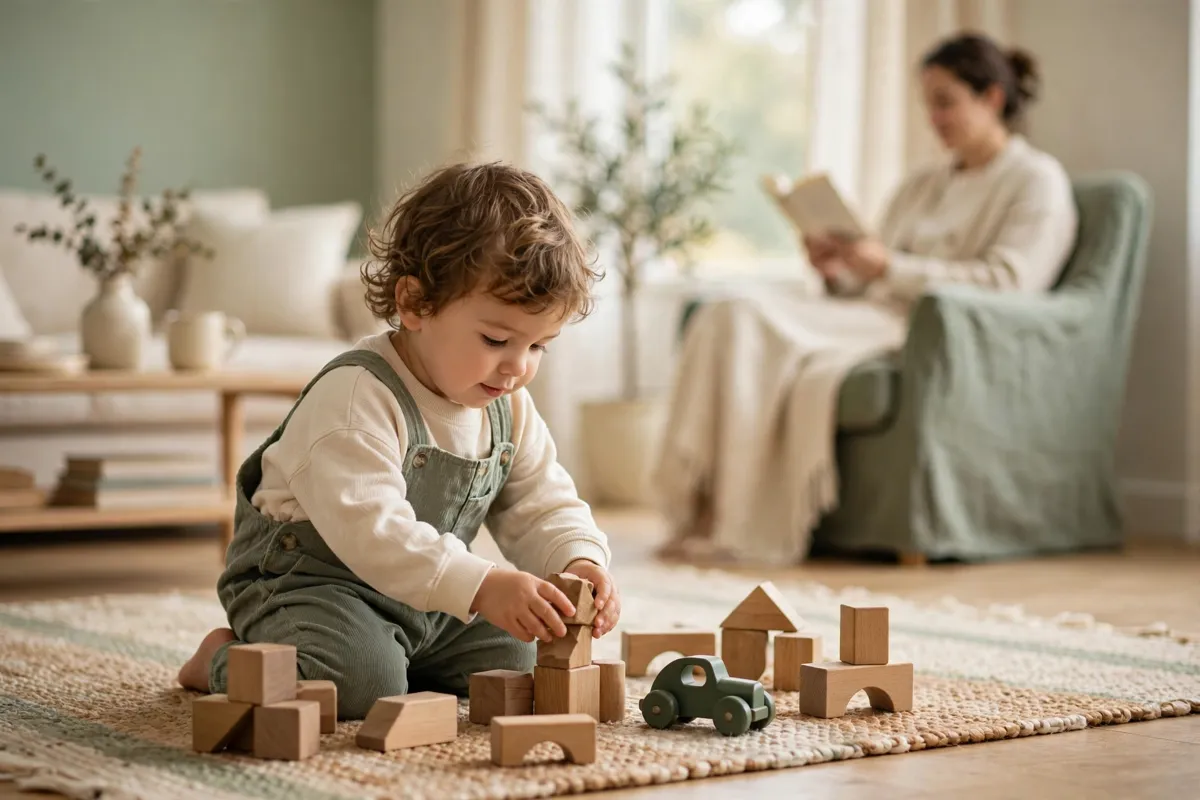
Quick answer: Start together, then fade. Sit with your two year old, start the activity with them for a minute or two, then quietly become boring: stop directing, slide back a little, keep your hands busy with something of your own. Expect bursts of 3 to 10 minutes at first, at their freshest time of day, in a safe space with very few toys. Reconnect briefly when they check in, then fade again. Growth is measured in weeks, not days.
Starter activities, ready to pull out
The No-Screen Toddler Rescue Kit holds 115 print-and-go activities in 89 pages plus 28 printable activity cards, with the simplest, self-running ideas easy to find by age and moment. Made for ages 2 to 5, and tested against real two year old attention spans.
Instant download. Print it once, use it every day.
What independent play really looks like at two
Set the picture correctly and everything else gets easier. At two, independent play means your child is absorbed in something of their own while you are present but not participating. Same room, often same rug. You are the secure base they launch from and return to, and the returning is part of the system, not a failure of it. A two year old who plays for six minutes, comes to show you a block, gets a warm "you built it tall," and returns to the blocks for four more minutes is doing independent play beautifully.
Expect bursts, not sessions: three to ten minutes is a normal starting range, stretching toward fifteen or twenty for favourite activities over the coming months. Time of day matters enormously. The morning, fed and rested, is when two year olds play most independently. The same child at 5 PM will not manage two minutes, and that is tiredness, not a skill problem. Build the habit where it is easiest.
The method: start together, then fade
Step 1: fill the cup first. Five minutes of proper connection, cuddles, a shared book, rough and tumble, before you want independent play. Children who have just had you go off and play. Children who have been fended off all morning spend their play time bidding for you instead.
Step 2: start the activity with them. Sit down, get it going for a minute or two: post the first shapes, stack the first cups, drive the first car. Two year olds join activities far more easily than they start them cold.
Step 3: become boring on purpose. Stop suggesting, stop narrating, stop improving their tower. Slide back half a metre. Pick up your book or your tea. This is the skill: being present but uninteresting. If you keep offering ideas, you remain the entertainment and the play stays yours.
Step 4: answer check-ins briefly and warmly. They will bring you things, show you things, lean on you. Receive it, one sentence, genuine pleasure, then turn your attention back to your own thing. Long enthusiastic interviews restart interactive mode; cold rejection ends the experiment. Brief and warm is the line.
Step 5: end on a success. Rejoin them or move on together while it is still going well, rather than waiting for the collapse at minute twelve. Sessions that end happily get repeated tomorrow.
The setup that makes it possible
Independent play at two needs a yes space: a corner or room where everything within reach is allowed, safe and theirs. If you have to say "don't touch" every minute, nobody is independent. Keep very few toys out, four to six invitations, because a two year old surrounded by twenty toys plays with none of them for long. Our toy rotation guide covers the system behind that. Put the play where you actually are: a mat near the kitchen while you cook, a corner of the living room, not a lonely bedroom down the hall. And keep your own activity genuinely absorbing: a book reads as available-but-busy; a phone, somehow, reads as a challenge to be interrupted, and toddlers are correct that it can be.
12 starter activities for first independent play
These share a secret: each one is a loop. Post, tip out, post again. Stack, knock, stack again. Two year olds learn through repetition, and loop activities restart themselves without your help, which is the entire requirement.
1. Posting box
A lidded box or tub with a slot, plus large objects to post: lids, big bottle caps, chunky shapes, playing cards in a coffee tin slot. The tip-out-and-restart loop can hold a two year old longer than almost anything else at this age.
2. Nesting and stacking cups
Stack them, nest them, fill them, hide a ball under them. Open ended in five directions at once, unbreakable, and completely self-explanatory.
3. One big knob puzzle
Three to five pieces, knobs their whole fist can grab, at or just below their current level. A puzzle they almost always succeed at builds the solo habit; a frustrating one ends it.
4. Blocks and animals
A small set of blocks plus two or three animals or figures. The animals give the building a story, the small count keeps it manageable. Expect enclosures, towers, and animals being put to bed.
5. Tape road with two cars
A painter's tape loop on the floor, two favourite vehicles. Driving in circles is meditation at two. Add a cardboard box garage and the loop gains a destination.
6. Playdough squish tray
One ball of dough, two tools maximum, a cutter and a roller. Poking, rolling sausages, squashing flat. Keep the palette to one colour at this age to protect both the dough and your carpet budget.
7. Sticker page
One sheet of big stickers, backing peeled off by you, one piece of card. Peeling is the challenge, sticking is the reward, and the whole thing is silent and seated.
8. Book basket on a cushion
Four or five beloved board books in one spot that signals settling. Two year olds read pictures, recite memorised lines, and turn pages for the pleasure of it. Familiar is the point.
9. Teddy picnic setup
A blanket, two teddies, cups and plates set out by you together, then handed over. The pretend script is already installed in most two year olds from watching you, and pouring imaginary tea is a complete solo activity.
10. Ball roll ramp
A cardboard tube or a plank lent against the sofa, balls or cars to send down and fetch. The fetching is part of the loop, and the cause and effect never gets old at two.
11. Real jobs basket
Socks to match, a duster for the skirting boards, soft toys to deliver to a basket one by one. Real work is the most absorbing category of all at this age, because it is what the big people do.
12. Big scoop sensory tray
A tray or washing up bowl with dry pasta or lentils, two scoops and a pot, on a mat with you in the room. Scooping and pouring is pure two year old flow. Keep quantities small and sweep without comment afterwards.
Twelve ideas today. A hundred in reserve.
The Rescue Kit's 115 activities include a full section of first independent play ideas for the youngest toddlers, plus 28 printable cards. 89 pages, ages 2 to 5, organised by the moment you are actually in.
Instant download. Print it once, use it every day.
Troubleshooting at two
They follow you everywhere. Usually a connection problem, not a play problem. Front load more together time, start the fade in the room you are staying in, and keep your own activity in one chair so you stop being a moving target. Following often drops sharply once the connection cup is filled first, on purpose, every time.
Bursts are still only two or three minutes. Normal, especially under two and a half. Check the activity is a loop rather than a task with an ending, check the time of day, and count the growth honestly over a month. If they played for six minutes today and two last month, the system is working precisely as designed.
They only play if you watch. The audience stage is a genuine developmental step: your attention is the stage lighting. Sit where you can be glanced at, narrate less over time, and let the loop activities do the heavy lifting. Children grow out of needing the audience as the play itself gets more absorbing, which is another reason to keep the activities simple and successful.
Everything gets thrown or tipped. At two, emptying and scattering are legitimate play schemas, not sabotage. Offer things designed for it: a box to empty, cups to knock down, a posting box whose whole purpose is tip and restart. Save the "gentle" corrections for things that are actually unsafe.
Safety, plainly: independent at two always means in sight or easy earshot, in a space made safe for them, with choking hazards, water and anything climbable properly managed. It never means alone behind a closed door. You are nearby, available, and simply not directing. That is the whole definition at this age.
How this page fits with the bigger guides
This page is the age two doorway into a skill that keeps growing. Our main guide, independent play activities for toddlers, covers ages 2 to 5 with the full method and more activities for older toddlers whose bursts are stretching toward half an hour. When the specific problem is the daily rest slot rather than play, our quiet time activities for 2 year olds page builds that routine. And when the independence collapses specifically right after a screen goes off, that is its own pattern, covered in the TV off transition guide.
How we choose these activities
Activities for this page are screened for a young two year old playing near a supervising adult: loop based rather than goal based, success built in, no choking hazards, nothing that needs instruction mid-play. Guidance reflects general early development advice from sources such as the American Academy of Pediatrics' HealthyChildren.org and ZERO TO THREE. Every child develops at their own pace; if you have concerns about your child's play or development, your own clinician is the right first call.
Build the habit that gives you your mornings back
115 activities and 28 printable cards, including the starter set for first solo play at two. The No-Screen Toddler Rescue Kit is $9.99, downloads instantly, and grows with them to age 5.
Instant download. Print it once, use it every day.
Frequently asked questions
How long should a 2 year old play independently?
Expect bursts of about 3 to 10 minutes at first, with you in the same room, growing toward 15 to 20 minutes on favourite activities over the months. Short bursts are not failure; they are the normal shape of the skill at two, and they lengthen with practice, the right loop activities, and being scheduled at your child's freshest time of day.
How do I teach my 2 year old to play on their own?
Use the fade. Fill their connection cup first, start the activity with them for a minute or two, then deliberately become boring: stop directing, slide back, do something of your own nearby. Answer check-ins briefly and warmly, and end while it is going well. Repeat daily at the same fresh time of day and the bursts grow.
Is it OK for a 2 year old to play in another room alone?
Independent play at two means absorbed play with a supervising adult in sight or easy earshot, in a space made safe for them. It does not mean playing alone behind a closed door. As they approach three and prove themselves with the habit, short stretches in a fully childproofed adjacent room with checks are a natural next step many families take.
Why won't my 2 year old play without me?
Usually one of four things: their connection cup is empty, the activity needs starting rather than just offering, the time of day is wrong, or there are too many toys fragmenting their attention. Work through the list in that order. Needing you nearby at two is developmentally normal; the goal is you nearby but not directing.
What are the best first independent play activities for a 2 year old?
Loops: a posting box, nesting cups, one big knob puzzle, blocks with animals, a tape road with two cars, playdough with two tools, sticker pages, a book basket, a teddy picnic, a ball ramp, real jobs like sock matching, and a big scoop sensory tray. If it restarts itself, it belongs on this list.
When does independent play get longer?
Gradually across the third year. Many children reach 15 to 25 minute stretches by around age three on activities they love, especially with the fade method practised consistently. There is wide normal variation. Measure your child's growth against their own last month, not against anyone else's child or anyone's internet claims.
Is independent play just ignoring my toddler?
No, and the difference matters. Ignoring is unresponsive. Independent play, as described here, is built on responsiveness: connection first, warm brief answers to every check-in, and a parent who is present and available, just not directing. The child plays freely precisely because the parent is reliably there. That security is the engine of the whole thing.
For calmer moments in the day, quiet activities for toddlers keeps the volume down without a screen, and 15 minute toddler activities fits the short windows while you cook, work or reset the house.