
Toddler Activities While Cooking: 18 Screen-Free Ideas
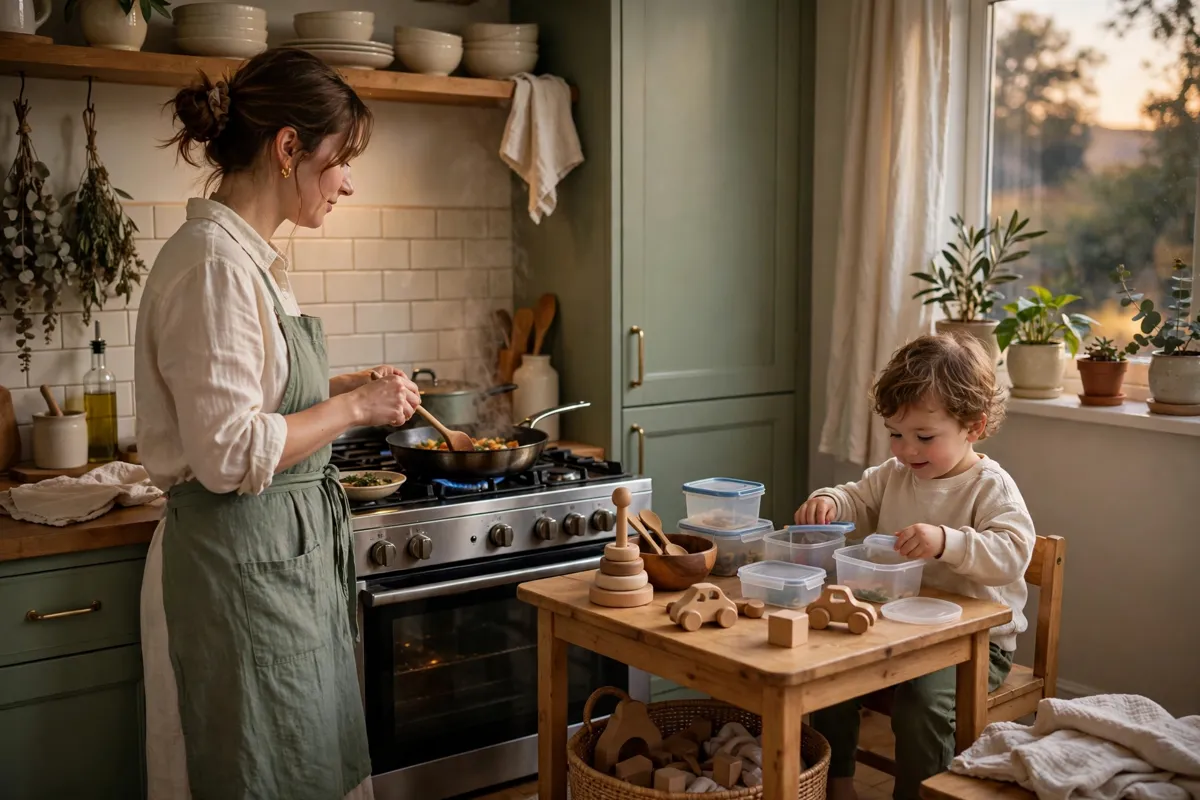
Dinner needs cooking, and your toddler has chosen this exact moment to need you most. They are underfoot, tugging your leg, asking to be picked up while your hands are covered in raw chicken. Sound familiar? This is the hardest cooking problem in a house with a small child, and it is not solved by better recipes. It is solved by having a plan for the toddler before the stove goes on. Here are 18 screen-free toddler activities while cooking that real parents actually use, sorted by where your child plays and what they can genuinely help with.
Cooking time is one of the 9 moments this kit was built for

The No-Screen Toddler Rescue Kit has 115 print-and-go activities sorted by real life situations: cooking, the late afternoon crash, waiting rooms, sick days and more. 89 pages and 28 printable cards for ages 2 to 5, so tonight's idea is ready before the pan is hot.
Get the Rescue Kit · $9.99Why cooking time is the hardest part of the day
Cooking with a toddler underfoot combines every difficulty at once. It usually happens in the late afternoon, when your child is hungry, tired and low on patience, and you are busy, against the clock, and surrounded by things that are hot or sharp. If this hour sounds exactly like the evening meltdown window, it is: dinner prep sits right inside what we call the toddler witching hour, and the two problems share most of the same fixes.
There is another reason your toddler wants to be in the kitchen specifically. You are in it. Toddlers are wired to copy adults and be near them, and cooking looks fascinating from knee height: water, fire, chopping, smells. Fighting that instinct rarely works. Using it does. Half the activities below are simply safe ways to let your child feel involved in what you are doing.
Simple household materials are enough. UNICEF's screen-free play ideas lean on familiar items like socks, clothes, pots and pans, and the American Academy of Pediatrics suggests keeping safe play items available for children while adults work in the kitchen. UNICEF Parenting and HealthyChildren.org both have more guidance.
Set up first: three rules that make all of this work
1. Start the activity before the stove
The single biggest upgrade costs nothing: put your toddler's activity in place while the kitchen is still cold and calm. Once oil is hot and something needs chopping, you have no spare hands and no spare patience, and your toddler knows it. Two minutes of setup at 5:00 saves twenty minutes of chaos at 5:20.
2. Give your toddler a "yes" spot
Instead of a kitchen full of no, mark one place where everything is allowed. It might be a learning tower at the counter away from the stove, a high chair pulled close on the safe side, a mat on the floor with a defined edge, or a playpen in the doorway where they can see you. The spot matters less than the rule: inside it, they can touch everything.
3. Keep a cooking basket
One small basket or box that only comes out at cooking time, with four or five rotating items: containers and lids, a wooden spoon and pot lid, a sticker sheet, a small puzzle, chunky crayons. Rationed like this, ordinary objects stay interesting for weeks. It is the same trick as the witching hour box, built for the kitchen.
- About 10 minutes (pasta, eggs, reheating): the toddler drawer, fridge magnets or one book from the basket. Keep it to one activity.
- About 25 minutes (most weeknight dinners): start with a play activity, switch to a helper job when it fades. The wash-the-vegetables job plus the drawer covers most of this.
- 40 minutes or more (roasts, curries, big batches): plan three stations and rotate: drawer or magnets, then table activity, then helper job or pretend restaurant. Also seriously consider whether half the prep can happen earlier in the day.
18 toddler activities while cooking, sorted by spot
Right next to you, in the kitchen
The Toddler Kitchen Drawer
Give up one low drawer or cupboard and make it theirs: pan lids, wooden spoons, plastic containers, a whisk, measuring cups. Parents swear by this one because it works every single night. Your child "cooks" with their equipment while you cook with yours.
Easy prompt: "Your cooking things are in your drawer. What are you making tonight?"
Fridge Magnet Station
Big letters, shapes or animal magnets on the lowest part of the fridge door, exactly at toddler height. It keeps them in one place, facing away from the stove, for longer than you would expect.
Make it last: Set a mini challenge when you walk past. Find all the red ones. Put your name first. Line them up like a train.
Wash the Vegetables
A bowl of water, tonight's carrots or potatoes, and a small brush, at their spot or at the table. This is the rare activity that is also genuinely useful: dinner prep actually gets done, and toddlers take real jobs seriously.
Keep it small: Half a bowl of water is plenty. Put a towel underneath and keep the flood manageable.
Pots and Pans Band
An upturned pot or a stack of lids plus a wooden spoon, on a mat on the floor. Yes, it is noisy. It is also contained, joyful noise that keeps a toddler in one spot while the oven does its work.
Parent tip: Save this for the loud parts of cooking, like blending or boiling, and switch to something quieter for the final stretch.
Smell the Spice Jars
Three or four closed spice jars with distinctive smells, like cinnamon, cumin and dried herbs. Your toddler unscrews nothing; they just sniff and react while you narrate. It feels like real cooking because it is real cooking, one sense at a time.
Safety: Lids stay on and jars stay in your sight. Skip anything hot like chilli.
Sticker Placemat
Your toddler decorates the paper placemat they will eat off at dinner. One sheet, one strip of stickers, and the activity points towards the meal instead of away from it.
Easy prompt: "Decorate where your plate will go. Add one sticker for everyone coming to dinner."
Real helper jobs (toddlers can smell a fake job)
Tear the Salad
Lettuce leaves, soft herbs or cooled cooked vegetables, torn by hand into a big bowl. No knife, no heat, and the result goes in tonight's dinner. Tearing is also excellent work for little fingers.
Make it last: Ask for small pieces, then smaller. "Can the pieces be tiny enough for a mouse?"
Pour and Stir in Their Own Bowl
Pre-measured dry ingredients (flour, oats, breadcrumbs) go into your toddler's own bowl to pour, stir and generally take charge of. Their bowl, their spoon, their pace. When it is ready it tips into the real mix, with great ceremony.
Reality check: Some will end up on the floor. That is the price, and it is lower than the price of cooking one-handed.
Carry and Set
Napkins, cutlery (forks and spoons, never knives), unbreakable cups and placemats, carried to the table one trip at a time. Walking back and forth with a mission burns both time and energy in the best way.
Easy prompt: "The table needs four napkins. One trip each. Go."
Wash-Up Helper
A small basin of warm water with a few plastic dishes and a cloth, on a towel at the table or on the floor. Your toddler washes their dishes while you wash yours. Small water, big absorption.
Parent tip: This pairs beautifully with activity 3. Wash the vegetables, then wash the dishes. A whole career in ten minutes.
At the table or high chair
Container and Lid Matching
Four or five clean food containers with their lids mixed up in front of them. Matching lids to bases is a real puzzle at this age, and the stacking afterwards is the encore.
Make it harder: For 4 and 5 year olds, add a timer made of a song. "Can you finish before the song ends?"
Draw Tonight's Dinner
A big sheet of paper taped to the table, chunky crayons, and one commission: draw what we are eating tonight. Or draw the menu for a restaurant, with you as the only customer.
Easy prompt: "I would like to order. What does your restaurant serve?"
Playdough Pinch and Roll
A ball of playdough, a rolling pin and two cookie cutters at the table. Pinching, rolling and cutting keeps hands busy and mouths mostly out of it. Tell them they are making bread or biscuits for dinner.
Safety: If your child still mouths everything, use big pieces, stay in sight, or swap this for drawing until the phase passes.
Cotton Ball Transfer
Two bowls, a pair of chunky tongs or a big spoon, and a pile of large cotton balls or crumpled paper balls. Transfer everything from one bowl to the other, then back again while counting out loud.
Why it works: It is quiet, it needs real concentration, and concentration is what buys you uninterrupted minutes.
In sight, in the next space
Cook-Along Pretend Kitchen
A play kitchen or a box with toy food, set up near the real kitchen. Your toddler cooks the same dinner as you, in parallel. Parents in every parent forum have a version of this one because mimicry is the strongest toddler instinct there is.
Parent prompt: "My soup needs stirring. How is yours coming along, chef?"
Cardboard Box Grocery Shop
A big box becomes the shop. Your toddler packs your order from empty, clean food boxes and brings it to the kitchen door for inspection. You get a delivery service and several minutes per delivery.
Easy prompt: "I need three things for dinner. Can your shop find them?"
Cup Tower, Build and Crash
Plastic cups stacked as high as possible, then knocked down on purpose. Building and destroying in one game, and the destroying is the reward that makes them rebuild it.
Make it last: Count the cups together at the tallest point. Tonight, can it beat last night's tower?
Book Basket and First Course
Two or three favourite books plus a tiny starter snack (a few cucumber sticks, a piece of cheese) while dinner finishes. The "first course" trick comes straight from parents of impatient toddlers: a small something now massively lowers the whining while waiting.
Reality check: A small snack at this point does not spoil dinner for most toddlers. Hunger is more likely to spoil the whole evening.
One less thing to think up at 5 PM
The Rescue Kit keeps 115 ideas like these ready, organised by the moments you actually face: while you cook, while you work, while you wait. Print the cards, keep them in the kitchen drawer, and grab one instead of improvising.
Get the Rescue Kit · $9.99What changes by age
- Age 2: Short wins. The drawer, magnets, water in a bowl, books and the first-course snack carry most evenings. Expect 5 to 10 minutes per activity and plan to rotate. A high chair close by is often the safest spot at this age.
- Age 3: The helper era begins. Washing, tearing, pouring and carrying all land well. Playdough and matching games stretch to 15 minutes on a good day.
- Ages 4 to 5: Real responsibility works: setting the full table, drawing the menu, simple measuring with you, and longer pretend play next door. These are also the years where independent play stretches furthest, because the skills have had time to build.
What if nothing keeps my toddler busy while I cook?
Some evenings, nothing on this page will work, and that is not a failure of the list or of you. Your toddler may be overtired, coming down with something, or simply need you more than they need an activity. When that is the evening you have, change the dinner before you fight the toddler: something cold, something from the freezer, something that takes eight minutes. Parents are allowed to redesign the plan.
Two honest tactics from parents who live this daily: do the long prep earlier when you can (nap time, morning, the night before), and lean on slow cooker or oven meals on the hardest days, because they ask the least of you at 5 PM. And if a show covers the last fifteen minutes of cooking some days, this page is not here to judge it. These ideas exist so you have options, not homework.
If the rest of your workday looks like this too, see our guide to working from home with a toddler. For shorter windows, the 15 minute toddler activities fill the gaps between tasks.
Keep the ideas ready before you need them
115 screen-free activities, 28 printable cards and nine sections built around real parent moments, for ages 2 to 5. Instant download, print at home, and tonight's plan is already made.
Get the No-Screen Toddler Rescue Kit · $9.99How we choose these activities
We prioritise everyday materials, simple setup and flexible play that caregivers can adapt to a child's age and abilities. We avoid activities that depend on small loose parts, and every idea on this page passed one test: could a busy parent set it up with dinner half cooked? If not, it did not make the list.
Cooking safety: Keep your toddler within sight and in a separate safe area away from the stove, knives, hot pans, hot liquids and other cooking hazards. Never rely on an activity to supervise a child while you cook.
Frequently Asked Questions
How do I keep my 2 year old busy while I cook?
Containment plus familiarity. At 2, the winning setup is a safe spot (high chair close by, playpen in the doorway, or a mat spot) with things they can explore without help: the toddler drawer, magnets, containers, books. Expect 5 to 10 minutes per activity and rotate through two or three. Build the tiny attention span into the plan rather than fighting it.
My toddler only wants to be held while I cook. What can I do?
First, give the connection before you need your hands: two minutes of holding and eye contact when you get home buys more peace than twenty minutes of distraction attempts. Then move them close, not away: a high chair pulled up on the safe side of the kitchen with measuring cups, or a spot where they can see and hear you. If the clinginess is really about hunger, the first-course snack helps too.
Is a learning tower worth it, and what age?
For families who cook most nights, usually yes: it gives your toddler a defined, enclosed place at counter height instead of a chair they can topple from. Most children are ready somewhere around 18 months, once they stand steadily and can follow simple instructions. Keep the tower away from the stove, keep hot and sharp things out of reach, and always supervise. A regular step stool is not the same thing for a young toddler.
What can my toddler actually help cook?
More than you would think, as long as heat and knives stay yours. Washing produce, tearing lettuce and herbs, pouring pre-measured dry ingredients, stirring cold mixtures, carrying napkins and unbreakable items, and pressing nothing near the stove. The trick is real jobs with real results, at their own bowl or station.
How long should an activity last while I cook?
Five to fifteen minutes is normal and useful. Nobody's toddler plays independently for the full 40 minutes of a curry, including the toddlers in the glossy photos. Plan two or three short activities in sequence and count anything over ten focused minutes as a genuine success.
What is the safest place for my toddler while I cook?
A defined spot inside your sight and outside the hot zone: a high chair, a playpen, a learning tower positioned away from the stove, or a mat area with a clear boundary. Never on the counter, never on a chair pushed up to the stove, and never wandering between you and hot pans. When in doubt, the spot further from the cooking wins.
Is it OK if my toddler watches a show while I cook sometimes?
Yes, and most parents do at some point. This page exists to give you other options, because screen-free play builds skills screens cannot, and because the switch-off can be its own battle. Use the tool that tonight needs. Nobody's childhood was decided by Tuesday's dinner prep.
Quick safety reminder
Keep toddlers away from hot stoves, ovens, hot liquids, grease, sharp tools, cleaning products, electrical hazards and other kitchen dangers. Use an age-appropriate safe area for play while cooking, and supervise according to your child's abilities and the activity. Water play, stickers, small objects and movement activities may require closer supervision. If you are unsure whether a setup is appropriate, simplify it or skip it.
This article provides general activity ideas and is not medical advice. Adapt activities to your child's abilities and your home environment, and use appropriate adult supervision.
Related guides
Toddler Witching Hour Activities
The full 4 to 6 PM plan, for when dinner is only half the problem.
Low-Energy Toddler Activities
Calm ideas for days when you have little energy left.
Quiet Activities for Toddlers
Calmer, lower-noise play ideas.
Independent Play Activities for Toddlers
Child-led play while you stay nearby.
Easy Toddler Activities at Home
Zero-prep ideas with things you already own.
Screen-Free Toddler Activities
The full guide: 15 screen-free ideas for ages 2 to 5.
Browse all toddler activity guides
Sources and further reading
- UNICEF Parenting, "Screen-free activities for children"
- UNICEF Parenting, "21 learning activities for babies and toddlers"
- American Academy of Pediatrics / HealthyChildren.org, "10 No-Cost, Screen-Free Activities to Play with Your Preschooler"
- American Academy of Pediatrics / HealthyChildren.org, "Toddler Activity"