
Toddler Christmas Crafts: 15 No-Mess Ideas for Ages 2 to 5
Updated November 5, 2026
Toddler Christmas crafts should end with a proud toddler and a clean table, not with glitter in the carpet until February and a parent scrubbing paint off the wall. Most craft lists online fail this test on the first idea: they ask a two-year-old to handle loose glitter, open paint pots, and tiny beads, and then they call the result "easy" because an adult could do it in five minutes. A toddler is not a small adult, and a craft that needs an adult to do 90 percent of the work is not a toddler craft at all. This page is built the other way around. Every one of the 15 crafts below passes a strict no-mess test, asks your toddler for exactly one simple action, and works for ages 2 to 5 with a small tweak per age. They are sorted by mess level, so you can pick a zero-mess craft on a tired day and save the one contained mess for a day when you have a tray and ten spare minutes. There is a December plan, a gifts section for grandparents, and safety rules that never bend. It pairs with our Christmas activities for toddlers guide, which covers the whole December season, while this page goes deep on the making itself.
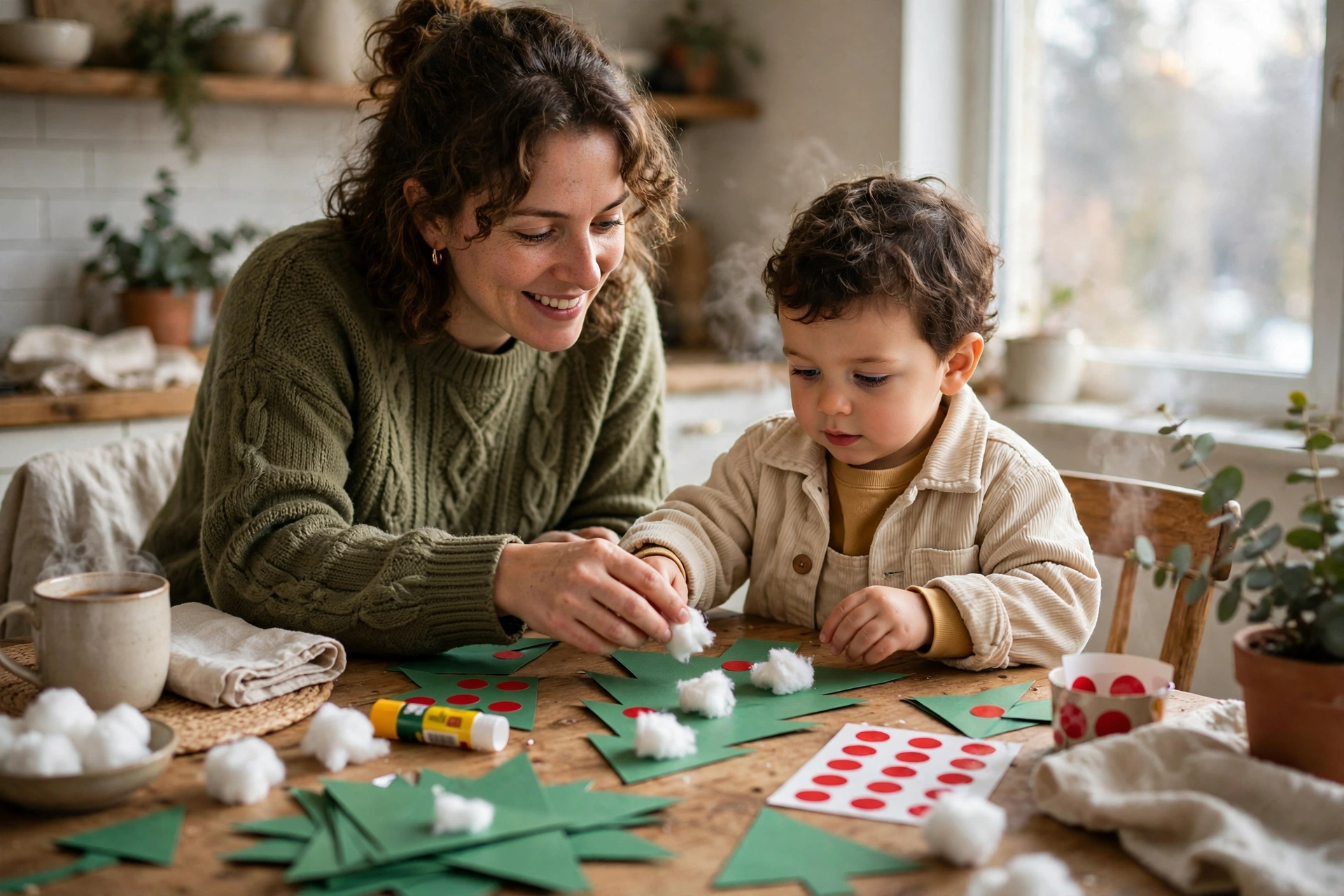
Quick answer: Start with the zero-mess crafts: sticker trees, sticker ornament cards, a felt tree, a paper chain, and torn paper trees. They need only dry supplies, one simple action each, and no cleanup at all. Move to the low-mess crafts, cotton Santas and snowmen, fingerprint lights, handprint reindeer, and sponge wreaths, when you have a damp cloth nearby. Save the one contained mess, salt dough, sealed bag painting, fork trees, pasta snowflakes, and a sealed shaker, for a tray day. One craft a day across December beats ten crafts in one afternoon, and five of these fifteen make gifts grandparents keep for years.
The no-mess test: three questions before any craft
Every craft on this page passed the same test, and you can use the test on any craft you find anywhere else, including the ones on Pinterest that look adorable and end in disaster. Ask all three questions before you set anything out. If any answer is no, adapt the craft or skip it. A craft that fails the test is not a bad craft, it is just a craft for older children, or for a day when you have help and a washable floor.
| Question | Pass looks like | Fail looks like |
|---|---|---|
| Can it be done with dry supplies, or with paint that stays sealed or in a small dish? | Stickers, cotton balls, torn paper, felt, paint in a small dish or sealed in a bag | Open paint pots on the table, loose glitter, a full bottle of glue a toddler can squeeze |
| Is every piece bigger than a toilet paper tube, with nothing small enough to swallow? | Big dot stickers, cotton balls, large pasta shapes, large bells sealed inside a bottle | Small beads, sequins, loose bells, tiny buttons, anything that fits through a toilet paper tube |
| Can cleanup be done in under two minutes with one damp cloth? | Peel the table cover, wipe once, lids on, done | Paint on the wall, glitter in the carpet, glue on the chair, a bath afterwards |
The test also explains why the crafts are sorted by mess level instead of by how pretty they look. A beautiful craft that fails question three is a craft you will do once and never again, and a toddler who only crafts once in December has missed the whole point. The point is the making, repeated often, in short happy sessions. Keep the test on your fridge for December. It takes ten seconds, and it saves every craft session you run.
The one craft box: everything you need for all 15
Buy nothing special until you have tried three crafts with what you already own. Most families own most of this box already, and the whole point of toddler Christmas crafts is that they use ordinary things, not a craft store order. One box, kept together on a shelf, means every craft on this page starts in under three minutes, because you are never hunting for supplies while a toddler waits.
| Supply | Used in | Notes |
|---|---|---|
| Paper plates, several | Santa, snowman, wreath | Plain white, the cheap kind, sturdy enough to hold glue and cotton |
| Colored card and paper: red, green, brown, yellow, dark blue | Almost every craft | Card for bases, paper for tearing and folding |
| Cotton balls, one big bag | Santa, snowman, Santa card | The single most useful craft supply for ages 2 to 5 |
| Glue stick, plus one small pot of glue | Almost every craft | Glue stick for toddlers, pot for the adult when something must hold fast |
| Washable paints: brown, red, yellow, green, blue | Handprint, fingerprints, fork tree, sponge wreath | Washable only, never anything labelled permanent or fabric paint |
| Large dot stickers, red and gold | Sticker tree, ornament cards | Big enough to peel easily, never the tiny reward-chart size |
| Tissue paper, yellow and gold, plus green | Star, tree filling | Pre-tear the squares for ages 2 to 3, let ages 4 to 5 tear their own |
| A small sponge and a clothespin | Sponge wreath | Clip the sponge in the clothespin and a toddler has a paintbrush they can grip |
| Ribbon, string, and a tray | Wreath, ornaments, contained mess | The tray is the whole secret of the contained-mess crafts: everything happens inside it |
| Table cover, a smock or old shirt, a damp cloth | Every craft | The cover goes down before anything else comes out, every single time |
Two things are deliberately missing from this box. There is no glitter, because loose glitter never leaves a house once it escapes, and there are no small beads or sequins, because they are choking hazards for under-threes and a cleanup nightmare for everyone else. If a craft you find online needs either one, it fails the no-mess test, and you now know what to do with it.
Zero-mess toddler Christmas crafts
These five need no paint, no water, and no cleanup at all. They are the crafts for tired days, for the witching hour, for the ten minutes before dinner, and for the first craft you ever do with a two-year-old. Each one asks for exactly one simple action, and each one ends with something worth putting on the fridge. Start here, every time, and only move to paint when your toddler asks for more.
1. Sticker Christmas tree
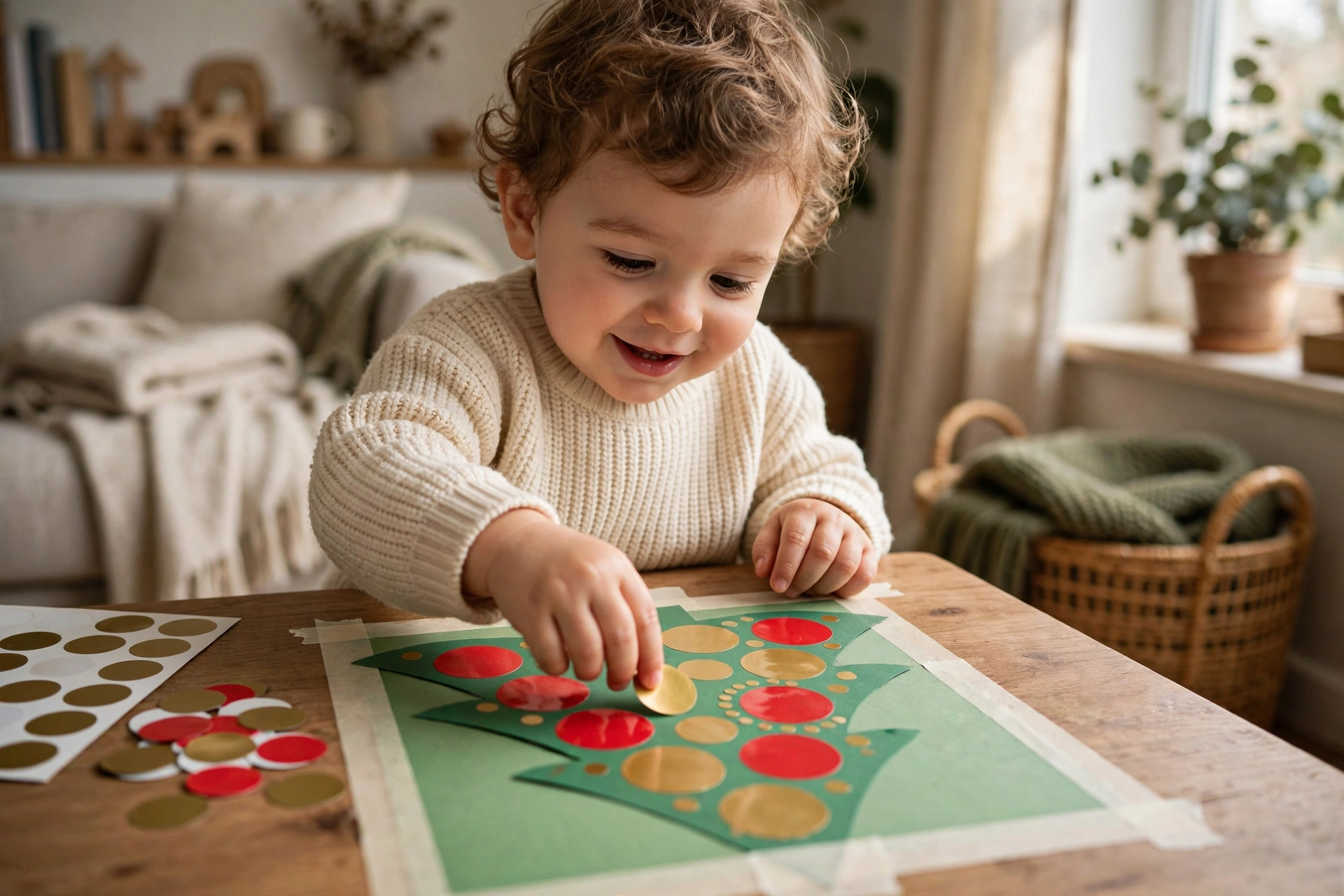
Draw a big green triangle on card, or cut one out yourself, and tape it to the table so it cannot slide. Hand your toddler a sheet of large red and gold dot stickers and say, "Decorate the tree." Peeling a sticker is a genuine skill at two, so hold the sheet flat, lift one edge with your nail to start it, and let your toddler pull and place it. If peeling defeats them today, hand over pre-peeled stickers and let placement be the job. Age 2: stickers anywhere, and that is finished. Age 3 to 4: ask for rows, or one color at a time. Age 5: let them draw the star on top and count the stickers as they go. Time: 10 minutes. Mess: zero.
2. Sticker ornament cards
Fold a sheet of card in half, draw three big round ornament outlines on the front, and give your toddler the dot stickers. Same action as the tree, different result, and this one can be posted to a grandparent, which matters to a toddler far more than any adult expects. Write the name and year on the back before you start, because you will forget afterwards, and a dated card is a keepsake while an undated one is just a card. Age 2: stickers anywhere on the circles. Age 3 to 4: one color per ornament. Age 5: let them draw the string the ornaments hang from. Time: 10 minutes. Mess: zero.
3. Felt Christmas tree on the wall
Cut a large tree shape from green felt and stick it to the wall at toddler height with painter's tape, then cut simple ornament shapes from red, gold, and blue felt. Your toddler presses the ornaments onto the tree, pulls them off, and starts again, which means this is the only craft on this page that never ends, because it can be re-decorated every day of December. It is also the best craft for a toddler who cannot sit at a table, because the whole thing happens standing up, which burns energy instead of demanding stillness. Age 2: press and pull, that is the whole craft. Age 3 to 4: sort ornaments by color first. Age 5: let them design the layout and photograph it. Time: 5 minutes to set up, then daily play. Mess: zero.
4. Paper chain countdown
Cut colored paper into strips, loop the first one into a ring, and show your toddler how to thread the next strip through it and tape the ends together. Each day of December, your toddler tears off one link, which is a small daily ceremony that builds anticipation without a single piece of chocolate. This craft pairs with our toddler Christmas countdown activities page, which gives you one simple activity per day for the same 24 days, so the chain and the activity can share the same morning moment. Age 2: tear the links, you do the looping. Age 3 to 4: help loop, you do the tape. Age 5: let them make the whole chain alone. Time: 15 minutes to make, 10 seconds a day to use. Mess: zero.
5. Torn paper strip tree
Give your toddler green paper, two shades if you have them, and let them tear it into strips and bits over a tray. Draw a big triangle outline on card, spread glue one section at a time, and let your toddler press the green pieces inside the lines, overlapping freely. A brown rectangle becomes the trunk, added by you or stuck by them at the bottom, and a yellow paper star goes on top. Tearing is real hand-strength work disguised as destruction, which is the best kind of work there is at two, and it builds the same small hand muscles our fine motor activities for toddlers at home guide works on all year. Age 2: tear and stick, you handle the glue. Age 3 to 4: let them spread the glue with a stick. Age 5: let them cut the star and trunk themselves. Time: 15 minutes. Mess: zero, apart from paper bits in the tray.
The craft box, printed before December
The No-Screen Toddler Rescue Kit sorts 115 activities by the moment you need them, including quiet crafts for rainy afternoons and calm activities for the Christmas wind-down. 89 pages, 28 printable activity cards, ages 2 to 5.
Instant download. Print it once, use it every day.
Low-mess toddler Christmas crafts
Low-mess means paint or glue appears, but in small dishes, in small amounts, and with a damp cloth already on the table. These are the heart of the page: cotton Santas and snowmen, fingerprint lights, the handprint reindeer every grandparent wants, and a sponge wreath. Do them in the middle of a session, when your toddler is warmed up and confident, never first thing, and always stop while it is still fun.
6. Cotton ball Santa
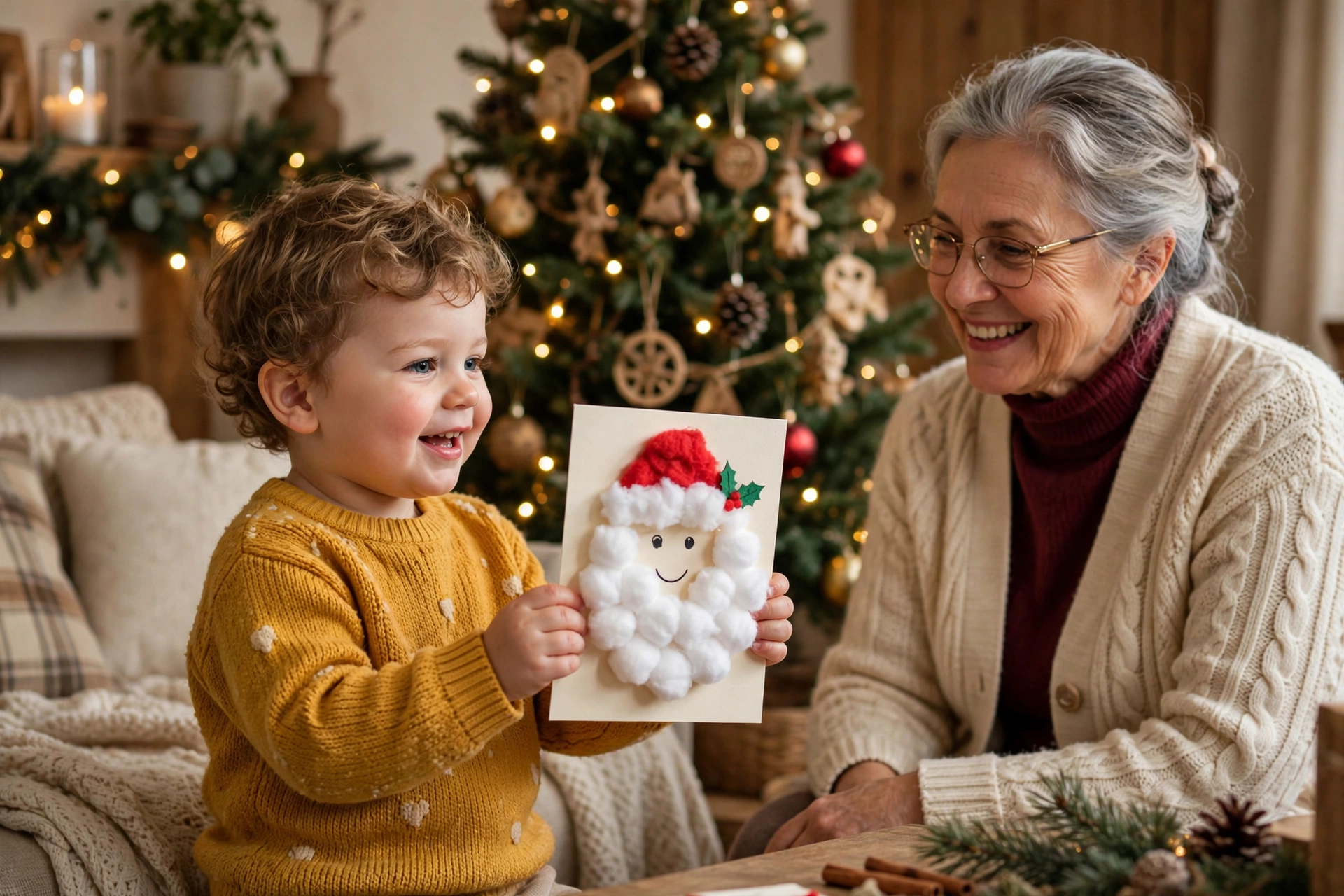
Give your toddler a paper plate, a pot of glue, and a bowl of cotton balls, and say, "Santa needs his beard. Stick, stick, stick." Let them glue cotton all around the plate's edge while you hold the plate steady, then add a red paper hat triangle on top and draw the eyes yourself. Gluing cotton is squeezing and placing practice sized down for two-year-old hands, and toddlers judge success by fluffiness, which is the correct standard. Prop Santa by the tree when he is done, because a finished craft that goes straight into a drawer teaches a toddler that making things does not matter. Age 2: you hold the plate, they glue. Age 3 to 4: let them hold the plate with one hand. Age 5: let them cut the hat triangle. Time: 15 minutes. Mess: low, cotton balls on the table.
7. Cotton ball snowman
Draw three big circles in a snowman stack on blue or dark card, and let your toddler glue cotton balls inside each circle until the snowman is plump. Flattening the cotton slightly makes it stick and covers more ground, so show them the pat once, then let them do it. You add the details a toddler cannot: a tiny orange triangle nose, two dot eyes, and stick arms drawn or glued at the sides. This is the second cotton craft on the page, and the two sit at a comfortable distance from each other on purpose, because cotton crafts reward small hands immediately, and every ball visibly changes the picture. Age 2: fill one circle and call it done. Age 3 to 4: fill all three. Age 5: add a paper hat and scarf strip. Time: 15 minutes. Mess: low.
8. Fingerprint Christmas lights card
Draw a gentle curving line across dark card yourself, the wire, and set out small dishes of washable paint in red, yellow, green, and blue. Say, "Dip one finger, dot a light on the line," and guide their fingertip from dish to line, one color at a time, wiping the finger between colors on the damp cloth. The dots wander off the line, and that is the charm. A card with nine lights is finished, whatever the plan said, so stop there and set it beside Santa in the gallery to dry. This card is also one of the five gift crafts in the gifts section below, and it is the easiest of the five to post. Age 2: one color, three dots, done. Age 3 to 4: all four colors, one finger at a time. Age 5: let them choose the pattern order. Time: 10 minutes. Mess: low, one damp cloth handles it.
9. Handprint reindeer
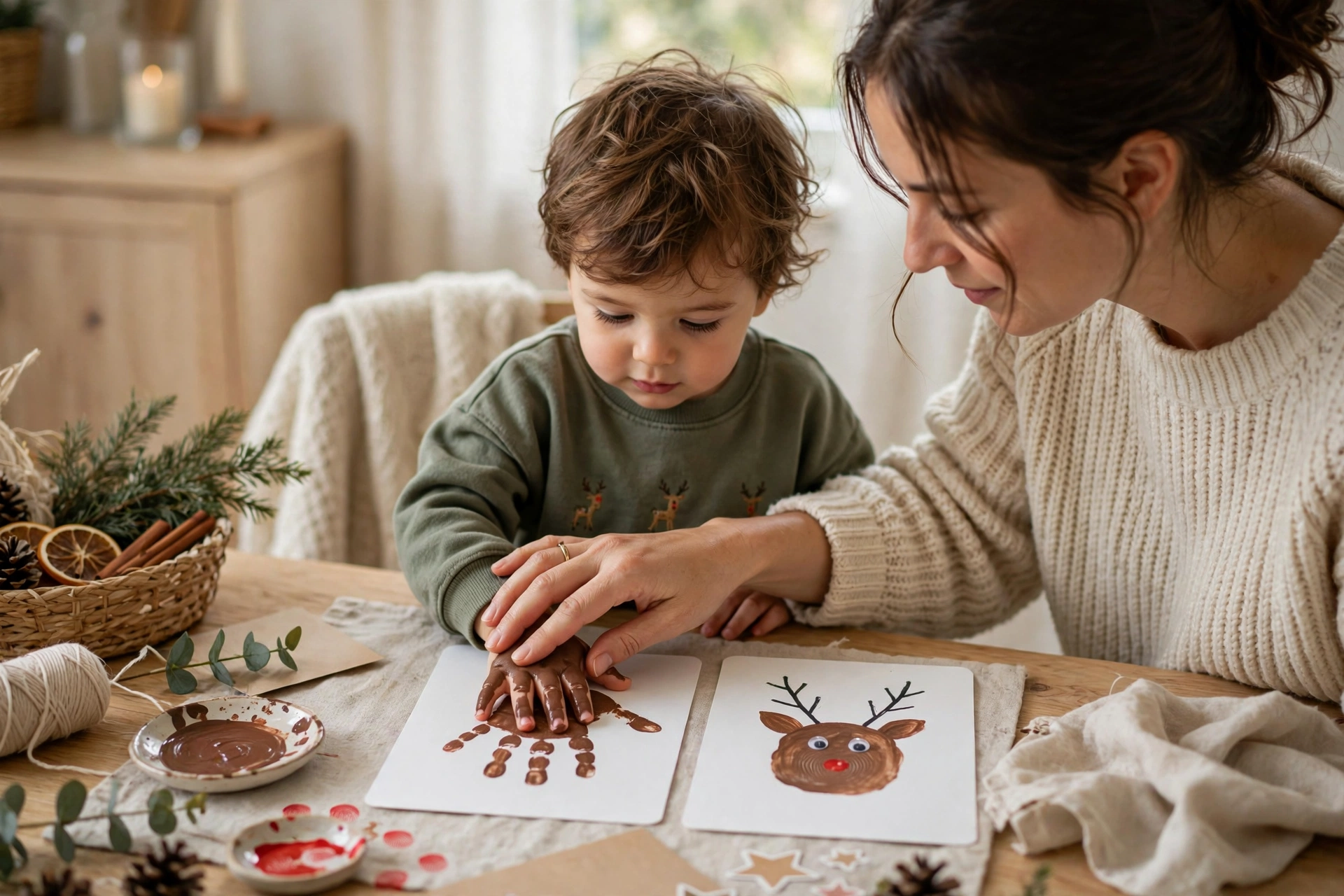
This one is paint, so it anchors the middle of a session, once your toddler is warmed up. Brush brown washable paint onto their palm and fingers yourself, because painting the hand for them keeps the dose right, and say, "Open your hand like a star, press." Guide the hand down onto card, fingers spread: fingers become antlers, the palm becomes the face. Lift straight up together and count the reveal: "One, two, three, reindeer." Let them add a red fingerprint nose with one fingertip, and you dot the eyes. Wash hands immediately after, while the print dries flat where small feet cannot step on it. Age 2: you do everything except the press. Age 3 to 4: let them choose the nose color. Age 5: let them write their name under it. Time: 10 minutes plus drying. Mess: low, one hand to wash.
10. Sponge-painted paper plate wreath
Cut the center out of a paper plate yourself, before the session, because the ring is the wreath. Clip a small sponge piece in a clothespin for a handle your toddler can grip, set out green washable paint in two shades, and say, "Dab, dab, dab, all around the circle." Let them stamp the ring green edge to edge, because overlapping shades look like foliage without any skill requirement. While it dries, they can press red fingerprint berries around the wreath with one fingertip, which is the second fingerprint moment on this page, now with practiced confidence. You tie a ribbon bow at the top when dry. Wreaths are the most giftable make here: light, flat, and proudly displayable on any door or fridge. Age 2: dab only, you add the berries. Age 3 to 4: berries too. Age 5: let them tie the bow with help. Time: 15 minutes plus drying. Mess: low.
One contained mess: the crafts worth a tray
These five crafts involve real paint, dough, or pasta, and they are worth it, but only inside a tray. The tray is the whole rule: everything happens inside it, the tray lives on the table cover, and when the craft is done, the tray goes to the sink and the table is clean. Never do these on a bare table, never do two of them in one session, and never do one when you are already tired. One contained mess per day, maximum, and only on a day when you have ten spare minutes afterwards.
11. Salt dough ornaments
Mix one cup of flour, half a cup of salt, and half a cup of water into a dough, and let your toddler press shapes, handprints, or a thumbprint into it. Cut a hole for the ribbon before baking, and the oven is adult-only, always: you bake, you take them out, and your toddler paints them once they are fully cool. Salt dough needs a full bake and dry cycle, so start these first in December, never in Christmas week. They last for years when stored dry, which is why they are the best keepsake on this page. Age 2: press a handprint, you do the rest. Age 3 to 4: press shapes with cookie cutters. Age 5: paint the finished ornament alone. Time: 10 minutes to make, plus baking and drying. Mess: contained, one tray and one bowl.
12. Ziploc bag tree painting
Place a card triangle inside a large Ziploc bag, add blobs of green and yellow washable paint, squeeze the air out, and seal the bag, taping the seal for extra safety. Your toddler squishes the paint around with their hands, decorating the tree without touching a drop of paint, which makes this the best craft on this page for a sensory-sensitive child who does not want paint on their hands. Tape the bag to the table so it cannot slide, and check the seal before every use. When the squishing is done, open the bag, lift the tree out, and let it dry flat. Age 2: squish only, you handle the bag. Age 3 to 4: let them choose the paint colors. Age 5: let them seal the bag with help. Time: 5 minutes. Mess: contained, zero if the seal holds.
13. Fork-painted evergreen tree
Give your toddler a plastic fork, green paint in a small dish, and a paper tree shape, and show them how to dip the back of the fork into the paint and press it onto the paper. The fork tines leave a pine needle texture that a brush cannot make, and the action builds fine motor strength in a way that feels like stamping, not like work. Keep the paint in the dish, never in an open pot, and keep one damp cloth beside it, because fork painting is the craft most likely to travel to a sleeve. Age 2: you hold the paper, they stamp. Age 3 to 4: let them hold the paper with one hand. Age 5: let them add a brown trunk and a star. Time: 10 minutes. Mess: contained, one dish and one cloth.
14. Pasta snowflakes
Set out large pasta shapes, bow ties and wheels work best, with glue and paper, and let your toddler arrange the pasta into snowflake patterns. Once the glue is dry, they can paint the snowflakes white and add a little sparkle with white paint dots, never loose glitter. Large pasta only, because small pasta is a choking hazard for under-threes, and the pieces must all be bigger than a toilet paper tube. This craft is slow and absorbing, which makes it the best one on this page for a quiet afternoon when you need thirty calm minutes. Age 2: place three pieces and call it done. Age 3 to 4: build a full snowflake. Age 5: let them paint it alone. Time: 15 minutes plus drying. Mess: contained, pasta in the tray.
15. Sealed jingle bell shaker
This craft is sound first and needs your closest supervision, because bells are small parts. Put two or three large bells inside a clear, sturdy plastic bottle yourself, add a handful of dry rice for extra sound, screw the lid on tight, and seal it with strong tape around the lid edge yourself. Only then hand it over and dance together for a full song. The bottle lives in the music basket afterwards and never gets opened by little hands, and you check the seal before every use. Any shaker whose lid loosens is retired on the spot. Age 2: shake and dance, that is the whole craft. Age 3 to 4: let them choose the rice or the bells. Age 5: let them decorate the outside with stickers. Time: 5 minutes to make, then daily play. Mess: contained, zero once sealed.
When the crafts are done, the day still needs a plan
The No-Screen Toddler Rescue Kit sorts 115 activities by the moment you need them, so the hours after craft time are covered too: quiet play, busy play, and wind-down ideas for the whole Christmas season. 89 pages, 28 printable activity cards, ages 2 to 5.
Instant download. Print it once, use it every day.
Crafts that become Christmas gifts
Five of the crafts on this page make gifts grandparents genuinely keep, and the rest do not, so do not try to gift them all. The rule is simple: a gift craft must be flat or hangable, dry in a day, and sturdy enough to survive the post. A paper chain is wonderful at home and useless in an envelope, and a shaker is a toy, not a gift. Make the gift set in mid-December, post it by December 15, and make a second set for yourself, because the first set always leaves the house and you will want one on your own fridge.
| Gift craft | Who it is for | How to finish it |
|---|---|---|
| Handprint reindeer card | Grandparents, godparents | Folded card, name and year on the back, flat in an envelope |
| Fingerprint Christmas lights card | Anyone who loves post | Dark card, nine lights, name and year on the back |
| Salt dough ornament | Grandparents with a tree | Fully dry, sealed with varnish, ribbon through the hole, tissue in a small box |
| Cotton ball Santa card | Grandparents, aunts, uncles | Flat card, name and year on the back, the fluffier the better |
| Sponge-painted wreath | Anyone with a door or a fridge | Ribbon bow on top, flat in a large envelope with card backing |
Presentation elevates everything, and it costs nothing. Nestle each ornament in tissue in a small box, add a handwritten tag with the child's name and year, and include a note about the making, one sentence about what your toddler did. Grandparents consistently rank these as their favorite gifts, and the reason is simple: a bought gift says you spent money, and a made gift says a small person spent an afternoon thinking of them. If you want more giftable ideas, our toddler Christmas countdown activities page ends with a calm Christmas Eve, and the morning after is covered by our toddler Christmas morning survival timeline, so the gifts arrive into a day that is already planned.
The December plan: which crafts when
Crafts work best spread across December, one a day, not crammed into a single weekend. The plan below follows the drying times: salt dough first because it needs days, gift crafts in mid-December so the post arrives in time, and quick crafts in Christmas week when energy is high and patience is low. If you start late, skip the salt dough and start at the middle of the plan, because a late start with the quick crafts still gives you a full December of making.
| When | Do these | Why now |
|---|---|---|
| Early December, December 1 to 7 | Salt dough ornaments, paper chain countdown, felt tree on the wall | Salt dough needs drying time, and the chain and tree set up the whole month |
| Mid-December, December 8 to 15 | Gift crafts: handprint reindeer, fingerprint lights, cotton Santa card, sponge wreath | Gifts posted by December 15 arrive before Christmas, and making them now avoids the rush |
| Late December, December 16 to 23 | Quick crafts: sticker tree, sticker cards, cotton snowman, fork tree, pasta snowflakes | Energy is high and patience is low, so short crafts with fast results win |
| Christmas Eve | One calm craft only: sticker tree or torn paper tree | Christmas Eve is for landing softly, not for starting something new |
115 activities for the whole winter, not just craft day
The No-Screen Toddler Rescue Kit sorts 115 activities by the moment you need them, including indoor play for cold days, quiet activities for early mornings, and calm wind-downs for the long December evenings. 89 pages, 28 printable activity cards, ages 2 to 5.
Instant download. Print it once, use it every day.
Safety rules that never bend
Every craft on this page follows these rules, and they do not bend for a cute idea or a busy day. They are short, they are simple, and they are the reason you can run every craft here without worrying.
Washable and non-toxic only. Every paint, glue, and marker on this page must say washable and non-toxic on the label. Never use anything labelled permanent, fabric, or acrylic with a toddler, because it does not wash out of clothes, skin, or tables.
Nothing smaller than a toilet paper tube for under-threes. If a piece fits through a toilet paper tube, it can block a small airway, so it stays out of the craft box entirely for ages 2 to 3. Large pasta, large stickers, large bells sealed in a bottle, cotton balls, all fine. Small beads, sequins, tiny buttons, loose bells, all out.
No loose glitter, ever. Glitter is the one supply this page bans outright, because it never leaves a house once it escapes, and it ends up in eyes, mouths, and carpets for months. White paint dots give you the same sparkle without the cleanup.
Bells only sealed, oven only adult. Bells go inside a sealed, taped bottle and never into little hands loose. Salt dough goes into the oven only with an adult, and your toddler paints the ornaments only once they are fully cool.
An adult stays at the table. Every craft on this page assumes an adult is sitting there, watching, with a damp cloth in reach. Toddlers under three should be supervised with all craft supplies, even the dry ones, because the risk is not the supply, it is the speed at which a small piece can go into a mouth.
When the craft goes wrong
Most craft sessions go wrong in one of four ways, and all four are normal, fixable, and no reason to stop crafting. The mistake is not the mess or the wandering attention, it is expecting a toddler to behave like a small adult with a Pinterest board.
Your toddler loses interest after two minutes. That is a full session at two, not a failure. Put the craft away without a comment and try again another day, with a different kind of action, because a toddler who hates gluing may love stamping. Our no prep toddler activities page is the backup for days when no craft will hold them at all.
Paint ends up on the wall. That is why the paint lives in small dishes and the table cover goes down first. Washable paint comes off a wall with a damp cloth, and the table cover rule means it rarely gets there at all. If it keeps happening, switch to the zero-mess crafts for a week and try paint again later.
The craft looks nothing like the picture. Good. That is the whole point of process art: the value is in the making, not in matching a model. The National Association for the Education of Young Children explains this clearly in its guide to supporting the development of creativity, where process art experiences build fine motor skills, language, and self-regulation precisely because there is no right way to do them and no model to fail against. A lopsided reindeer your toddler made is worth more than a perfect one you made for them.
Two children fight over the supplies. Give each child their own bowl of cotton balls, their own sticker sheet, and their own card, and run the paint crafts one child at a time at a single supervised spot. Shared supplies cause fights, and duplicate supplies prevent them, which is cheaper than the argument.
Frequently asked questions
What Christmas crafts can a 2-year-old actually do?
A 2-year-old can glue cotton balls, tear and stick paper, stamp fingerprints, place large stickers, and press a painted handprint with help. The pattern is always the same: an adult prepares the shapes and does any cutting, and the toddler does the sticking, stamping, and pressing, the parts that feel like real making. Start with the zero-mess crafts on this page, because they ask for exactly one simple action each.
What supplies do I need for toddler Christmas crafts?
One small box covers all 15 crafts on this page: paper plates, colored card and paper in red, green, brown, and yellow, cotton balls, a glue stick, washable paints, large dot stickers, tissue paper, a small sponge, ribbon, and a tray. Everything should be washable and non-toxic. Buy nothing special until you have tried three crafts with what you already own, because most families own most of this box already.
How do I keep Christmas crafts mess-free?
Run every craft through the no-mess test before you start: dry supplies or sealed paint only, nothing smaller than a toilet paper tube for under-threes, and cleanup under two minutes with one damp cloth. Cover the table, set out only one craft at a time, and keep the paint in small dishes, never in open pots. If a craft fails the test, adapt it or skip it, because a craft that ends in a bath is a craft nobody wants to repeat.
How long should a toddler craft session last?
Fifteen to 30 minutes is plenty for most 2- and 3-year-olds, and 20 to 40 minutes for ages 4 to 5. Stop while it is still fun, even mid-craft, because a session that ends happy gets repeated tomorrow and a session that ends in tears does not. One craft a day across December beats ten crafts in one overwhelmed afternoon.
Can toddler Christmas crafts be Christmas gifts?
Yes, five of the crafts on this page make gifts grandparents genuinely keep: the handprint reindeer card, the fingerprint lights card, the salt dough ornament, the cotton ball Santa card, and the sponge-painted wreath. Write the name and year on the back, post them by December 15, and make a second set for yourself, because the first set always leaves the house and you will want one on your own fridge.
Are Christmas crafts safe for a 2-year-old?
Yes, when the supplies are washable and non-toxic, every piece is bigger than a toilet paper tube, and an adult stays at the table. Loose glitter is the one thing to skip entirely, it never leaves the house once it escapes. Bells go only inside a sealed, taped bottle, and the oven is adult-only for salt dough. If a craft needs something small or sharp, the adult does that part and the toddler does the making part.
What if my toddler loses interest after two minutes?
That is normal at this age, not a failure. A 2-year-old who walks away after two minutes has still glued, torn, or stamped something, and that was the point. Put the craft away without a comment, try again another day, and try a different kind of action next time, because a toddler who hates gluing may love stamping. Never force a craft to finish, because forced crafts teach a toddler that making things is a chore.
Sources and further reading
The one-action-per-craft idea, and the session order of glue first and paint in the middle, is also covered in a ten-make list of easy Christmas crafts for toddlers that runs the same confidence-first arc for ages 2 to 3, and the process-over-product reasoning behind letting a toddler's reindeer look lopsided follows the National Association for the Education of Young Children's guide to supporting creativity, linked above. This page adds what neither gives you: the no-mess test, the mess-level system with fifteen crafts, the December plan, the gift crafts, and the age 2 to 5 tweaks on every single craft.