
Activities for 4 Year Olds at Home: 20 Ideas That Build Preschool Readiness
Updated October 26, 2026
Age 4 is the year everything starts to click. Your child tells longer stories, plays games with actual rules, recognises their name in print, and asks what every sign says. Preschool or kindergarten is suddenly close enough to think about, and every other parent seems to be asking whether their child is ready. This page answers that worry the useful way: 20 activities for 4 year olds at home, each one matched to a real preschool readiness skill, plus a checklist that turns the whole thing into a plan instead of a panic.
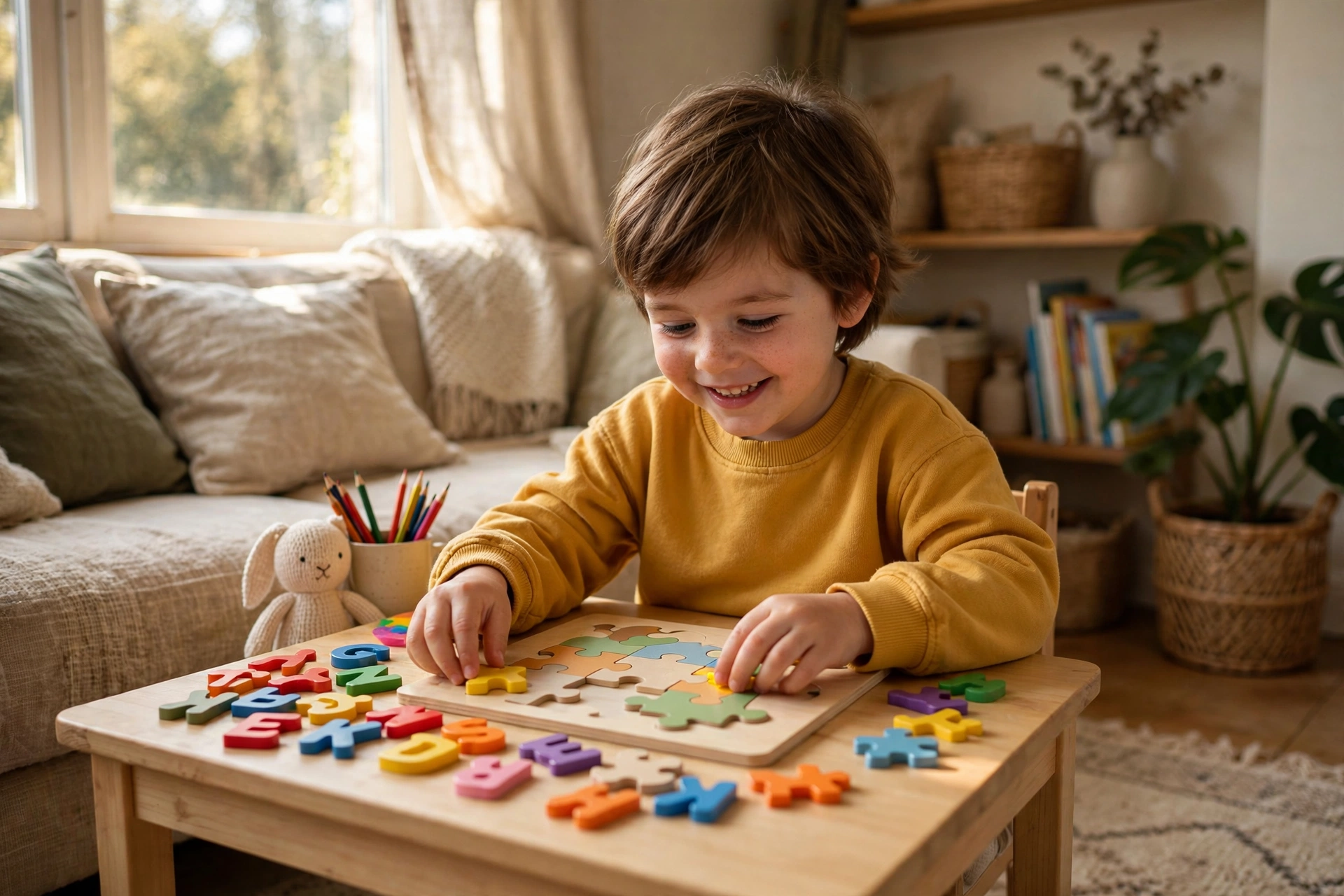
Quick answer: At 4, readiness is built through play, not lessons. The five areas that matter are early letters and sounds, numbers to 20, pencil and scissor control, listening and following directions, and turn-taking with other children. Every activity below builds one of those areas, in 10 to 20 minute blocks, at home, with things you already own.
What 4 year olds can do now that 3 year olds could not
At 3, the jump was imagination and simple rules. At 4, the jump is structure: longer stories, real rules, and early academic skills that stick because they arrive inside play. If your child just turned 4, our activities for 3 year olds at home guide shows where these skills began.
- Talk in full stories: Retelling a day, a book, or a pretend adventure in order, with a beginning, a middle, and an end.
- Recognise print: Their own name, some capital letters, and a few letter sounds. Reading readiness, not reading itself.
- Count to 10 and beyond: Counting real objects accurately, and many 4 year olds reaching toward 20.
- Play with rules: Board games, Simon Says, and turn-taking games where losing does not end the world, most of the time.
- Hold a pencil and scissors properly: A proper grip is emerging, and 10 to 12 piece puzzles are now doable.
- Cooperate: Building something together, playing a role in a group game, and waiting for a turn with reminders.
- Manage self-help: Bathroom alone, coat and zippers with effort, opening lunch containers, and tidying up after play.
The readiness checklist, turned into activities
Checklists alone only tell you what to worry about. This table turns each readiness skill into the activity on this page that builds it, so you can check progress by playing, not by testing.
| Readiness skill | What it looks like at 4 | Activity that builds it |
|---|---|---|
| Early letters | Recognises own name, some letters and sounds | Name hunt, letter treasure hunt, rhyming toss |
| Numbers | Counts to 10, learning toward 20 | Sticker numbers, pattern path, measuring jumps |
| Fine motor | Pencil grip, scissors, 10 to 12 piece puzzles | Tracing, tweezer transfer, cutting shapes |
| Listening | Follows 2 step directions in order | Simon Says, board games, pretend school |
| Social play | Takes turns, plays cooperatively | Group games, block city together, role play |
| Self-help | Bathroom, coat, lunch containers alone | Coat zip race, lunch box practice, tidy routine |
The day plan: one day at home with a 4 year old
Blocks run a little longer at 4 than at 3, because focus stretches. The shape stays the same, so the day feels familiar.
| Block | When | What happens |
|---|---|---|
| Morning movement | After breakfast | Big energy first: obstacle games, skipping, ball play. A 4 year old who moved in the morning listens better later. |
| Midday learning play | Late morning | One letters activity and one numbers activity, each 10 to 20 minutes. This is the sharpest thinking time. |
| Quiet time | After lunch | Books, puzzles, or drawing. Many 4 year olds have dropped the nap, and quiet time protects the afternoon instead. |
| Afternoon creative | Mid afternoon | Crafts, pretend play, or kitchen helping. Messy is fine here, because the day is nearly done. |
| Evening wind-down | Before bed | Story retelling, a calm game, and a slow finish. No new exciting activity in the last hour. |
Want readiness without worksheets?
The No-Screen Toddler Rescue Kit has 115 print-and-go activities sorted by the exact moments parents struggle with, including the preschool year. 89 pages, 28 printable activity cards, made for ages 2 to 5.
Instant download. Print it once, use it every day.
Early letters and sounds
At 4, letters stop being decorations and start being a code your child wants to crack. Keep it playful and short, and let stories do the heavy lifting.
1. Name hunt
Write your child's name on cards and hide them around the room. Each time they find one, they say the letters. Then try the names of family members. Recognising their own name in print is the first reading milestone, and hunting for it is far more fun than tracing it.
2. Letter treasure hunt
Pick one letter a week and hunt for it on packets, books, and signs around the house. Say its sound every time you find it, and stick a star on a chart for each find. One letter a week, learned in the real world, beats a whole alphabet song learned by rote.
3. Rhyming bean bag toss
Toss a bean bag and say a word. Whoever catches it must say a rhyming word before tossing it back. Cat, hat, bat. Rhyming is one of the strongest early predictors of reading success, and this game builds it without a single worksheet.
4. Story retelling
Read a short picture book, then ask your child to retell it with the pictures as prompts. What happened first, what happened next, how did it end? Retelling in order builds memory, sequencing, and sentence length all at once. Let them change the ending sometimes. That is creativity, not cheating.
5. Sound matching
Put out three objects and ask which one starts with the same sound as another: sun, sock, apple. Beginning sounds are the skill behind phonics, and this game teaches it with toys from around the house.
Numbers to 20, through play
At 4, maths works best when it is built into play. Counting cups, repeating patterns, and comparing things all give a child maths language without a worksheet in sight.
6. Sticker numbers
Write the numerals 1 to 10 down one side of a sheet of paper. Your child sticks the matching number of stickers beside each numeral. If they only recognise 1 to 5 so far, tell them the number for 6 to 10 and let them count out the stickers. This teaches one-to-one correspondence, the real foundation of counting.
7. Pattern path
Lay out blocks or paper squares in a repeating pattern: red, blue, red, blue. Ask your child what comes next, then let them build their own pattern for you to finish. Patterns are early algebra in disguise, and 4 year olds love catching you out.
8. Measuring jumps
Put tape marks on the floor and jump a toy from each mark, seeing how far it lands. Then measure with hand spans or blocks: how many blocks long was that jump? Comparing distance with words like longer, shorter, and further builds measurement language naturally.
9. Balance basket scale
Hang two small baskets from a coat hanger and let your child add objects to each side, watching it tilt. Which side is heavier? How many spoons balance one toy car? Weight and comparison, learned by hand.
10. Card concentration
Take 10 to 15 pairs of playing cards, numerals 2 to 10 in red and black, and lay them face down. Turn over two at a time to find matching numbers. Say the numbers out loud as matches are made. Memory plus number recognition, in a game adults enjoy too.
Readiness hidden inside play
The Rescue Kit builds letters, numbers, and patience the way 4 year olds actually learn: inside games, stories, and pretend play. 115 activities, 28 printable cards, ages 2 to 5.
Instant download. Print it once, use it every day.
Pencil and scissor skills
Fine motor control is the skill teachers notice first, because it shows up in every classroom task. Build it through play, not drills.
11. Tracing lines and shapes
Draw thick lines, zigzags, and simple shapes, and let your child trace over them with a short, thick crayon. Short crayons force a better grip than long ones. Keep it to a few minutes and stop while it is still fun.
12. Tweezer transfer
Give your child tweezers and a bowl of large beads, dried pasta, or pom-poms to move from one bowl to another. It takes real concentration and finger precision, and children find it deeply satisfying. Use large pieces only, and sit beside them.
13. Cutting shapes
Move past straight lines now: cut out circles, triangles, and squares drawn thick on paper, then glue them into a picture. Cutting curves is the next step after straight lines, and it is exactly the scissor skill preschool expects.
14. Threading small beads
At 4, beads can get smaller: pony beads on a shoelace, or a simple pattern to copy, like red, blue, red, blue. Threading plus patterning in one activity. Keep small beads away from younger siblings.
Listening, instructions, and group games
Following directions and waiting for a turn are classroom skills, and they are learned fastest in games where the rules are fun.
15. Simon Says
The classic, with a 4 year old twist: give two instructions in a row ("Simon says touch your head, then clap twice"). Two step directions in sequence are a kindergarten readiness item, and this game practises them without feeling like practice.
16. Simple board games
Snakes and Ladders, or any game with a spinner and counters, teaches more than it looks like: counting spaces, waiting for a turn, and losing without falling apart. Play cooperatively at first if losing is still too hard, then add gentle competition.
17. Pretend school
Let your child be the teacher: lining up stuffed animals, reading them a story, teaching them a song. Playing teacher is how 4 year olds rehearse classroom life, and it shows you exactly what they already understand about school routines.
Longer independent play
At 4, independent play stretches to 15 to 30 minutes on the right setup. The method is the same as at 3, with bigger challenges: start together, then leave one clear task.
18. Block city together, then alone
Build the first street together, then ask your child to build the rest of the city while you sit nearby. Add a challenge: a bridge, a garage, a tower taller than the last one. Block cities hold attention because they grow, and growing things are hard to walk away from. For the full method, our independent play activities for toddlers guide goes deeper.
19. Puzzles and quiet setups
A 10 to 12 piece puzzle, a magnetic tile house, or a pretend shop setup are the solo activities that hold longest at 4. Set out one invitation at a time, not the whole toy box. One clear setup beats a room full of choices, at every age.
Self-help practice, disguised as games
Teachers consistently say the most useful readiness skills are practical ones. Practise them as races and challenges, not chores.
20. Coat zip race and lunch box practice
Time how fast your child can zip their coat, then try to beat yesterday's time. Practise opening and closing their actual lunch containers and water bottle before school starts. A child who can manage their own lunch and coat walks into preschool confident, and that confidence carries into everything else. Our quiet activities for toddlers guide has calm setups for the days when practice needs to slow down.
One kit for the preschool year
Letters, numbers, patience, and independence: the Rescue Kit sorts 115 activities by the moment you need them, so readiness builds a little every day without a single worksheet. 89 pages, 28 printable cards, ages 2 to 5.
Instant download. Print it once, use it every day.
Frequently asked questions
How is age 4 different from age 3 for play?
At 4, children hold longer stories in their heads, play cooperatively with rules, recognise their name and some letters, count to 10 and beyond, and manage 10 to 12 piece puzzles. At 3, play is mostly parallel and sensory. The jump at 4 is rules, roles, and early academic skills inside play.
Does my 4 year old need to read before kindergarten?
No. Kindergarten expects early reading readiness, not reading: recognising their name, knowing some letter sounds, enjoying books, and understanding that print runs left to right. Reading aloud daily and playing rhyming games builds all of that without any pressure.
How high should a 4 year old count?
Most 4 year olds count to 10 reliably and many are learning to 20, especially when counting real objects they can touch. Counting accurately matters more than counting high. Count snacks, steps, toys, and stairs every day, and the numbers will grow on their own.
What if my 4 year old cannot hold a pencil properly yet?
That is normal and fixable through play, not drills. Threading beads, tweezer games, playdough, and cutting all build the same hand muscles. Use short, thick crayons, keep sessions to a few minutes, and let them draw freely. Grip usually matures across the 4 year old year.
How long can a 4 year old play independently?
Many 4 year olds manage 15 to 30 minutes of independent play on a setup they chose, longer than at 3. Build it the same way: start together, leave one clear challenge, and stay nearby at first. Puzzles, block cities, and pretend school setups are the ones that hold longest.
What if my 4 year old is not interested in letters?
Do not push worksheets. Hide letters inside play instead: their name on their cup, a letter hunt around the house, rhyming songs, and stories they love. Interest in letters usually follows interest in stories, and it often arrives suddenly after months of seeming indifference.
Is my child ready for preschool or kindergarten?
Readiness is a mix, not a test score: separating happily, following 2 step directions, taking turns, recognising their name, counting to 10, holding scissors and crayons, and managing bathroom and coat routines. If most of those are emerging, your child is on track. Talk to their teacher or paediatrician about any specific worry.
Sources and further reading
American Academy of Pediatrics (HealthyChildren.org) guidance on kindergarten readiness and preschool development. CDC milestone checklists for age 4: language, movement, and social development.
If your child just turned 4, start with our activities for 3 year olds at home to see how these skills began. When the day is mostly indoors, our indoor toddler activities guide covers big movement. And for shorter windows, our 15 minute toddler activities guide fits the gaps between everything else.