Activities for 3 Year Olds at Home: 20 Ideas for Longer, Happier Play
Updated October 25, 2026
Something changes around age 3. Your toddler starts telling stories to their stuffed animals, asks why about everything, and can suddenly follow two instructions in a row. The activities that worked at age 2 start to feel too easy, but the activities made for older preschoolers are still too hard. This page is built for exactly that gap: 20 activities for 3 year olds at home, matched to what a 3 year old can actually do, grouped by the kind of play, with a simple day plan so you never have to invent the day from scratch.
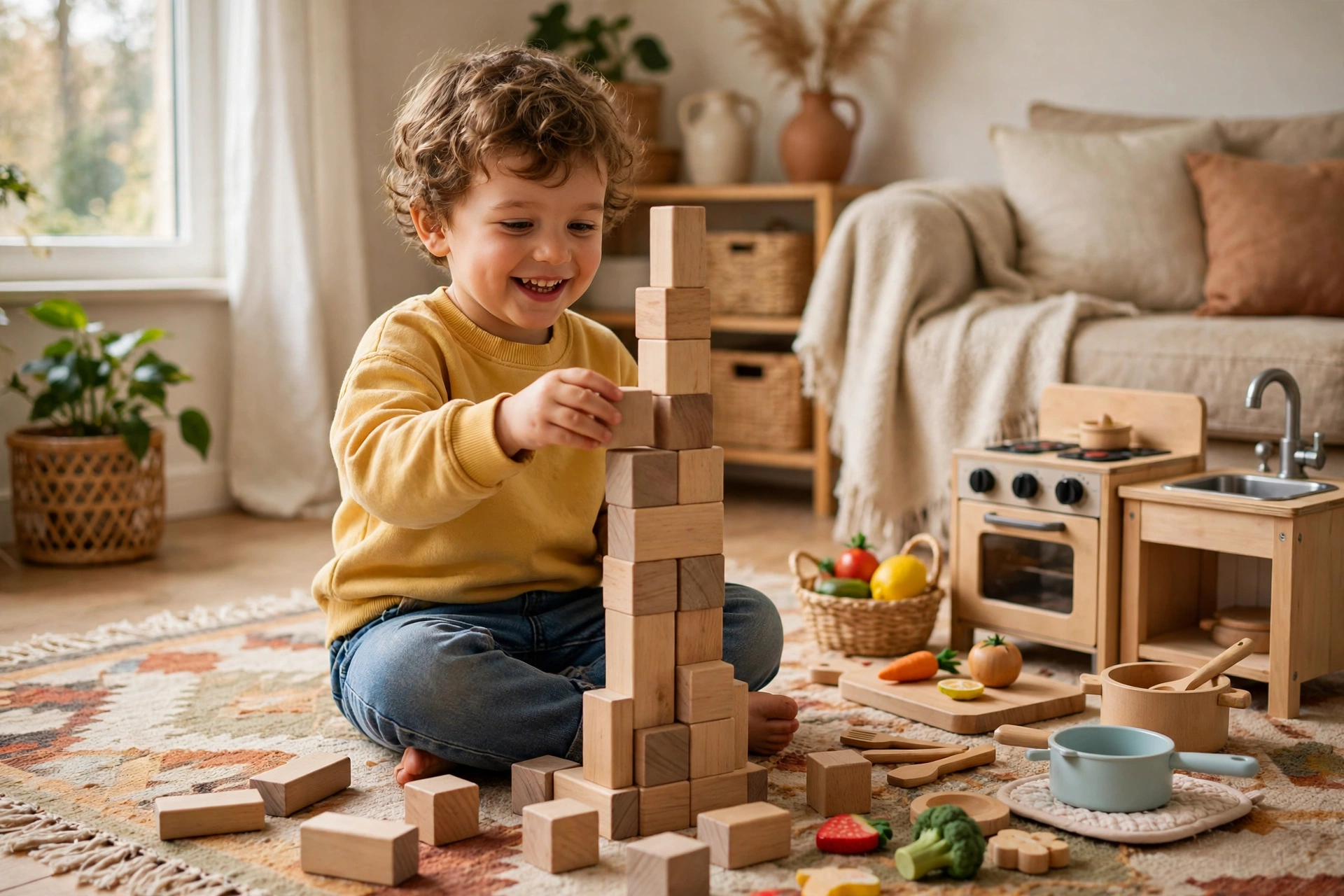
Quick answer: At 3, play in 10 to 20 minute blocks, and lean into the three new powers: pretend play, sorting and counting, and simple rules. Start each activity together, then leave one tiny challenge so your child can finish alone. Mix big movement, pretend play, something creative, and something calm across the day, and the day mostly runs itself.
What 3 year olds can do now that 2 year olds could not
This is the key to the whole page. Most lists for 3 year olds are just lists for toddlers with a different title. These are the real new skills at age 3, and every activity below is built on one of them.
- Follow 2 to 3 step instructions: "Get the red cars, park them in a line, and count them." A 2 year old manages one step. A 3 year old can hold a short chain.
- Sort and match: By colour, by shape, by size. Sorting is the quiet superpower of age 3, and it turns tidying into a game.
- Count small sets: Most 3 year olds count to 5 reliably and are learning to 10, especially when counting real objects they can touch.
- Pretend with roles: Not just holding a toy phone, but being the shopkeeper, the doctor, or the teacher, and staying in the role for several minutes.
- Use safety scissors with help: Snipping playdough and paper, with an adult beside them. Cutting is a brand new fine motor skill at this age.
- Simple turn-taking: Two turns each, with a clear marker for whose turn it is. Sharing is still hard, but the idea of turns is now learnable.
- Draw with meaning: A person becomes a head with legs, a house gets a door. Drawing stops being scribble and starts being a story.
If an activity on this page feels too easy or too hard, check it against this list. The right difficulty is one step past what your child already does comfortably. For the age 2 version of this stage, our independent activities for 2 year olds guide shows where these skills began.
The day plan: one day at home with a 3 year old
Here is a shape for a full day at home. Move blocks around freely. The shape matters more than the clock.
| Block | When | What happens |
|---|---|---|
| Morning movement | After breakfast | Big energy first: obstacle course, dance game, or indoor bowling. Tired bodies focus better afterwards. |
| Midday learning play | Late morning | One sorting or counting game, plus one pretend play setup. This is the sharpest thinking time of the day. |
| Quiet time | After lunch | Books, puzzles, or colouring. Not a test, just calm. Many 3 year olds still nap, and quiet time protects the afternoon either way. |
| Afternoon creative | Mid afternoon | Crafts, playdough, or kitchen helping. Messy is fine here, because the day is nearly done. |
| Evening wind-down | Before bed | Stuffed animal picnic, story, and a slow finish. No new exciting activity in the last hour. |
Want the whole week planned?
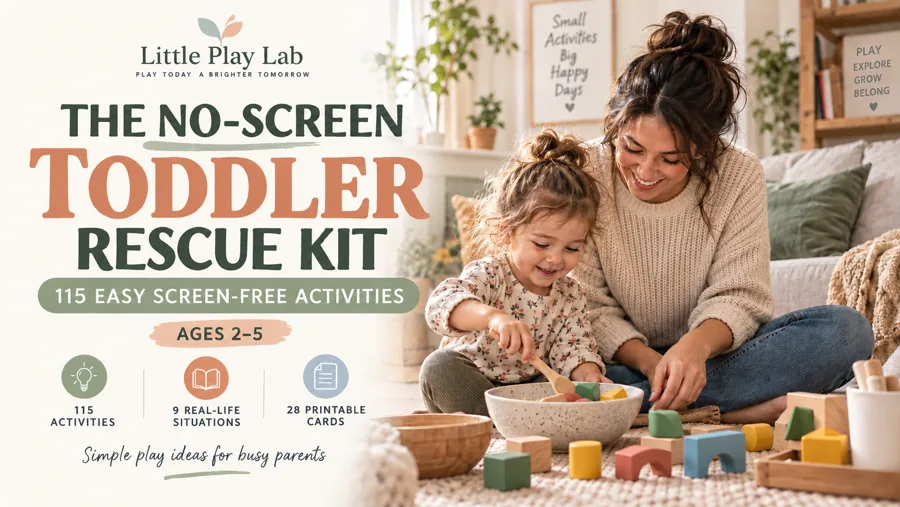
The No-Screen Toddler Rescue Kit has 115 print-and-go activities sorted by the exact moments parents struggle with, including long days at home with a 3 year old. 89 pages, 28 printable activity cards, made for ages 2 to 5.
Instant download. Print it once, use it every day.
Pretend play: the heart of age 3
Pretend play is where 3 year olds grow fastest: language, empathy, memory, and patience all get practised inside a game. Give them props and a role, then step back a little.
1. Play cafe
Turn a table into a cafe. Your child takes orders, cooks pretend meals, and serves guests, who can be you or stuffed animals. Write the menu together with pictures, so your child can point at what the customer wants. This one game practises speaking, listening, counting, and waiting, all at once.
2. Grocery store with real packets
Save empty cereal boxes and food packets, add paper money made from scrap paper, and set up a shop on a low shelf. Your child stocks the shelves, you shop, and they count out the money. It is the single best early maths game in this guide, and it costs nothing.
3. Dress-up and roles
A box of old clothes, hats, and bags becomes a doctor kit, a teacher, or a firefighter. At 3, children stay in a role for several minutes and start inventing what happens next. Ask questions inside the role ("Doctor, what is wrong with teddy?") instead of directing the story, and the language flows.
4. Stuffed animal school
Line up the stuffed animals and let your child be the teacher: reading them a story, teaching them a song, putting them to nap. Teaching a toy is how 3 year olds practise everything they are learning, and it is often the first time you hear what they actually remember from books.
Learning through play: counting, colours, and letters
No worksheets needed. At 3, learning hides inside games, and the game must come first.
5. Count as you tidy
Count blocks as they go back in the box, count socks as they come out of the laundry, count steps to the kitchen. Counting real things, in real moments, is how numbers become meaningful. Aim for counting to 5 first, then stretch to 10 when 5 feels easy.
6. Sort by colour, shape, and size
Put out a pile of mixed toys and three bowls, and ask your child to sort by colour, then try again by shape. Sorting by two rules in a row is a genuine thinking challenge at 3. Use toys you already own: cars, blocks, socks, and buttons all work.
7. Alphabet treasure hunt
Pick one letter, like the first letter of your child's name, and hunt for it on packets, books, and signs around the house. Point it out, say its sound, and let your child stick a star on everything they find. One letter a week is plenty. The goal is recognising letters in the real world, not reciting the alphabet.
8. Number hopscotch indoors
Tape paper numbers to the floor in a line and call out a number for your child to jump to. It mixes counting, number recognition, and big movement, which is exactly the combination 3 year olds learn best from. Keep it to numbers 1 to 5 at first.
9. Matching and memory games
Start with 4 pairs of picture cards face up, match them together, then try a few face down. Memory games build concentration fast at this age. Keep the set small: 4 pairs is a win, 10 pairs is a frustration.
Learning disguised as play
The Rescue Kit is built the way 3 year olds actually learn: counting hidden in tidying games, letters hidden in treasure hunts, patience hidden in turn-taking. 115 activities, 28 printable cards, ages 2 to 5.
Instant download. Print it once, use it every day.
Fine motor and crafts: hands getting clever
At 3, hands can do careful work for short bursts. These activities build the hand strength that writing will need later, without any writing practice.
10. Playdough with a job
Plain playdough gets boring. Give it a job: roll snakes, cut them with safety scissors, poke holes with a straw, or press in buttons to make faces. Cutting playdough is the perfect first scissor skill, because there is no paper to hold straight.
11. Threading beads and pasta
Large beads on a shoelace, or penne pasta on a piece of string, make a necklace. Threading builds the exact finger control that pencils will need. Use big beads only, and sit beside your child, because small beads are a choking hazard.
12. Cutting along thick lines
Draw thick, straight lines on paper and let your child cut along them with safety scissors. Then try zigzags, then simple shapes. Hold the paper steady at first and keep sessions to five minutes. Scissor skill grows week by week, not day by day.
13. Sticker scenes
Give your child a paper background and a sheet of stickers: animals for a farm scene, stars for a night sky. Peeling stickers builds pincer grip, and placing them with a plan in mind is early storytelling. This is a perfect quiet time activity.
14. Draw a person, draw a house
Ask your child to draw their family, or their house, and then ask them to tell you about it. Do not correct the drawing. A head with legs is a person at 3, and the story they tell about it matters more than how it looks. Keep paper and crayons always within reach, because drawing bursts happen without warning.
Big movement indoors
Three year olds need to move, and bad weather does not cancel that need. These games burn energy without breaking furniture.
15. Indoor obstacle course
Cushions to climb over, a taped line to walk along, a tunnel from chairs and a blanket, and a pillow to jump onto. At 3, add one rule: go through in order, then try it backwards. Rules make the course a game instead of chaos. Our indoor toddler activities guide has a full version.
16. Dance freeze game
Play music, dance wildly, and freeze when the music stops. It sounds simple, but stopping on command is a real self-control skill at 3, and it is hilarious every time. Add animal dances: waddle like a penguin, stomp like an elephant.
17. Indoor bowling
Stand up plastic bottles and roll a soft ball to knock them down. Count how many fell, set them up again, and try to beat the score. Counting plus throwing plus turn-taking, in one game you already own.
18. Tape roads for cars
Stick painter tape on the floor in roads with turns and a parking area. Your child drives cars along the roads, parks them in the right spots, and builds garages from blocks at the end. Tape roads keep a car-obsessed 3 year old busy far longer than the cars alone.
Independent play that actually works at 3
This is the section parents ask about most. Independent play at 3 is real, but it works differently from how it is usually described. The method is simple: start together, then leave one tiny challenge.
Build the first tower together, then ask your child to build three more while you sit nearby with a coffee. Park the first red car together, then ask them to park all the red cars. Make the first house for one toy together, then ask them to make houses for the rest. The first round together is what makes the solo round possible. For the full method, our independent play activities for toddlers guide goes deeper.
19. Repeatable solo setups
The best solo setups have repeatable actions: stack, sort, park, build, roll, reset. Magnetic tile houses, block towers, cup towers, tape roads, and box garages all work because your child can start them again after finishing. Set out one setup at a time, not the whole toy box. One clear invitation beats a room full of choices.
20. Quiet time that is not a punishment
After lunch, keep a small basket by the sofa: two books, a puzzle, and crayons. Quiet time works when it is a cosy ritual, not a banishment. Sit nearby with your own book for the first few days. Many 3 year olds who fight quiet time are really fighting being alone with nothing to do, and the basket solves that. Our quiet activities for toddlers guide has more calm setups.
One kit for the whole 3 year old day
Morning movement, midday learning play, quiet time, afternoon crafts: the Rescue Kit sorts 115 activities by the moment you need them, so the day has a plan even when you are tired. 89 pages, 28 printable cards, ages 2 to 5.
Instant download. Print it once, use it every day.
Frequently asked questions
How long can a 3 year old focus on one activity?
Most 3 year olds focus for about 8 to 15 minutes on one activity, and up to 20 minutes when they chose it themselves. Plan activities in 10 to 20 minute blocks and expect them to move on. A short, happy session beats a long, forced one every time.
What is the difference between activities for 2 year olds and 3 year olds?
At 3, children can follow 2 to 3 step instructions, sort by colour and shape, count small sets, play pretend roles, and use safety scissors with supervision. At 2, play is mostly sensory and physical. The jump at 3 is imagination and simple rules, which is why pretend play and sorting games suddenly work.
How do I teach my 3 year old letters and numbers at home?
Through play, not lessons. Count toys as you tidy up, hunt for the letter their name starts with on packets and books, sing counting songs, and match numerals to groups of objects. Five minutes of playful counting a day teaches more than a worksheet they did not ask for.
How can I get my 3 year old to play independently?
Start the activity together, then leave one tiny challenge: build three towers, park all the red cars, or make a house for one toy. Stay nearby at first and stretch the solo time slowly. Independent play grows from confidence, and confidence comes from small wins, not from being left alone.
Are 3 year olds ready for scissors?
Yes, with child safety scissors and an adult beside them. Start with snipping playdough snakes or strips of paper, then move to cutting along thick lines. Keep sessions short, hold the paper steady for them at first, and store scissors out of reach between uses.
How much screen-free play does a 3 year old need each day?
There is no exact number, but most of a 3 year old's waking hours should be active play, not screens. Aim for a mix across the day: big movement, pretend play, something creative, something calm, and time outside when possible. The balance matters more than any single activity.
My 3 year old will not share or take turns. What helps?
Turn-taking is a skill 3 year olds are just learning, not a character flaw. Play simple turn games with only two turns each, use a timer or a song to mark whose turn it is, and praise the turn itself. Keep groups small and sessions short, and expect progress over months, not days.
Sources and further reading
Help Me Grow Minnesota developmental guidance for 3 year olds: movement, language, and play milestones. American Academy of Pediatrics (HealthyChildren.org) guidance on play, preschool development, and early learning at home.
If your 3 year old still plays best in short bursts, our 15 minute toddler activities guide is built for exactly that. When the day is mostly indoors, start with our easy toddler activities at home. And for the festive season, our Christmas activities for toddlers guide has a full December plan.