
Fine Motor Activities for Toddlers at Home: 20 Ideas That Build Little Hands Step by Step
Updated October 27, 2026
Every parent has watched it happen: a toddler who wants to do it themselves, but the sticker will not peel, the bead will not thread, and the scissors will not open. It is not stubbornness and it is not a lack of trying. Little hands build skill in a strict order, and most fine motor lists online ignore that order completely. They hand you playdough, puzzles, and scissors in one mixed list, as if a 2 year old and a 4 year old need the same thing. This page does it differently: 20 fine motor activities for toddlers at home, sorted on a skill ladder, so you always know which activity fits your child right now.
Quick answer: Start where your child's hands are, not where their age says they should be. Rung 1 is squeeze and grasp, rung 2 is pincer control with thumb and finger, rung 3 is two hands working together, and rung 4 is tool use with scissors, crayons, and pencils. Find the first rung your child cannot do yet, and play there. Ten to twenty minutes a day, woven into normal moments, builds more skill than any drill.
What fine motor skills actually are, and why the order matters
Fine motor skills are the small, precise movements of the hands and fingers: grasping, pinching, twisting, cutting, and drawing. They are built by small muscles in the hands, and by the brain learning to coordinate those muscles with what the eyes see. That coordination is why a toddler can stack a block but cannot yet thread a bead. Stacking needs a whole-hand grasp. Threading needs a pincer grip plus a steady holding hand plus eyes guiding a lace through a hole, three skills at once.
The order matters because each skill is the foundation for the next. A child who cannot squeeze with strength will tire quickly with scissors. A child without pincer control will hold a crayon in a fist, because the fist is the only grip their hand knows. When you match the activity to the rung, the child succeeds, and success is what keeps them playing. When you skip rungs, the child fails at something their hands were never ready for, and that is how a toddler learns to hate coloring.
The skill ladder: four rungs, in order
Every activity in this page sits on one rung. Read the table, find your child's rung, and start there. Most toddlers sit between two rungs: strong on one, shaky on the next. That is normal. Play mostly on the shaky rung, and revisit the strong one for confidence.
| Rung | What it builds | Signs your child is ready | Start with |
|---|---|---|---|
| 1. Squeeze and grasp | Whole-hand strength, hand arches, stamina | Opens and closes hands, squeezes soft toys, bangs objects together | Playdough squish, sponge squeeze |
| 2. Pincer | Thumb and finger control, finger isolation | Picks up small food pieces between thumb and finger | Pom-pom tongs, large bead threading |
| 3. Two hands together | Bilateral coordination, one hand holds while the other works | Passes objects hand to hand, holds paper while drawing | Lacing cards, treasure jars |
| 4. Tool use | Grip control, hand-eye coordination, pressure control | Holds a crayon with fingers, snips paper, traces a line | Child-safe scissors, dot markers, tracing |
Which rung is my child on? Four quick checks
You do not need a test. Try these four checks during normal play, and watch what the hands do. The first check your child cannot do yet is the rung to play on.
Check 1, squeeze: Hand them a wet sponge over a bowl. Do they squeeze it with the whole hand and get water out? If the sponge just gets waved around, play on rung 1.
Check 2, pincer: Put a pom-pom or a piece of cereal on the table. Do they pick it up with thumb and finger, or scoop it with the whole fist? A fist pick-up means rung 2 is the work.
Check 3, two hands: Hold a paper steady and ask them to draw, then let go. Does the other hand come in to hold the paper, or does the paper slide everywhere? Sliding paper means rung 3 needs practice.
Check 4, tools: Hand them blunt child-safe scissors and a strip of paper. Can they open and close the scissors themselves? If the scissors stay shut or the paper tears instead of cutting, rung 4 is still ahead, and that is fine. Go back one rung and build from there.
Rung 1: Squeeze and grasp, whole-hand strength
Everything starts here. Before fingers can pinch, the whole hand must squeeze, and before a hand can hold a pencil for more than a minute, it needs stamina. These five activities build that strength, and they are the most forgiving activities in this page: no small parts, no right answer, and almost no setup.
1. Playdough squish, roll, and poke
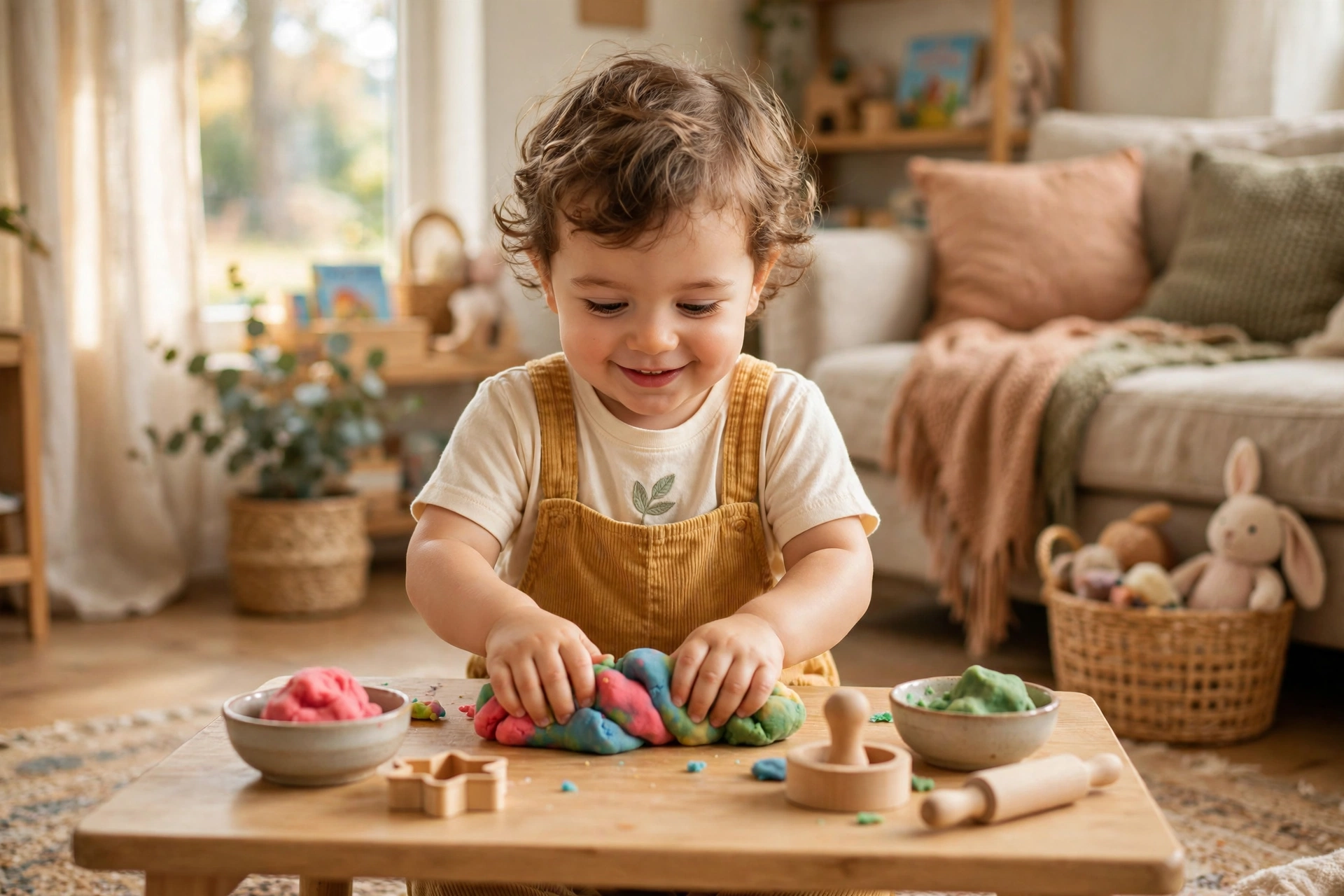
Give your toddler a lump of playdough and no instructions. Squashing it flat, rolling it into snakes, and poking holes with fingers all build hand arches and grip strength. Add a garlic press or a rolling pin later, but the bare hands do the real work. Ten minutes of playdough is a full hand workout, and it is the single best preparation for holding a crayon later.
2. Sponge squeeze water transfer
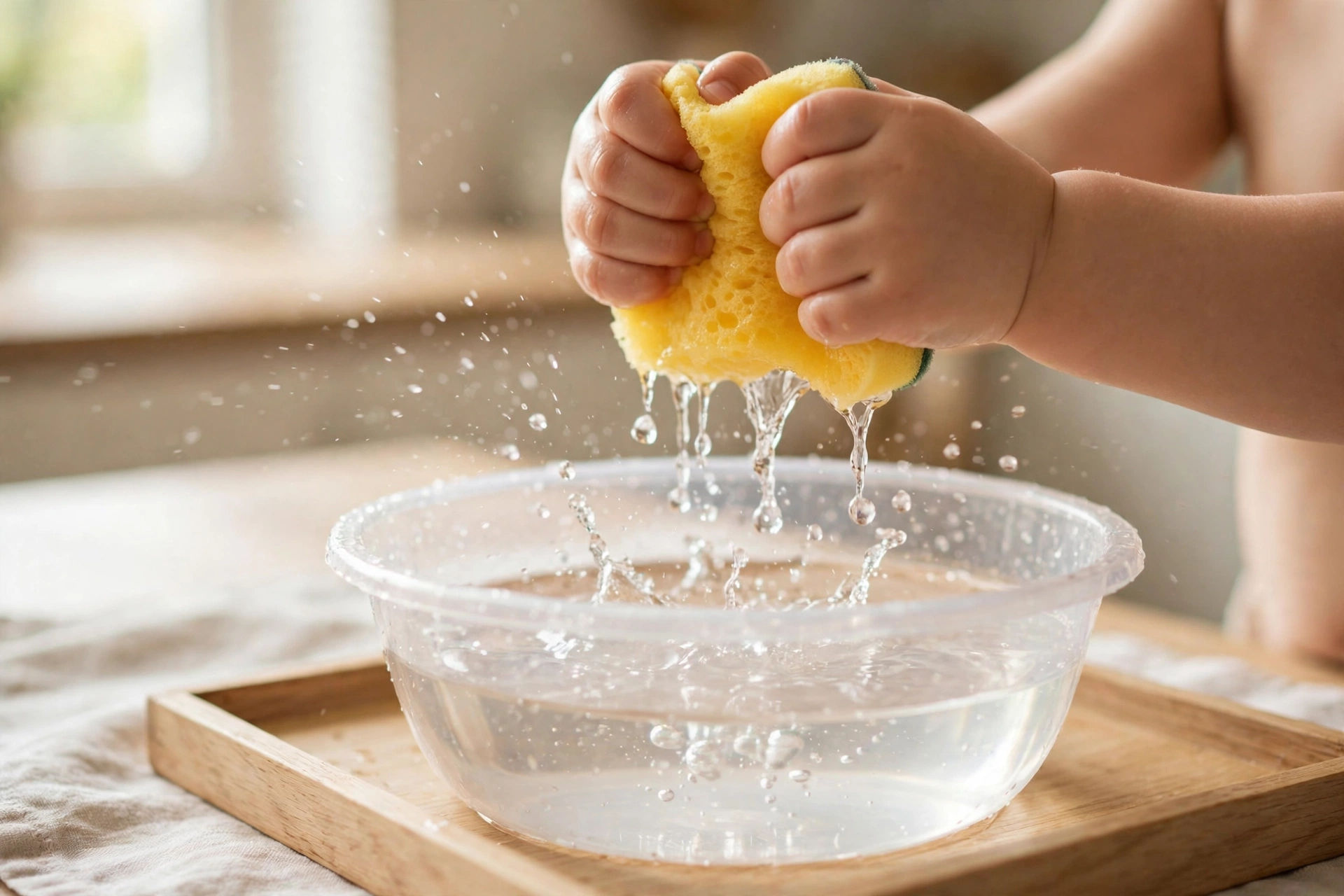
Two bowls, one with warm water and one empty, plus a sponge. Your toddler soaks the sponge, carries it across, and squeezes it out. Repeat until the water has moved. This is rung 1 in its purest form: squeeze, release, squeeze, release. It also teaches full and empty, and it works at the kitchen sink, in the bath, or on a towel on the floor.
3. Spray bottle play
Fill a small spray bottle with water and let your toddler water plants, spray a chalk drawing on the pavement, or mist a window and wipe it. The trigger action builds a different kind of hand strength than squeezing, because it needs repeated finger pressure. Start with an easy trigger, not a stiff one, or small hands tire in a minute.
4. Tear and crumple paper collage
Old magazines, junk mail, or coloured paper, torn into pieces and glued onto a big sheet. Tearing needs both hands pulling in opposite directions, and crumpling needs a full fist squeeze. The collage at the end is a bonus. This is the activity to reach for on a rainy afternoon when you want noise-free play with zero preparation.
5. Squeeze and release games
Squeezable bath toys, stress balls, and even a wet flannel twisted and wrung out all count. Make it a game: squeeze the sponge ten times, then pour. Squeeze the ball, then roll it. The repetition is the point. Hand stamina grows the same way any muscle grows, through short, repeated effort, not one long session.

Strong hands first, pencils later
The No-Screen Toddler Rescue Kit sorts 115 activities by the moment you need them, including hand-strengthening play that comes before any pencil work. 89 pages, 28 printable activity cards, ages 2 to 5.
Instant download. Print it once, use it every day.
Rung 2: Pincer, thumb and finger control
The pincer grip, thumb against index finger, is the most important fine motor milestone of the toddler years. It usually appears around 9 to 12 months for food pieces, and it keeps refining until age 3. Every later skill, from buttoning to writing, leans on it. These five activities train it directly, and they all use pieces big enough to be safe while the grip is still learning.
6. Pom-pom transfer with kitchen tongs
A bowl of pom-poms, kitchen tongs, and a muffin tin or ice cube tray. Your toddler picks up one pom-pom at a time and drops it into a compartment. Tongs force the same thumb and finger action as a pincer grip, but with a tool doing half the work, which is why this is the kindest first pincer activity. Start with large pom-poms and small tongs, then shrink the pom-poms as the grip gets surer.
7. Threading large beads on a shoelace
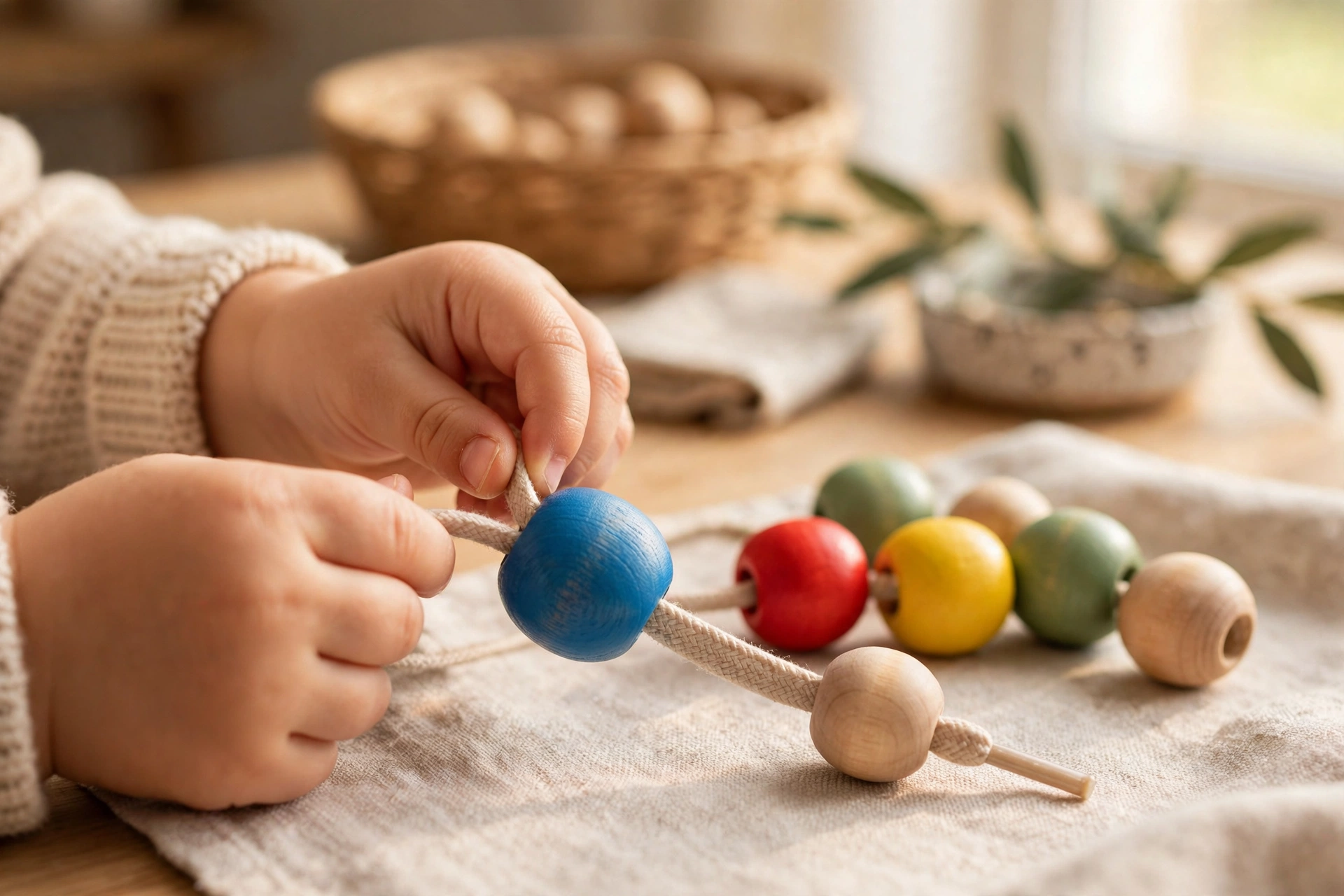
Large wooden beads with big holes, threaded onto a stiff shoelace with a taped end. Threading is pincer plus patience: hold the bead, aim the lace, push it through, pull it out the other side. Use beads too big to fit in a mouth, and sit with your toddler for this one. When large beads get easy, move to smaller beads, not longer strings.
8. Sticker peeling and placing
A sticker book, or plain dot stickers and a sheet of paper. Peeling a sticker off its sheet is pure finger isolation: one fingertip lifts an edge, thumb and finger pull it free, then place it exactly where you want it. It is also the activity most toddlers will do without being asked. Keep a sticker book in your bag for waiting rooms and restaurants, and the pincer practice happens by itself.
9. Posting box
Cut a slot in the lid of a tin or a sturdy box, and give your toddler large coins, buttons, or poker chips to post through it. Posting needs a pincer grip plus aim: line the piece up with the slot and push. It is deeply satisfying for toddlers, because every piece disappears with a clink. Use pieces too big to swallow, and count them back out at the end so none go missing.
10. Pincer pick-up race
Scatter dry cereal pieces or large pasta shapes on a tray, and race to pick them up one by one into a cup, using thumb and finger only. No tongs this time, just the fingers. Time it if your toddler likes a race, or just count together. This is the closest activity to the real pincer milestone, picking up small food, and it shows you clearly whether the grip is a true pincer or still a whole-hand scoop.
Rung 3: Two hands together, bilateral coordination
Most real tasks need both hands doing different jobs: one holds, the other works. This is called bilateral coordination, and it is the rung parents notice most in daily life, because it is what lets a child hold paper while drawing, hold a bowl while scooping, and hold a shoe while putting it on. These five activities train the two hands to cooperate instead of competing.
11. Lacing cards
Cardboard shapes with holes punched around the edge, laced with a shoelace. One hand holds the card steady while the other pushes the lace through and pulls it out. Start with a few big holes and a stiff lace, then add more holes. If shop-bought lacing cards feel too fiddly, cut your own from a cereal box: bigger holes, stiffer card, and your toddler's own drawing on the front.
12. Treasure jars: opening and closing containers
A basket of jars, bottles, and tubs with different lids: screw tops, snap lids, and flip caps. Hide a small toy inside each one. Your toddler must hold the jar with one hand and twist or pop the lid with the other. This is bilateral coordination disguised as a treasure hunt, and it is also the skill behind opening a snack packet and a lunchbox at preschool.
13. Block towers and stacking cups
Wooden blocks, Duplo, or stacking cups, built as high as they will go. Stacking looks simple, but the top hand places while the bottom hand steadies, and the eyes judge the balance. Towers of 4 or more blocks by age 2, and 9 or more by age 3 to 4, are the usual milestones, but the number matters less than the practice. Let the tower fall. Rebuilding is where the learning happens.
14. Rolling playdough snakes with both hands
Back to playdough, but this time with a job for each hand: both palms roll the dough back and forth into a long snake. This is harder than squashing, because both hands must move together at the same speed and pressure. Snakes become letters, roads, and spaghetti for pretend cooking. If the snake keeps breaking, the dough is too dry. Add a drop of oil and try again.
15. Buttoning, zipping, and snapping
A dressing doll, a busy board, or just an old shirt with big buttons. One hand holds the fabric taut while the other pushes the button through. Start with large buttons and loose buttonholes, then shrink them. Zips work the same way: one hand holds the bottom, the other pulls. These are the same movements behind getting dressed alone, which is why this activity pays off twice, in play and in the morning routine.
Two hands, one job
The Rescue Kit shows you how to turn everyday moments into two-hand practice: dressing, snack time, and tidying up all build coordination without a single worksheet. 115 activities, 28 printable cards, ages 2 to 5.
Instant download. Print it once, use it every day.
Rung 4: Tool use, scissors, crayons, and pencils
This is the rung most parents ask about, and the one most often rushed. Tools need everything below them: strength from rung 1, pincer control from rung 2, and a steady holding hand from rung 3. When those are in place, tools click quickly. When they are not, tools frustrate. If your toddler struggles here, go back one rung for a week. That is not going backwards. That is building the foundation the tool needs.
16. Snipping strips with child-safe scissors
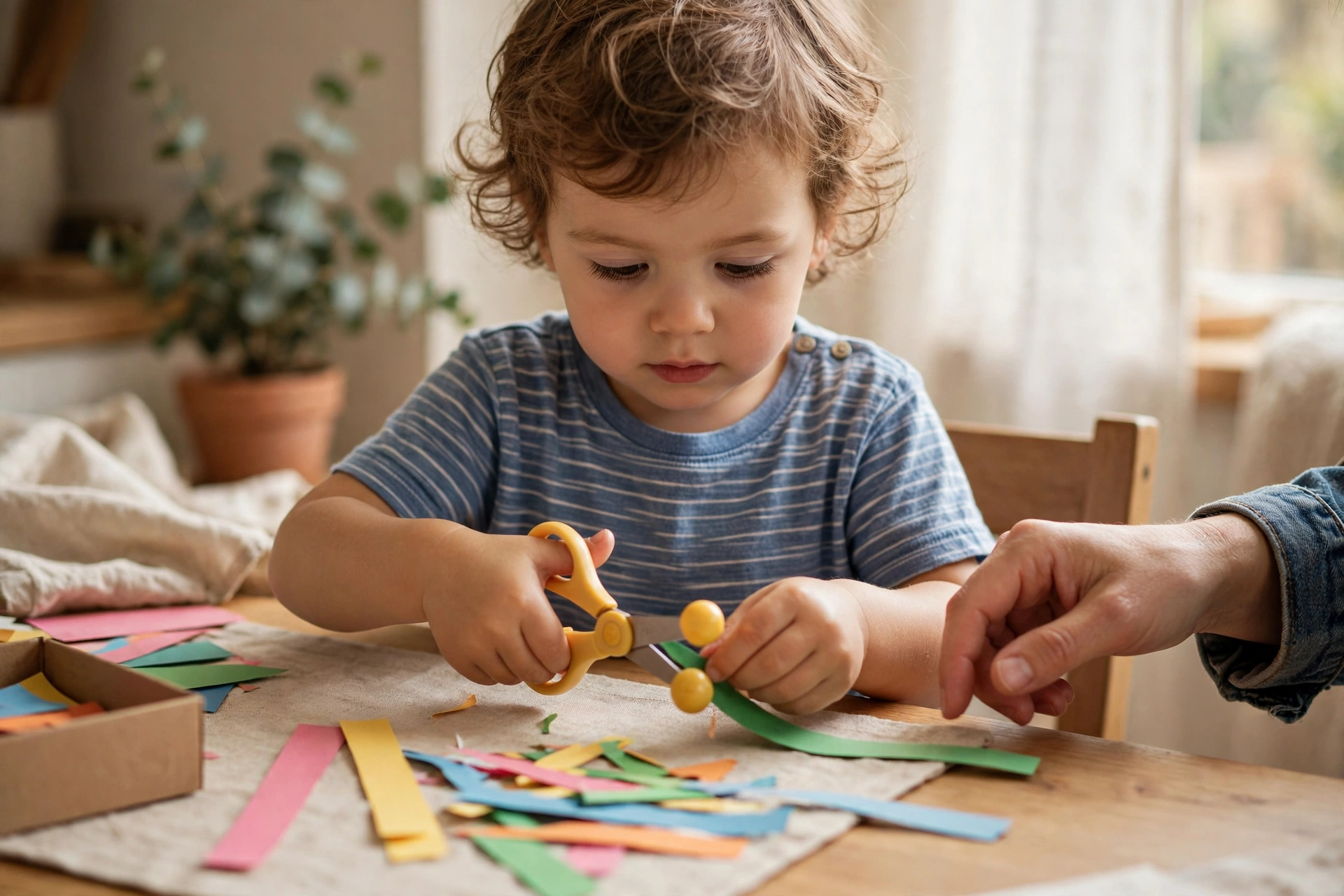
Blunt, round-tipped child-safe scissors and strips of paper or thin card. Not shapes, not lines, just snipping: open, close, and a piece falls off. Snipping is the first scissor skill, usually around age 2 to 3, and it is the only scissor activity that needs no aim at all. Sit beside your toddler for every scissor session, and keep the scissors put away between sessions, so they stay special and safe.
17. Cutting along a line
Draw a thick straight line on a strip of paper, then a zigzag, then a curve. Your toddler cuts along it, one hand holding the paper and turning it, the other opening and closing the scissors. Cutting on a line usually arrives around age 4 to 5, so do not expect it at 3. Thick lines first, thin lines later, and praise the effort, not the accuracy. A wobbly cut on the line beats a perfect cut made by an adult hand guiding theirs.
18. Dot marker art
Dot markers, bingo dabbers, or a sponge on a stick, stamped onto big paper. Dot markers are the kindest first mark-making tool, because they need no grip correction and no pressure control: press, and a dot appears. They build the same hand-eye coordination as crayons, with instant success. Use them for colour sorting, counting dots, and free art, and keep the sessions short and joyful.
19. Tracing lines and shapes
Thick lines on paper: vertical, horizontal, then a circle, then a cross. Your toddler traces over them with a finger first, then a chunky crayon. Finger tracing teaches the path before the tool adds difficulty. Copying a circle and a cross usually arrives around age 2 to 3, and a square around age 4 to 5. If tracing frustrates your toddler, go back to dot markers for a week. The path matters more than the tool.
20. Hole punch and ribbon threading
A single hole punch and strips of card, then ribbon threaded through the punched holes. The punch needs a strong squeeze, which revisits rung 1, and the threading revisits rung 3, so this activity ties the whole ladder together. Punch a row of holes along a card, thread a ribbon through in order, and tie it off. Your toddler has just used a tool, both hands, and a plan, all in one activity.
A simple day plan that covers all four rungs
You do not need to do all 20 activities in a day. One activity per rung, spread across the day, is more than enough. Here is a day that does exactly that, with no extra shopping and no long setup.
Morning, after breakfast: Rung 1 and rung 2 at the table. Playdough squish for ten minutes, then a sticker book while you clear up. Hands are warmed up and the day has started with success.
Midday, before nap: Rung 3 calm table play. Lacing cards or treasure jars, quiet and focused, which also helps the wind-down to nap.
Afternoon, after nap: Rung 4 at the table. Scissors and strips, or dot markers, for ten to fifteen minutes. This is the moment hands are freshest after rest.
Evening, before bath: Low-mess two-hand play. Block towers or the posting box, on the floor, with no cleanup pressure. The day ends with building, not with a worksheet.
When to worry, and when not to
Children develop at different rates, and one slow skill on its own is rarely a worry. What matters is a pattern: the same difficulty across weeks, in different places, and across different activities. Mention it at your next well-child visit, or sooner if you see regression, when you notice several of these together: cannot stack 3 to 4 blocks by around age 2 and a half, no interest in scribbling by age 3, cannot snip with scissors by age 3, cannot cut at all by age 4, one hand doing everything while the other dangles, or losing a skill they used to have. Paediatricians screen development at every well-child visit from 9 months, and you can raise a concern between visits too. There is no threshold for too minor to mention, and asking early is always better than waiting.
The setup system that makes fine motor play happen daily
Fine motor play only happens regularly when the tools are within reach. Keep one basket with the ladder tools: tongs, clothespins, blunt scissors, dot markers, large beads, lacing cards, and a small ball of playdough. One activity at a time, on a tray, for ten to twenty minutes. When the basket lives in one spot and the tray lives under the table, setup takes one minute, and one minute of setup is the difference between daily practice and a forgotten intention. If your toddler is just starting, begin with our activities for 3 year olds at home for age-matched ideas, or our activities for 4 year olds at home for the preschool year. For the sensory side of hand play, our sensory activities for toddlers at home pairs with this page, and our easy toddler activities at home guide has more no-prep setups like these.
From squeeze to scissors, all in one kit
The Rescue Kit gives you 115 activities with setup times marked, so you can pick a 2 minute hand-strength win on a tired day and a full scissor session on a slow one. 89 pages, 28 printable cards, ages 2 to 5.
Instant download. Print it once, use it every day.
Frequently asked questions
What age should my toddler be able to use scissors?
Most toddlers start snipping paper with child-safe scissors around age 2 to 3, and cut along a straight line around age 4 to 5. Snipping comes first: short, random cuts on strips of paper. Cutting on a line needs more hand control and patience, so it arrives later. If your toddler only snips at 3, that is right on track.
When should my child hold a crayon properly?
Crayon grip changes in stages: a full fist grip first, then fingers and thumb together, then the three-finger tripod grip, usually around age 4. Do not force the tripod grip early. A toddler who grips with a fist is not behind; the hand muscles and control for a mature grip are still building, and playdough, squeezing, and threading build them faster than correcting a grip.
What if my toddler hates coloring or avoids craft activities?
One avoided activity is usually just preference. A pattern is different: if your child avoids almost every activity that needs hand use, across weeks and in different places, that is worth noticing. Try a different route in first: dot markers, painting on a vertical surface like an easel, or short 5 minute table sessions. If avoidance stays broad and persistent, mention it at your next well-child visit.
How do I know which rung of the ladder my child is on?
Use four quick checks. Hand them a wet sponge: do they squeeze it with the whole hand? Put a pom-pom on the table: do they pick it up with thumb and finger, or the whole fist? Hold a paper steady while they draw: does the other hand help hold it? Hand them blunt scissors and a paper strip: can they open and close them? The first check they cannot do yet is the rung to play on.
How long should fine motor play last each day?
Short bursts beat long drills. Ten to twenty minutes of focused table play, woven into the day at two or three moments, is plenty for a toddler. Fine motor practice also hides inside everyday life: opening containers, turning pages, zipping a bag, and helping peel a banana all count, and they cost no setup at all.
Do I need special toys for fine motor skills?
No. The best fine motor tools are already in your kitchen: tongs, clothespins, jars with lids, a sponge, a colander, and blunt scissors. Special toys like lacing cards and bead sets are useful, but they are not required. A basket of household tools, rotated weekly, covers every rung of the ladder.
When should I worry and ask the paediatrician?
Mention it if you see a pattern across weeks and settings: cannot stack 3 to 4 blocks by around age 2 and a half, no interest in scribbling by age 3, cannot snip with scissors by age 3, cannot cut at all by age 4, one hand doing everything while the other dangles, or losing a skill they used to have. Paediatricians screen development at every well-child visit from 9 months, and you can raise a concern between visits too.
Sources and further reading
CDC Milestone Tracker guidance on fine motor milestones from infancy through age 5. American Academy of Pediatrics (HealthyChildren.org) guidance on developmental surveillance at well-child visits. Paediatric occupational therapy guidance on hand development, grip progression, and bilateral coordination at home.
If your toddler is just starting fine motor play, begin with our activities for 3 year olds at home for age-matched ideas, or our activities for 4 year olds at home for the preschool year. When the day is mostly indoors, our indoor toddler activities guide covers big movement alongside table play.