
Indoor Gross Motor Activities for Toddlers at Home: 20 Ideas That Burn Energy Without Breaking the House
Updated October 28, 2026
Indoor gross motor activities for toddlers at home solve the hardest part of a stuck-inside day: a small body full of energy and nowhere to run. When rain, cold, or a sick sibling keeps you inside, that energy does not disappear. It comes out as climbing the sofa, running laps around the table, and wrestling a sibling at exactly the wrong moment. Most indoor lists online hand you the same five ideas, obstacle course, dance party, and animal walks, with no plan for how wild to go, how long to last, or how to land the plane without a meltdown. This page does it differently: 20 indoor gross motor activities for toddlers at home, sorted on a wild-to-calm energy ladder, plus a 20-minute burn plan and apartment-safe rules that keep the downstairs neighbors on your side.
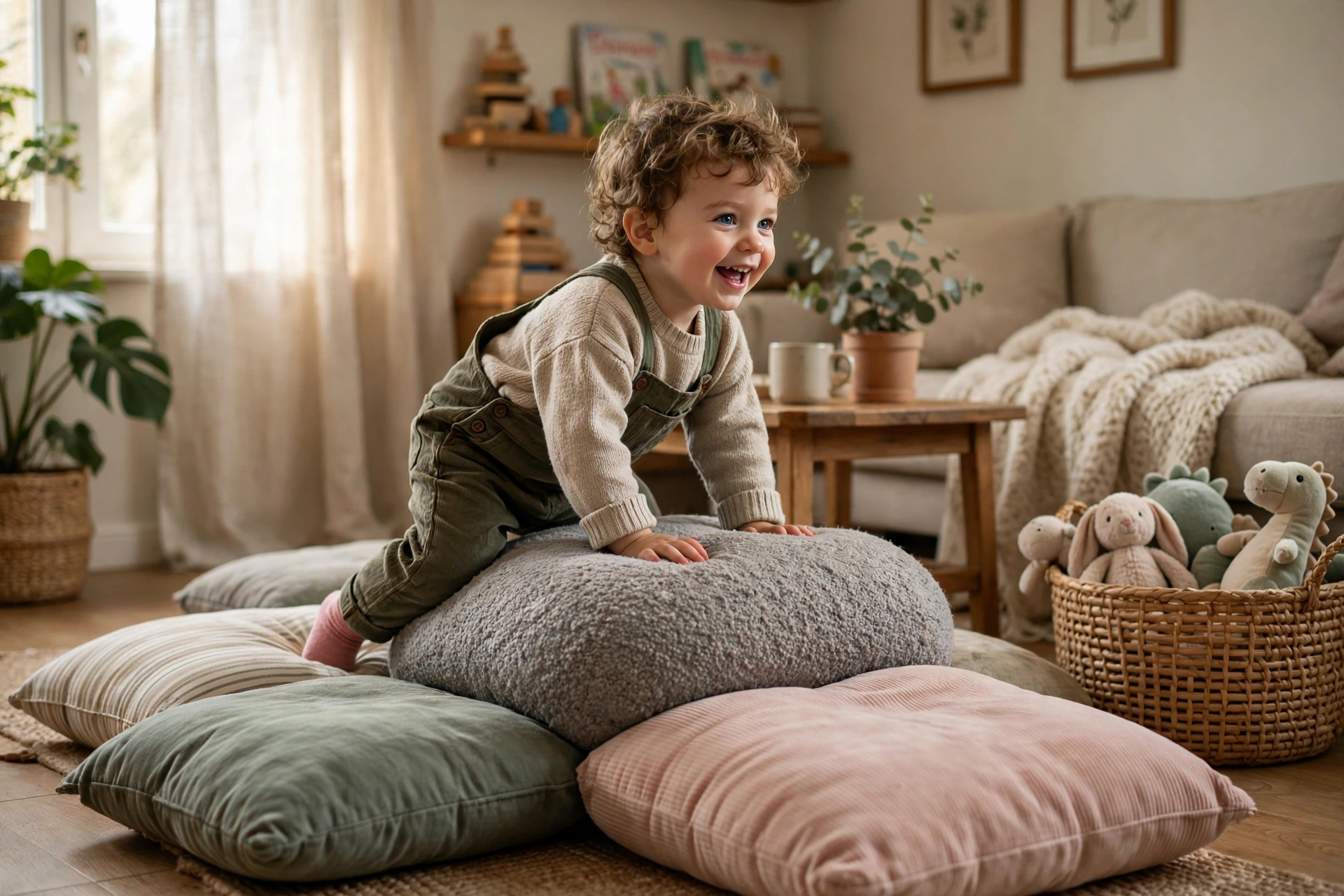
Quick answer: Start with the ladder, not the list. Level 1 burns energy fast with big, wild movement. Level 2 keeps bodies moving in small spaces with steady games. Level 3 lands the plane with slow movement so the session ends calm, not chaotic. Run them in that order, for about 20 minutes, and one short session beats an hour of random wild play. Every activity below uses things already in your home, and every one has a quiet-feet version for apartments.
Why indoor gross motor activities for toddlers matter
Gross motor skills are the big movements: running, jumping, climbing, balancing, throwing, and crawling. They use the large muscles of the arms, legs, and torso, and they are how a toddler's body and brain develop together. Balance, coordination, strength, and body awareness all grow out of big movement, and so does emotional regulation. A toddler who has moved enough is calmer, sleeps better, and handles frustration better than a toddler who has been sitting all day. The wiggles are not misbehavior. They are a body asking for what it needs.
The World Health Organization recommends at least 180 minutes of physical activity spread across the day for children ages 1 to 4, with at least 60 minutes of moderate to vigorous activity for ages 3 to 4. That number sounds large until you realize it counts everything: walking around the house, climbing onto the sofa, dancing in the kitchen, and chasing a ball down the hallway. Short bursts add up. You do not need a backyard, a playground, or a single three-hour session. You need a few short, well-chosen bursts, and this page gives you exactly that, indoors, in any weather, in any size of home.
The energy ladder: three levels, in order
Every activity in this page sits on one level. The order is the whole point. Wild first, while energy is highest. Steady second, while bodies are still moving but the chaos is dropping. Wind-down last, so the session ends with a calm child instead of a wired one. Most indoor lists fail because they mix all three levels together, and parents end up doing a calming activity first and a wild one last, which is backwards. Follow the ladder and the session runs itself.
| Level | What it does | Space needed | Noise | Best time |
|---|---|---|---|---|
| 1. Wild burn | Burns energy fast with big, whole-body movement | Living room or hallway | Loud | Morning or late afternoon, never right before bed |
| 2. Steady burn | Keeps bodies moving in small spaces with focused games | A corner, a tape line, a hallway | Medium | Any time, including apartments |
| 3. Wind-down | Lands the plane with slow, heavy, calming movement | A rug or mat | Quiet | End of every session, before nap or bed |
Level 1: Wild burn, when energy is at its peak
Start here when your toddler is bouncing off the walls, climbing furniture, or running laps for no reason. These seven indoor gross motor activities for toddlers burn the most energy in the shortest time, and they are the reason this page exists. Do two or three of them, not all seven, and then move down the ladder. Wild play is a burst, not a marathon, and ten minutes of it is plenty before you step down to level 2.

1. Cushion obstacle course
Pull the sofa cushions onto the floor and build a course: crawl over a cushion, balance along a cushion edge, jump off the last cushion onto a rug. Add a sheet tunnel over two chairs at the start and a laundry basket to throw a soft ball into at the end. Keep it to three or four stations, because a course a toddler can finish beats a course they abandon halfway. Let them rearrange the stations. Ownership keeps them running it again and again, and every repeat is another burst of climbing, crawling, and jumping.
2. Freeze dance party
Put on fast music and dance together, then pause the music and freeze like statues. The dancing burns energy, and the freezing builds listening and body control, because stopping suddenly is harder than moving for a toddler. Use songs with actions, like Head, Shoulders, Knees, and Toes, and add scarves or ribbons to wave. Three songs is a full session. If your toddler melts down when the music stops, shorten the freeze to two seconds and build up. The game should feel silly, not like a test.
3. Animal walk relay
Call out an animal and move like it down the hallway and back: bear crawl on hands and feet, frog jumps, penguin waddle, crab walk sideways, snake wriggle on the floor. Animal walks are gross motor gold, because each animal trains a different movement. Bear crawl builds shoulder and core strength, frog jumps build leg power, and the snake wriggle builds the core control toddlers need before they can sit still for table activities. Do them as a relay, one animal at a time, and let your toddler pick the next animal.
4. Balloon volleyball
Blow up a balloon and keep it off the floor, first with hands, then with feet, then with a rolled-up newspaper as a bat. Balloons move slowly, which is why they are perfect for toddlers: the game stays playable instead of ending in a chase. Tie a string across the room for a net if you want a goal, or just count how many hits before it touches the ground. Supervise closely, because a popped balloon is a choking hazard for children under 3. If a balloon pops, pick up every piece before the game continues.
5. Pillow mountain climb and crash
Pile every pillow, cushion, and folded blanket in the house into a mountain on the floor, and let your toddler climb up and crash down onto a soft landing. This is the indoor version of climbing the sofa, but on your terms, with a safe landing and no furniture involved. Climbing builds leg strength, balance, and confidence, and the crash landing gives the deep pressure input that calms many toddlers down. If your toddler starts climbing the mountain from the back or the sides, let them. Problem-solving the climb is part of the play.
6. Hallway races
A hallway is the most underused movement space in a home. Race from one end to the other: run, then hop, then walk like a giant, then crawl like a baby. Even a short hallway works, because the turn at the end is part of the game. Time it with counting, not a clock, and race against your own best count. If you have downstairs neighbors, use the quiet-feet version: fast walking, giant steps, and bear crawls instead of running and jumping. The hallway still burns energy, just without the thumps.
7. Laundry basket push
Load a laundry basket with soft toys or folded towels and let your toddler push it around the house, up and down the hallway, around the table. Pushing something heavy is called heavy work, and it is one of the most calming kinds of big movement, because the resistance tells the body where it is in space. A toddler who is wound up often settles after a few minutes of pushing. If the basket is too light, add books. If it will not move, take some out. The right weight is heavy enough to need effort, light enough to keep moving.

Wild energy, ready-made plan
The No-Screen Toddler Rescue Kit sorts 115 activities by the moment you need them, including big-energy play for stuck-inside days when the walls start closing in. 89 pages, 28 printable activity cards, ages 2 to 5.
Instant download. Print it once, use it every day.
Level 2: Steady burn, small spaces and tired parents
Level 2 is where most of the day's movement actually happens. These seven activities keep a toddler's body moving without needing a big room, a loud house, or a parent with energy to spare. They are the apartment level, the small living room level, and the level to use when you need movement but cannot handle chaos. Do one or two after the wild level, or use them alone on a day when wild play is not possible.
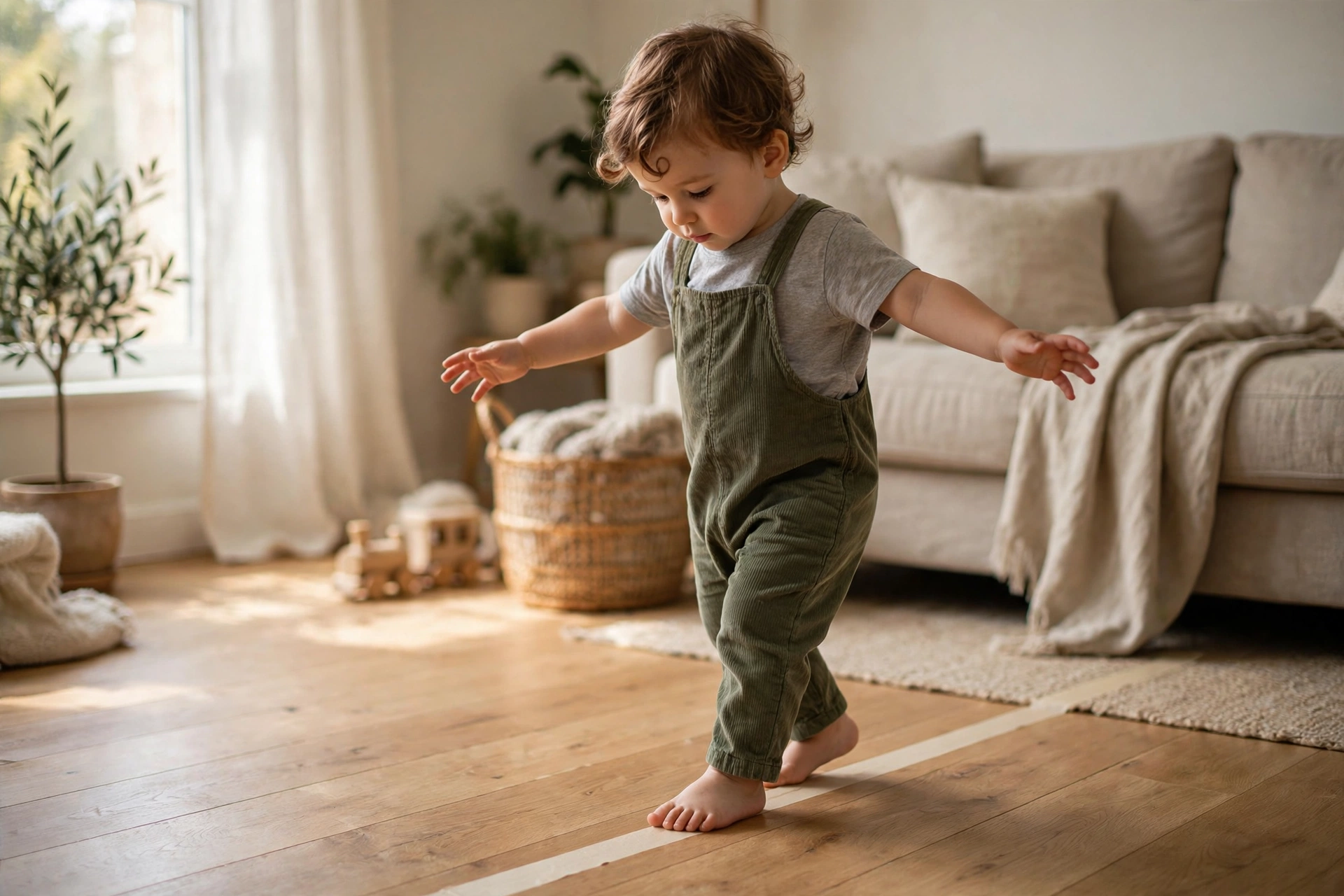
8. Tape balance beam
Stick a long line of painter's tape on the floor and walk along it, heel to toe, arms out like a tightrope walker. Tape is a parent's best friend for indoor movement: it goes down in a minute, peels off without damage, and turns any floor into a balance course. Add zigzags, curves, and a second line to jump between. For an 18-month-old, just walking near the line counts. For a 3-year-old, walking on it without stepping off is a real challenge. If the line stays down for a week, it becomes a path your toddler walks every time they cross the room, and the practice happens by itself.
9. Tape hopscotch
Build a hopscotch grid from tape on the floor, with numbered squares, and hop through it on one foot, then two feet, then with a soft beanbag tossed into a square first. Hopscotch trains balance, hopping, and number recognition at the same time, and it fits in a hallway or a kitchen corner. Keep the grid small, four to six squares, and let your toddler draw the numbers with you. If hopping on one foot is still too hard, two-foot jumps in each square build the same leg power.
10. Soft-ball target toss
Set out a laundry basket, a cardboard box, and a pot, and throw soft balls or rolled-up socks into them from a tape line on the floor. Move the line back as aim improves. Throwing builds arm strength, coordination, and aim, and the targets make it a game instead of a drill. Use soft balls only, never hard ones indoors, and keep the throwing zone away from breakables. If your toddler throws everything everywhere, shrink the targets and move them closer. Success keeps them throwing; misses in every direction end the game fast.
11. Tunnel crawl
Drape a sheet over two chairs, or open a pop-up tunnel if you have one, and crawl through it, then crawl back, then crawl through carrying a stuffed animal. Crawling is not just for babies. For a toddler, crawling on hands and knees builds shoulder strength, coordination between opposite arm and leg, and the core control that later supports sitting, writing, and sports. Make the tunnel longer with a second sheet, or add a cushion to crawl over halfway through. If your toddler is too big for the tunnel, they will tell you by getting stuck, and getting stuck is funny, not a failure.
12. Marching band parade
Put on marching music, grab a pot lid as a drum and a wooden spoon as a stick, and march around the house in a parade. Marching trains rhythm, coordination, and the high-knee stepping that builds hip strength. Add commands: march fast, march slow, march on tiptoes, march like a giant. The parade format keeps it going longer than plain marching, because there is a destination, even if the destination is just the kitchen and back. This is also the best quiet-feet swap for running: marching burns energy without a single jump.
13. Follow the leader
Take turns being the leader, and copy each other's movements: giant steps, tiny steps, side steps, backwards steps, arms up, arms out. Follow the leader trains listening, watching, and copying, which are the same skills behind classroom games and sports later. When your toddler leads, copy them exactly, even when the movement is silly. Being copied is deeply satisfying for a toddler, and it keeps them leading longer. Add a rule: the leader must move the whole time, no standing still, so the game never stalls.
14. Step-ups on a low stool
Put a low, sturdy stool or a single step platform on a rug, and step up and down, alternating feet, then both feet, then up with one foot and down with the other. Step-ups build leg strength and balance in a tiny footprint, and they are the safe indoor version of stair climbing, without any of the stair risks. Keep the stool low, keep it on a rug so it cannot slide, and stay beside your toddler. If the stool wobbles, it is too tall or too light. Use a heavier one, or stack two firm cushions instead.
Small space, big movement
The Rescue Kit is built for real homes, not big backyards. Every activity says how much space it needs, so you can pick a hallway game on an apartment day and a wild game on a big-room day. 115 activities, 28 printable cards, ages 2 to 5.
Instant download. Print it once, use it every day.
Level 3: Wind-down, land the plane
Never skip this level. Every movement session should end here, because the last five minutes decide what kind of child you get for the next hour. These six activities are slow, heavy, and calming, and they work by giving the body deep pressure and slow input after fast movement. Do two of them at the end of every session, every time, and the transition from play to nap, snack, or quiet time gets easier within a week.
15. Slow turtle walks
Walk as slowly as possible across the room, like a turtle, with heavy steps and arms hanging low. Slow movement is surprisingly hard for a toddler, because it needs control, and control is what calms a wired body down. Race to see who can walk the slowest, not the fastest, and praise the slowest walker. Add a shell: a cushion on the back, carried without dropping it. The game ends when everyone is walking slowly and breathing slowly, which is exactly the state you want.
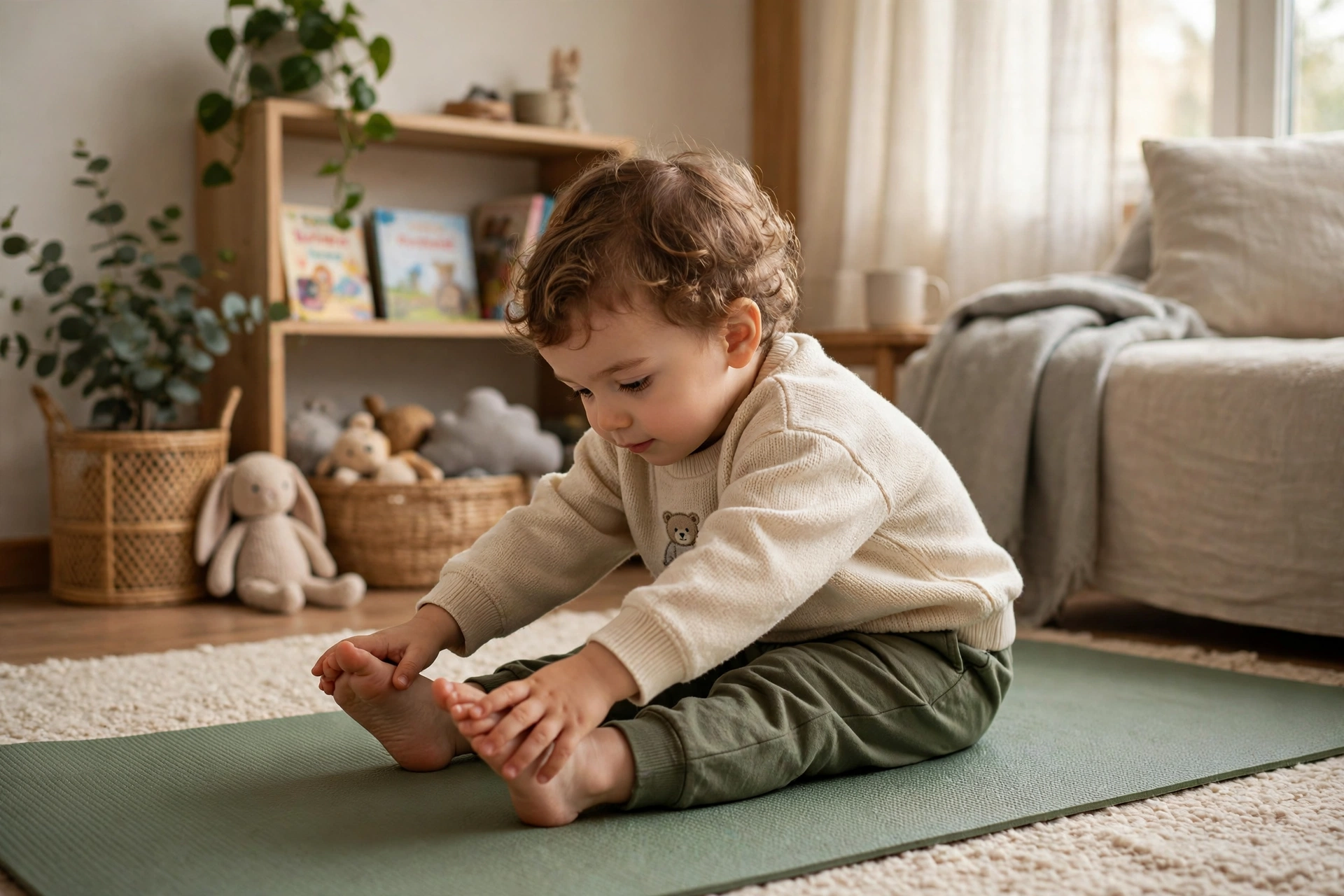
16. Stretch and reach
Reach up high like you are picking apples from a tall tree, then touch your toes like you are picking flowers from the ground, then stretch wide like a star. Stretching after movement does for toddlers what it does for adults: it lengthens muscles that just worked hard, and it slows breathing down. Name each stretch as an animal or a job: giraffe neck, starfish arms, sleepy cat back. Five stretches, done slowly, is a complete wind-down, and it works just as well before nap as it does after play.
17. Pillow sandwich press
Lie your toddler on a mat and stack soft pillows on top of them, one at a time, then press down gently and count to five, then lift them off one at a time. Deep pressure from the pillows calms many toddlers the way a tight hug does, because it tells the body where it ends and the world begins. Keep it light, keep your toddler's face uncovered and their breathing easy at all times, and stop the moment they want out. Never use heavy blankets or weights for this, and never press hard. Soft pillows and gentle pressure are the whole game.
18. Slow-motion walking
Replay a wild movement in slow motion: the frog jump, but at one tenth speed, or the bear crawl, but as slowly as a snail. Slow motion forces a toddler to control every part of a movement they just did fast, and that control is deeply calming. It is also funny, which helps, because laughter is a wind-down in itself. If slow motion turns back into fast motion, that is a sign the body is not ready to land yet. Go back to one more steady activity, then try slow motion again.
19. Rolling on a mat
Lie on a mat or a rug and roll side to side, slowly, like a log, arms by your sides, then roll back. Rolling gives the body spinning input in a controlled way, and it is one of the simplest calming movements there is. Roll together, count the rolls, and stop after five. If your toddler gets dizzy or giggly beyond control, that is enough rolling. Sit up, drink some water, and move to the last wind-down activity.
20. Quiet carrying jobs
Give your toddler a job that needs carrying: take the books back to the shelf, one at a time, carry the cushions back to the sofa, or carry a basket of toys to the bedroom. Carrying is heavy work at a slow pace, which is the perfect landing: the body is still working, but the speed is gone. End every session with a carrying job and the cleanup happens by itself, which is a bonus. A toddler who just carried everything back to its place is a toddler who is ready for the next part of the day.
The 20-minute burn plan
Here is the plan that ties the ladder together. Twenty minutes, three levels, in order, and then you are done. Use it when energy is high and the day is stuck inside. Repeat it once later in the day if needed, but do not run it back to back. Two separate sessions beat one long one, because toddler attention resets between sessions.
| Minutes | Level | What to do |
|---|---|---|
| 0 to 5 | Steady warm-up | Marching band parade or follow the leader, to warm muscles up gently |
| 5 to 15 | Wild burn | Two wild activities: cushion obstacle course, then freeze dance party |
| 15 to 18 | Steady burn | One steady activity: tape balance beam or target toss, to bring the speed down |
| 18 to 20 | Wind-down | One wind-down activity: slow turtle walks or pillow sandwich press, to land the plane |
On a day when the whole day is indoors, run this plan once in the morning and once in the late afternoon, and let the rest of the day's movement come from normal play. That covers the wild energy without turning your home into a gym, and it leaves the evening calm. If your toddler is still bouncing after the plan, they usually need the wind-down level repeated, not more wild play. More wild play on an already wired body often makes the wiring worse.
Apartment-safe rules that keep the neighbors happy
Small spaces and shared walls do not rule out big movement. They just rule out the loudest version of it. These rules keep the movement and drop the noise, and they work in any apartment, condo, or small house with neighbors below.
Put something soft under everything. A thick rug, a yoga mat, or a folded blanket under jumping and crashing games absorbs most of the impact before it reaches the floor below. Jump onto a cushion pile, never onto bare floor.
Swap the noisy move for a quiet one. Jump becomes march in place. Run becomes bear crawl or fast walking. Stomp becomes tiptoe. The body still works hard, but the floor stays quiet. Teach the swaps as a game, not a ban: show your toddler the quiet version first, then let them choose it.
Keep wild play to daytime hours. Morning and late afternoon are fair game in most buildings. Nap times and evenings are not. If you are unsure, ask your downstairs neighbor which hours bother them least. Most people are reasonable about daytime play noise when it is not constant and not at night.
Anchor furniture and clear corners. Before any wild session, push sharp-cornered furniture out of the play area, anchor bookcases and dressers to the wall, and move breakables up high. A safe play area is what lets you say yes to wild play instead of stopping it every two minutes.
Supervise balloons and small balls. Balloons are a choking hazard when popped, and small balls roll under furniture and cause trips. Keep balloon games supervised, pick up every piece after a pop, and use soft, large balls indoors.
When movement looks like too much, and when to ask
A toddler who seems unable to sit still is usually developing typically, not misbehaving. Constant movement is how toddlers build strength, balance, and body awareness, and a child who moves all day is doing exactly what their body needs. What matters is the pattern around the movement, not the movement itself. If your toddler is flushed, overly wound up, or heading toward tears, that is overstimulation, not energy, and the answer is the wind-down level, not more wild play. Switch to slow movement, water, and a snack, and the storm usually passes.
Mention it at your next well-child visit if you notice a pattern across weeks: losing a physical skill they used to have, one side of the body clearly weaker than the other, frequent falls far beyond normal toddler clumsiness, or pain during movement. Paediatricians screen development at every well-child visit from 9 months, and you can raise a concern between visits too. Asking early is always better than waiting, and most of the time the answer is reassurance and a few activity ideas, which is what this page is for.
The setup system that makes indoor movement happen daily
Big movement only happens regularly when the setup takes a minute, not twenty. Keep one basket by the play area with soft balls, scarves, a balloon or two, and a roll of painter's tape. Keep one corner of the living room clear, with cushions within reach, so the obstacle course starts with one pull, not a furniture move. Leave the tape balance line down for a week at a time, so it becomes a path your toddler uses without being asked. When setup is one minute, movement happens daily. When setup is a project, it happens never.
If your toddler is just starting with big movement indoors, our indoor toddler activities guide covers the full stuck-inside day, and our rainy day toddler activities guide covers weather days specifically. For the quiet side of the day, our low energy toddler activities guide helps when the parent is the tired one, and our fine motor activities for toddlers at home guide pairs with this page for small-muscle skills. For age-matched ideas, see our activities for 3 year olds at home and activities for 4 year olds at home guides.
From wild to calm, all in one kit
The Rescue Kit gives you 115 activities with setup times marked, so you can pick a 2 minute burn on a tired day and a full 20-minute ladder session on a stuck-inside day. 89 pages, 28 printable cards, ages 2 to 5.
Instant download. Print it once, use it every day.
Frequently asked questions
How much physical activity does a toddler need each day?
The World Health Organization recommends at least 180 minutes of physical activity spread across the day for children ages 1 to 4. For ages 3 to 4, at least 60 of those minutes should be moderate to vigorous activity, like running, jumping, or dancing. It does not need to happen all at once. Short bursts of movement across the day add up, which is why a 20-minute burn plan plus normal play easily covers it.
Can a toddler really burn energy in a small apartment?
Yes. A hallway, a tape line on the floor, and a rug are enough. Animal walks done in place, marching, balance beam walks on tape, and target toss all burn energy without distance. If noise is a concern, favor the steady level over jumping, and put a thick rug or yoga mat under jumping games to absorb impact.
What if my downstairs neighbors complain about jumping?
Swap the noisy move for a quiet one: march in place instead of jumping, crawl instead of running, and tiptoe instead of stomping. Put rugs or mats under play areas, and keep wild play to daytime hours, not nap times. Most neighbors tolerate daytime play noise when it is not constant, and the wind-down level at the end of every session helps.
Is jumping indoors safe for toddlers?
Yes, with two rules: always land on something soft, and always clear the area first. Jump onto a cushion, a mat, or carpet, never directly onto hard flooring. Move furniture with sharp corners out of the way, and stay close. If your toddler is jumping off furniture, redirect to a cushion pile on the floor instead of banning jumping outright.
What age can toddlers do an obstacle course?
Even an 18-month-old can do a simple one: crawl over cushions and through a sheet tunnel. By age 2 to 3, most toddlers can follow a course with stations: crawl, balance on a tape line, throw a soft ball, and climb a pillow mountain. Keep courses short, three to four stations, and let your toddler rearrange them. Ownership keeps them playing longer.
Does indoor movement help toddlers sleep better?
Usually, yes, when it happens at the right time. A burn session in the late afternoon helps many toddlers settle for bedtime, because the body is pleasantly tired. The wind-down level matters: finish every session with slow movement, not wild play, and leave a calm gap before bed. Wild play right before bed often has the opposite effect.
Are dance videos as good as free movement play?
Short bursts of screen-guided movement, like a dance-along video, are better than passive screen time, and they are useful on a housebound day. But they should not replace free movement play, which builds more balance, coordination, and problem-solving, because your toddler decides what to do next instead of copying a screen. Use videos as one station in the ladder, not the whole ladder.
Sources and further reading
World Health Organization guidance on physical activity for children under 5: at least 180 minutes of varied physical activity spread across the day for ages 1 to 2, and at least 180 minutes with 60 minutes of moderate to vigorous activity for ages 3 to 4 (WHO physical activity fact sheet). Small-space movement adaptations, including hallway play, tape balance lines, and impact-absorbing mats for apartments, are covered in detail in indoor movement activities for toddlers.