
Activities for 1 Year Olds at Home: 20 Easy Ideas for Ages 18 to 24 Months
Updated November 9, 2026
Activities for 1 year olds at home work best when you stop trying to teach and start letting your child touch, drop, and do it all over again. A one-year-old is not a small two-year-old. They are a baby who can walk, or almost walk, who puts everything in their mouth, who understands far more than they can say, and who gives you two to five minutes of attention per activity on a good day. Most lists for this age ignore all of that. They suggest crafts that need sitting still, games that need following rules, and toys with small parts that a one-year-old will try to eat. This page gives you 20 ideas built for the real one-year-old, sorted into four groups of five: sensory play, big movement, first words and sounds, and quiet hands. Every idea uses things already in your house, takes under two minutes to set up, and comes with the version for 12 to 18 months, the version for 18 to 24 months, and the stretch for a child who is turning two. The heart of this page is 18 to 24 months, the age when walking, first words, and copying adults all arrive at once, but the younger end gets its own version of every idea, because a 14-month-old and a 22-month-old are not playing the same game.
The Mouth Test
Every idea on this page passes three questions. If an activity fails even one, it is not on this page.
1. Is it taste-safe or too big to swallow? A one-year-old explores the world with their mouth, so everything they touch must be safe to taste or too big to fit through a toilet paper tube. If it is small, sharp, or breakable, it fails.
2. Does it survive being dropped, thrown, and stepped on? A one-year-old does not play gently. They drop things, they throw things, and they walk over things. If an activity breaks the first time it hits the floor, it fails.
3. Can a tired parent set it up in two minutes? If the setup takes longer than the play, it will never happen on a real day. One bowl, one box, one towel. If it needs a shopping trip or a craft drawer, it fails.
The test matters because this age fails most often at safety, not at boredom. A parent buys a toy meant for a two-year-old, the one-year-old puts a piece in their mouth, and the activity ends in a panic instead of play. These 20 ideas skip that trap. Big pieces, soft materials, and nothing that needs watching every second, because you are watching every second anyway. For the messy half of this list, sized up for older toddlers, the sensory activities for toddlers at home page has the full sensory range.
20 activities for 1 year olds at home for every kind of day
Every one of these activities for 1 year olds at home passes the Mouth Test. Pick one group for the morning and ignore the rest until you need them. Repeat the favorite tomorrow instead of hunting for a new one. A one-year-old learns more from the tenth time they fill and dump the same box than from the first time they try ten new things.
Sensory play
At this age, the senses are the classroom. Touch, splash, and texture teach more than any toy with buttons, and sensory play buys the longest stretches of focused attention you will get all day.
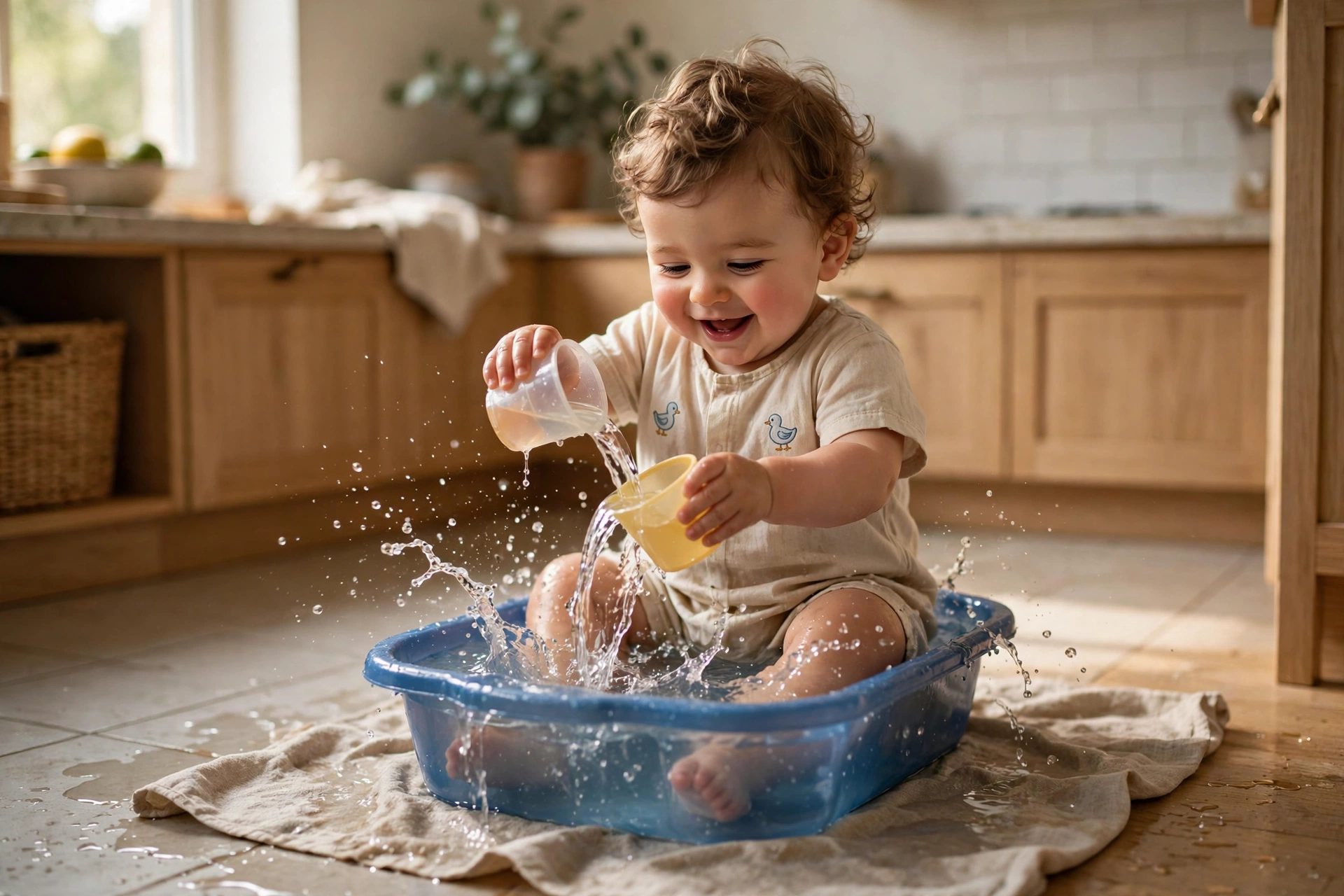
1. Water pouring station
A shallow tub or a baking tray with two inches of water, a jug, and two cups. Your child pours from one cup to the other, splashes, and watches the water move. Put a towel underneath and let the mess happen. 12 to 18 months: one cup and one jug, and you pour first while they watch. 18 to 24 months: two cups, and they pour from one to the other, with most of the water landing outside the cup. Turning 2: add a small funnel and a sponge, and they squeeze the sponge into the cup.
2. Taste-safe sensory bin
A shallow bin filled with cooked pasta or dry oats, with a big scoop and two containers. Your child digs, scoops, and pours, and everything in the bin is safe to taste. No rice, no beans, and no small beads at this age. 12 to 18 months: dry oats only, with one big scoop, and they grab fistfuls. 18 to 24 months: cooked pasta, and they scoop from one container to the other. Turning 2: add big pasta shapes and ask them to find the one that looks like a wheel.
3. Texture walk
Lay a row of textures on the floor: a folded towel, a sheet of foil, a piece of bubble wrap, and a damp flannel. Your child crawls or walks across them, barefoot, feeling each one change under their feet. 12 to 18 months: two textures only, towel and foil, and they crawl across slowly. 18 to 24 months: all four textures in a line, and they walk the whole path and back. Turning 2: they name each texture as they step on it, soft, crinkly, bumpy, wet.
4. Ice cube play
Three big ice cubes in a baking tray, with a small cup of warm water beside them. Your child pushes the cubes around, watches them melt, and feels the cold. Big cubes only, never small ones, and never leave them alone with it. 12 to 18 months: one big cube in the tray, and they poke it and watch it slide. 18 to 24 months: three cubes, and they move them from the tray to the cup and back. Turning 2: add a few drops of food coloring to the water before freezing, and they watch the color appear as the cube melts.
5. Sticky wall
A sheet of contact paper, sticky side out, taped to the wall at your child's height, with big felt shapes to press on. Your child sticks the shapes on, peels them off, and sticks them on again. 12 to 18 months: three big shapes, and you press the first one on together. 18 to 24 months: six shapes in two colors, and they sort them by color on the wall. Turning 2: they make a picture on the wall, a house or a tree, and they tell you what it is.
Big movement
A one-year-old needs to move, and the World Health Organization says children aged 1 to 2 need at least 180 minutes of physical activity spread across the day. That sounds like a lot until you count crawling, climbing, pushing, and dancing, which is most of what a one-year-old does anyway.
6. Pillow mountain
Pile the sofa cushions and pillows into a low mountain on the floor and let your child climb over it, crawl through it, and roll off the other side. Keep it low, keep it soft, and stay right beside them. 12 to 18 months: two cushions flat on the floor, and they crawl over the bump. 18 to 24 months: a mountain of three cushions, and they climb up and slide down on their tummy. Turning 2: add a tunnel made from a big cardboard box at the bottom, and they crawl through it and over the top.
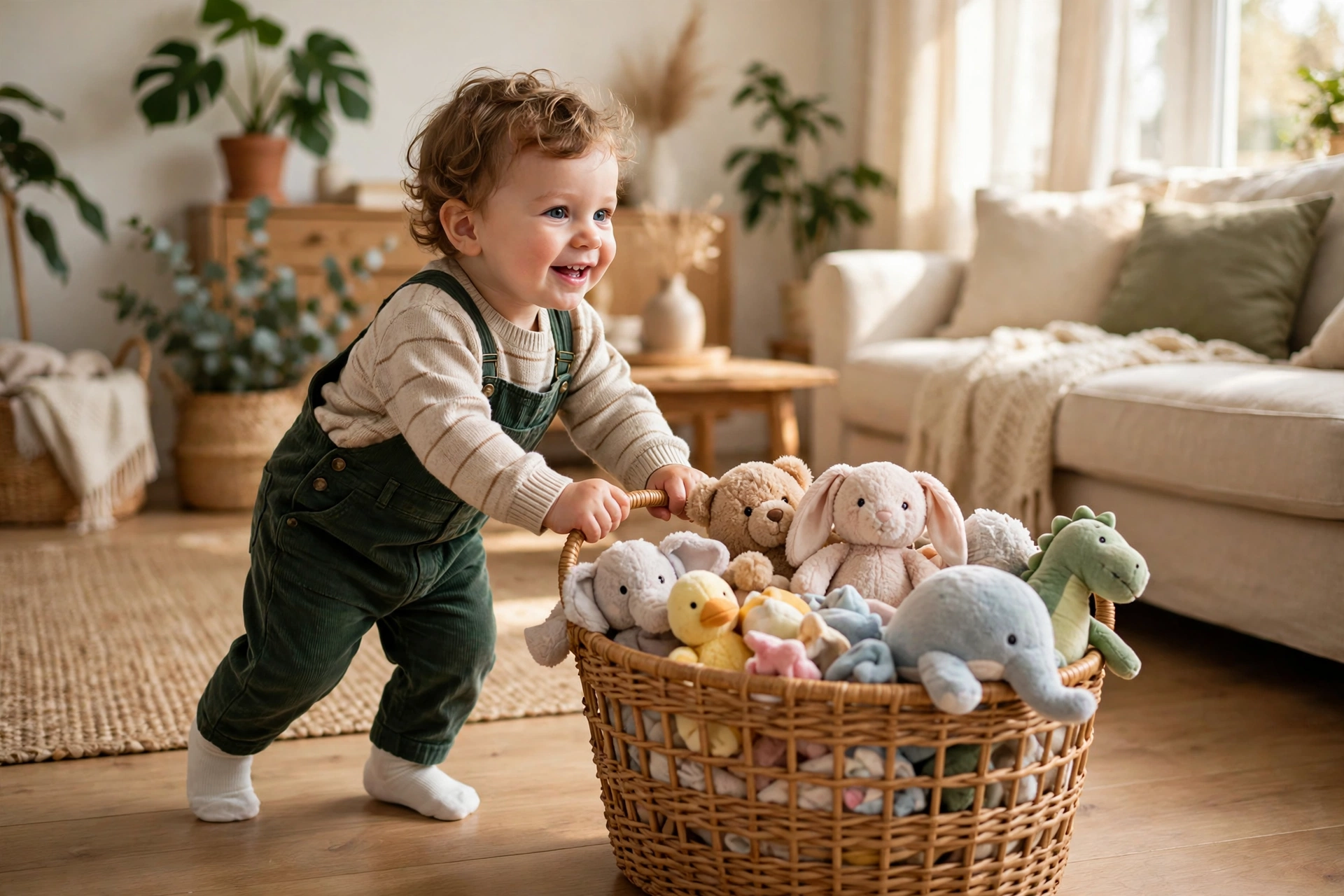
7. Push and pull
A laundry basket with a few soft toys inside, or a toy cart, pushed across the room and pulled back. Pushing builds leg strength and balance, and it is the best walking practice there is. 12 to 18 months: you hold the basket steady while they push it two steps. 18 to 24 months: they push it across the whole room and turn it around on their own. Turning 2: put a soft toy in the basket and ask them to deliver it to the other side of the room.
8. Ball roll back and forth
Sit on the floor facing your child and roll a big soft ball to them, then let them roll it back. One ball, one floor, and the whole game is taking turns. 12 to 18 months: roll the ball gently and let them stop it with both hands. 18 to 24 months: they roll it back to you, and you count each roll out loud. Turning 2: add a second ball and roll them both at the same time, then ask which one came back first.
9. Cardboard box tunnel
A big cardboard box with both ends open, laid on its side, becomes a tunnel. Your child crawls through it, pops out the other side, and runs around to do it again. 12 to 18 months: a short box with the ends open, and you peek through from the other side. 18 to 24 months: two boxes joined together for a longer tunnel, and they crawl the whole way. Turning 2: put a soft toy at the far end and ask them to go in and fetch it.
10. Dance and freeze
Put on music and dance together, then stop the music and freeze. Your child learns to listen, to stop, and to start again, and the freezing is the funniest part. 12 to 18 months: you dance and they bounce in your arms or on your lap. 18 to 24 months: they dance on their own feet and freeze when the music stops. Turning 2: they call out freeze themselves and you have to stop, which they find far funnier than the other way around.
Twenty ideas are a start, the kit covers the whole year
The No-Screen Toddler Rescue Kit sorts 115 activities by the moment you need them, including quiet time, travel, and rainy days, so the next age up is covered too. 89 pages, 28 printable activity cards, ages 2 to 5.
Instant download. Print it once, use it every day.
First words and sounds
Between 12 and 24 months, a child's spoken words go from two to fifty, and their understanding goes far past that. These five ideas give them words to hear, sounds to copy, and a reason to try talking.
11. Kitchen band
A pot, a wooden spoon, and a plastic container become a drum kit. Your child bangs, you bang back, and together you make a rhythm. Loud is fine here, because this is the noisy half of the day. 12 to 18 months: one pot and one spoon, and they bang while you clap along. 18 to 24 months: two pots with different sounds, and they switch between them. Turning 2: you play a pattern, two bangs and a pause, and they copy it back.
12. Peekaboo with a scarf
A light scarf over your face, then off, with a big hello. Your child learns that things disappear and come back, which is the first big idea of this age. 12 to 18 months: you hide and they find you, and they laugh every time. 18 to 24 months: they hide under the scarf themselves and pop out. Turning 2: hide a toy under the scarf and ask them where it went, then lift it together.
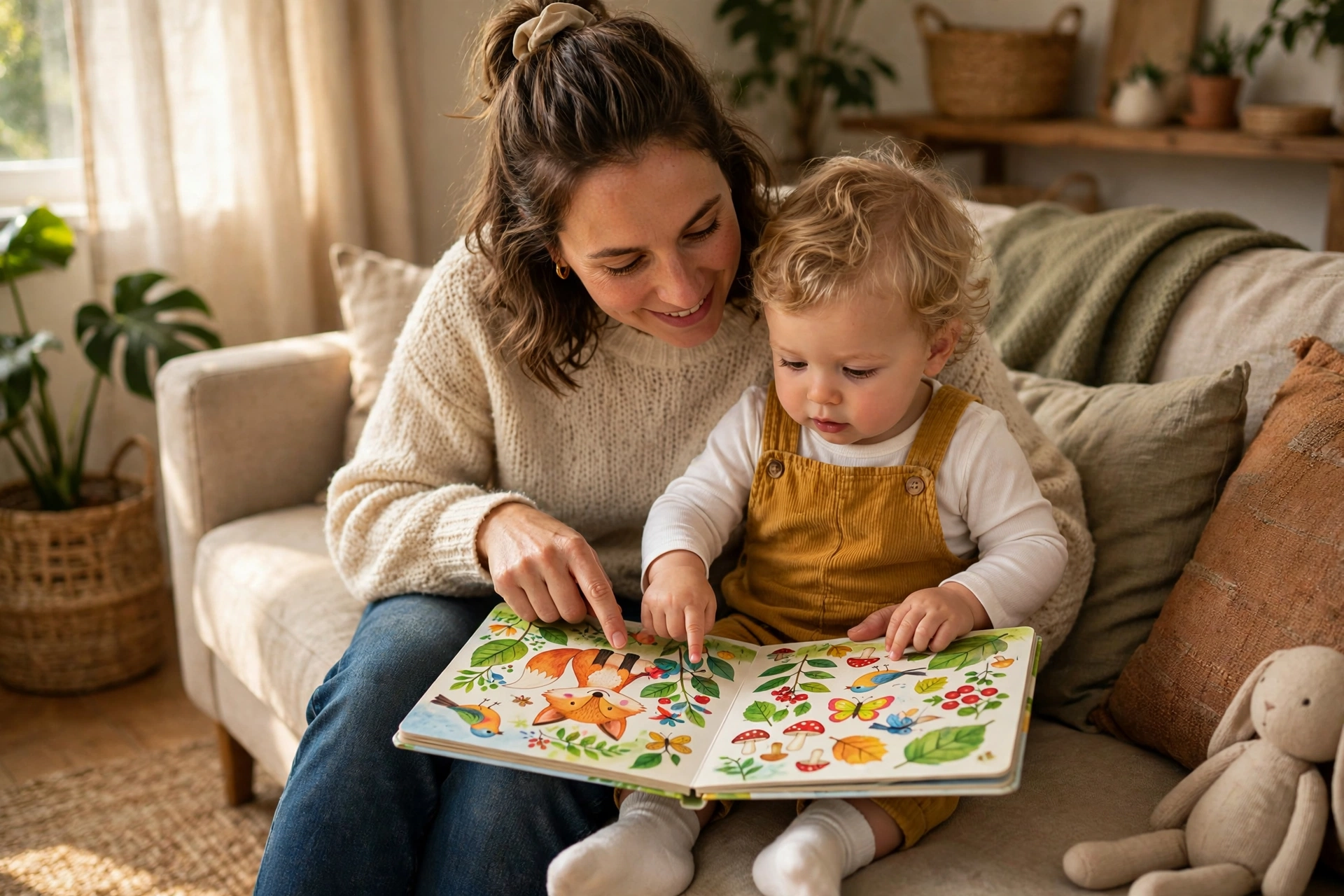
13. Point and name book
A board book with clear pictures, one per page. Point at a picture, say its name, and wait. Your child will point back, and soon they will say the word first. 12 to 18 months: one picture per page, and you name it slowly while they point. 18 to 24 months: they point at the picture and you ask what it is, then you say it together. Turning 2: they turn the pages themselves and name three pictures in a row.
14. Animal sounds game
Pick three animals, a cow, a dog, and a cat, and make the sound for each one. Your child copies the sound before they can say the word, and that is how talking starts. 12 to 18 months: one animal, a moo, and they try to copy it. 18 to 24 months: three animals, and they make the right sound when you point at the picture. Turning 2: they pick the animal and you have to make the sound, and they correct you if you get it wrong.
15. Sing and clap rhymes
Short rhymes with hand movements, like Pat-a-Cake and If You Are Happy and You Know It. Your child claps along, then copies the movements, then tries the words. 12 to 18 months: you do the movements and they watch, then they clap once at the end. 18 to 24 months: they do the clapping with you, all the way through. Turning 2: they start the rhyme themselves and you have to keep up.
Quiet hands
Not every moment needs movement. These five ideas slow the day down, build finger strength, and buy you a few quiet minutes, which is all you need to make a cup of tea.
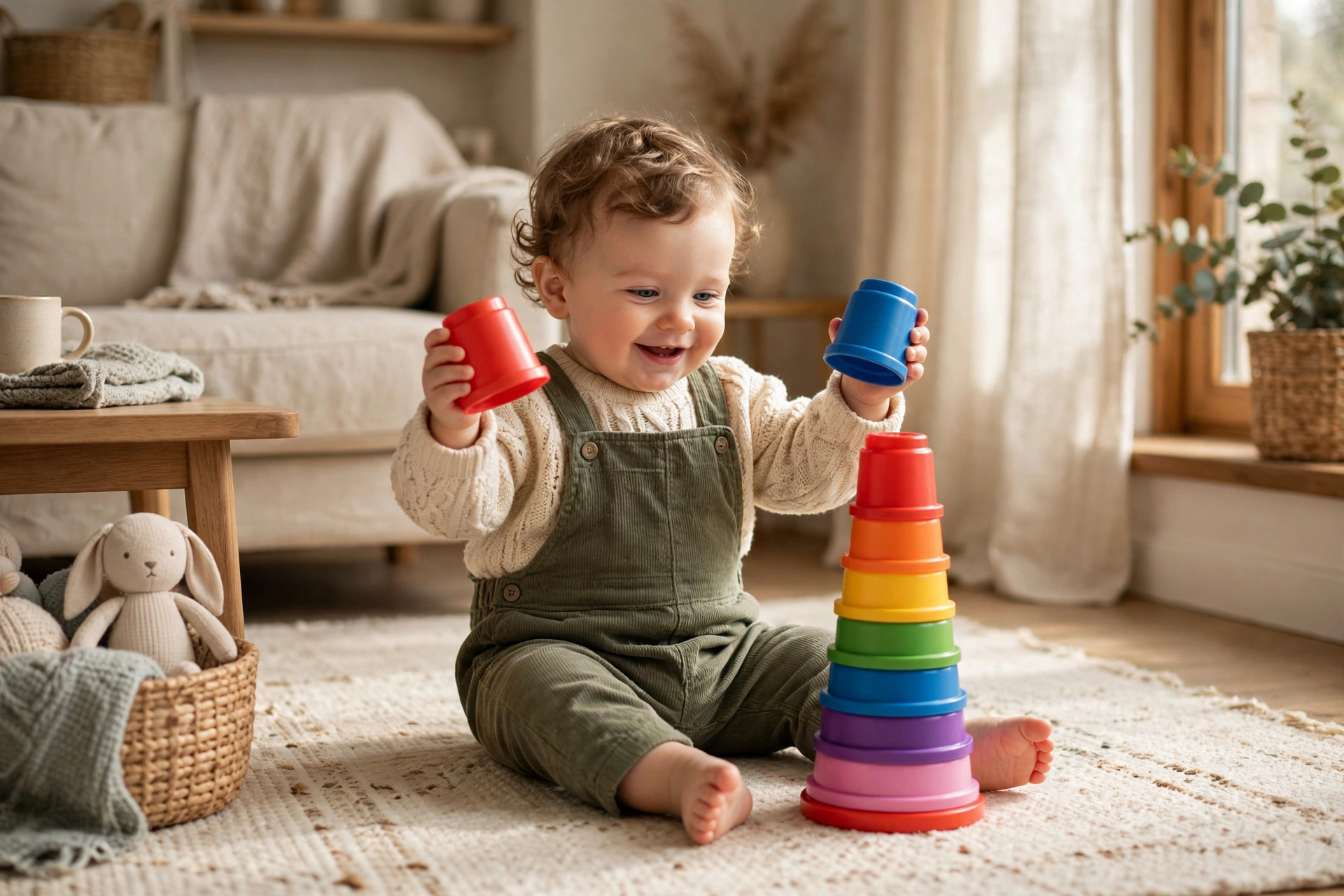
16. Stacking cups
A set of stacking cups, or plain plastic cups in different sizes. Your child stacks them, knocks them down, and stacks them again. Knocking down is the best part, and it is also the learning. 12 to 18 months: two cups, and they stack one on the other. 18 to 24 months: four cups in a tower, and they knock it down with one push. Turning 2: they stack the cups inside each other, smallest to biggest, and tell you which one is the baby cup.
17. Fill and dump
A box and a pile of soft blocks. Your child fills the box, tips it out, and fills it again. This is not a mess to stop, it is the whole activity. 12 to 18 months: three blocks and one box, and they drop them in one at a time. 18 to 24 months: ten blocks, and they fill the box, dump it, and fill it again without stopping. Turning 2: sort the blocks by color as they fill the box, all the red ones first.
18. Drop box
An empty tissue box and a set of big wooden rings, or large pom-poms the size of a fist. Your child posts them through the hole, one at a time, then tips the box over to get them back. 12 to 18 months: three big rings and a wide hole, and you hold the box steady. 18 to 24 months: six rings, and they post them all in and tip them all out on their own. Turning 2: use two boxes, one for red rings and one for blue, and they sort as they post.
19. Big sticker peeling
Large stickers, the kind made for little hands, and a sheet of paper. Your child peels the sticker off, sticks it on the paper, and peels the next one. Peeling builds finger strength, and sticking builds pride. 12 to 18 months: three very big stickers, and you start the peel for them. 18 to 24 months: a whole sheet of stickers, and they fill the paper themselves. Turning 2: they stick the stickers in a row, one after another, and count them as they go.
20. Shape sorter with big pieces
A shape sorter with only the big pieces, a circle, a square, and a triangle, each too big to swallow. Your child tries each piece in each hole until it fits, which is problem solving at its simplest. 12 to 18 months: one shape only, the circle, and they push it through the hole. 18 to 24 months: all three shapes, and they try each one until it drops in. Turning 2: they name each shape before they post it, and they turn the piece around until it fits.
The next age up is already in the kit
The No-Screen Toddler Rescue Kit gives you 115 screen-free activities for ages 2 to 5, with 28 printable cards, so when your one-year-old outgrows these ideas, the next ones are already waiting.
Instant download. Print it once, use it every day.
Educational activities for 1 year olds at home
Educational play at one looks nothing like school. There are no flashcards, no letters to learn, and no lessons to sit through, and anyone selling you those things for a one-year-old is selling you a shortcut that does not exist. What a one-year-old actually learns from is repetition, naming, and cause and effect, and every idea on this page is built on those three things.
Repetition. A one-year-old learns by doing the same thing ten times. The tenth fill and dump teaches more than the first five new activities. Repeat the favorite, do not replace it.
Naming. Say what they are touching, in the moment, in short words. Cup. Water. Cold. Dog. Woof. They understand far more than they can say, and every word you attach to a thing they are holding becomes a word they will use sooner.
Cause and effect. Push the ball and it rolls. Drop the cup and it falls. Press the shape and it pops through. A one-year-old is a scientist with no lab coat, testing the same idea again and again until it makes sense.
The four skills to cover are movement, hands, words, and senses, and the four groups on this page cover all four. If you do one idea from each group across the day, your child has had a full day of learning, and you have not taught a single lesson. What not to buy: flashcards, workbooks, and apps that promise to teach your baby. The American Academy of Pediatrics and the World Health Organization both say screens are not recommended for one-year-olds, and a stack of cups teaches more than any screen ever will. For the age after this one, the activities for 2 year olds at home page has the same day, one year older, with the learning made visible.
The 1-year-old day at home
A one-year-old does not need a schedule. They need a rhythm: a few short windows of play spread across the day, with food, naps, and free movement in between. This table is a rhythm, not a timetable, and it bends around naps and moods.
| Time of day | What to do |
|---|---|
| Morning, after breakfast | Big movement first: pillow mountain, push and pull, or a dance. Energy is highest in the morning, so spend it here. |
| Midday, before lunch | Sensory play: water pouring or the taste-safe bin. Then lunch, then a story, then the nap. |
| After the nap | First words and sounds: the point and name book, the animal sounds game, or the kitchen band. They wake up chatty, so give them words. |
| Late afternoon, the witching hour | Quiet hands: stacking cups, fill and dump, or the drop box. Slow the day down before dinner and bath. |
| Before bed | One rhyme, one book, and one peekaboo. No new activities, no big movement, just the familiar ones that say the day is ending. |
Three or four short windows are enough. Each one lasts two to five minutes of focused play, and the rest of the day is free movement, eating, napping, and being carried around the house watching you work. That is not wasted time. Watching you cook, fold laundry, and talk on the phone is how a one-year-old learns what grown-ups do, and it counts as much as any activity on this page.
One kit, every age from two to five
The No-Screen Toddler Rescue Kit covers the whole toddler years, with 115 screen-free activities for ages 2 to 5, including quiet time, travel, and rainy days, plus 28 printable activity cards.
Instant download. Print it once, use it every day.
Safety rules for 1-year-olds at home
The toilet paper tube test. If a toy or a piece of food fits through a toilet paper tube, it is too small for a one-year-old. Test every new toy, and every snack that is not soft and squishy, before you hand it over.
Water means watching. A one-year-old can drown in two inches of water in less than a minute. Never leave them alone with water, not even for a second, not even to answer the door. Water play always happens with you sitting right there, towel in hand.
Stairs and heights. A one-year-old who can climb up cannot always climb down. Gate the stairs, move the chairs away from the kitchen counter, and never let them climb on furniture unsupervised.
Small parts, every day. Coins, buttons, batteries, and older siblings' toys are the most common choking risks in a house with a one-year-old. Sweep the floor once a day, check under the sofa once a week, and keep the older child's small toys in a box with a lid.
Food is not a toy. Never let a one-year-old eat while walking, lying down, or laughing. Sit them up, watch them the whole time, and cut round foods like grapes and cherry tomatoes into quarters.
Screens off. The World Health Organization says sedentary screen time is not recommended for one-year-olds at all. A video does not teach a one-year-old words, because words at this age are learned from a real person, face to face, in the same room.
When play goes wrong
They will not sit still for any of it. That is normal at this age. A one-year-old is not supposed to sit still. Pick the movement ideas, not the quiet ones, and try the quiet hands again after the nap, when they are calmer.
They only want to dump things out. Let them dump. Fill and dump is the activity, and the tidying can wait. Give them one box they are allowed to empty, and keep the rest of the room out of reach.
They eat the playdough, the pasta, and the paint. At this age, tasting is testing. That is why every idea on this page is taste-safe or too big to swallow. If they eat it and it is safe, let them, and offer a snack after.
They cry at every new activity. New things are scary at one. Start with the familiar, the stacking cups they already know, and add one new thing a day, not five. Sit next to them and do it first, so they can copy you.
They only want to be held. That is a need, not a problem. Hold them, and do the activity with them on your lap. The kitchen band works from a lap, the point and name book works from a lap, and the peekaboo game works best from a lap.
Frequently Asked Questions
How long will one activity keep a 1-year-old busy?
Two to five minutes, and that is normal. A 1-year-old is not being difficult when they drop an activity after three minutes. Their attention span at this age is short, and the learning happens in the repetition, not in the length. Three short rounds of the same activity teach more than one long round of something new. Plan for short sessions, repeat the favorite, and stop while they are still happy, not after they are bored.
Is it normal for my 1-year-old to put everything in their mouth?
Yes. Mouthing is how a 1-year-old learns about texture, temperature, and shape, and it peaks between 12 and 18 months. It is not bad behavior and it is not something to scold. The job is to make the mouthing safe: taste-safe materials, nothing small enough to pass through a toilet paper tube, and nothing sharp or breakable. If your child is still mouthing everything at two and a half, mention it at the next checkup, but at one, it is exactly what they are supposed to do.
How much active play does a 1-year-old need every day?
The World Health Organization says children aged 1 to 2 need at least 180 minutes of physical activity spread across the day, and more is better. That sounds like a lot, but it includes everything: crawling, walking, climbing over cushions, pushing a basket, dancing in the kitchen. You do not need three hours of planned activities. You need a day with lots of moving and very little sitting in a seat or in front of a screen.
Can a 1-year-old play on their own?
In short bursts, yes. From around 12 months, most children can play alone for two to five minutes at a time, usually with something familiar like stacking cups or a fill and dump box. Stay in the room and within reach, because they will check that you are still there. Real independent play grows slowly from these tiny stretches, and the 2-year-old version of it is on the independent play page.
What do I do when my 1-year-old only wants to dump things out?
Let them. Dumping is the activity, not the mess before the activity. Filling and dumping teaches cause and effect, hand control, and the idea that things disappear and come back. Give them a box they are allowed to empty, sit next to them, and say what they are doing: in, out, all gone, again. The tidying can wait until they are asleep.
What are the best educational activities for 1 year olds at home?
The ones that repeat. A 1-year-old learns by doing the same thing ten times, not by meeting ten new things once. The best educational play at this age is naming what they touch, letting them fill and dump, stacking and knocking down, and copying the sounds you make. No flashcards, no apps, and no lessons. If an activity has a word attached to it and a chance to do it again, it is educational.
When should I worry about my 1-year-old's development?
Children reach milestones across a wide range of normal ages, so a late walker or a quiet talker is usually fine on its own. The CDC checklists show what most children can do by 12, 15, and 18 months, and they are a good way to check without guessing. Talk to your pediatrician if your child loses a skill they used to have, does not respond to their name, or is not pointing, babbling, or taking steps by 18 months. Trust your gut and ask early; that is what the checkup is for.
Sources and further reading
The World Health Organization says children aged 1 to 2 need at least 180 minutes of physical activity spread across the day, and that sedentary screen time is not recommended for one-year-olds at all. Read the WHO guidelines on play, screens, and sleep for children under five. For milestones, the CDC checklists show what most children can do by 12, 15, and 18 months, including first words, first steps, and stacking two blocks. Read the CDC 15-month milestone checklist.
Start with one idea this afternoon, the water pouring station or the stacking cups, and repeat the favorite tomorrow. That is the whole method. A one-year-old does not need a new activity every day, they need the same good one, with you next to them, and let activities for 1 year olds at home do the teaching while you watch them learn. For the next age up, the activities for 2 year olds at home page has the same day, one year older, and the sensory activities for toddlers at home page has the messy half of this list, sized up for ages 2 to 5. For the short version of this day, the 15-minute toddler activities page has the quick plans, and the independent play activities for toddlers page has the calm ideas for the day your one-year-old turns two.