
Airplane Activities for Toddlers: 20 Easy Screen-Free Ideas for Ages 2 to 5
Updated November 8, 2026
Airplane activities for toddlers work best when everything fits on a tray table. A plane seat is the smallest playroom your child will ever sit in, and it comes with rules: nothing loud, nothing messy, nothing that rolls down the aisle, and nothing that needs the whole row to cooperate. Most plane lists ignore those rules. They suggest playdough, paint, or a toy with fifty pieces, and then your toddler drops half of it under the seat in front, and you spend the flight apologizing to strangers. This page gives you 20 ideas that pass a stricter test, sorted into four groups of five: quiet hands on the tray table, paper and stickers, snacks that double as play, and pretend play and stories. Every one works in a single seat, uses things you can pack in one small bag, and comes with the age two version, because a two-year-old and a five-year-old are not playing the same game, even when they are sitting in the same row.
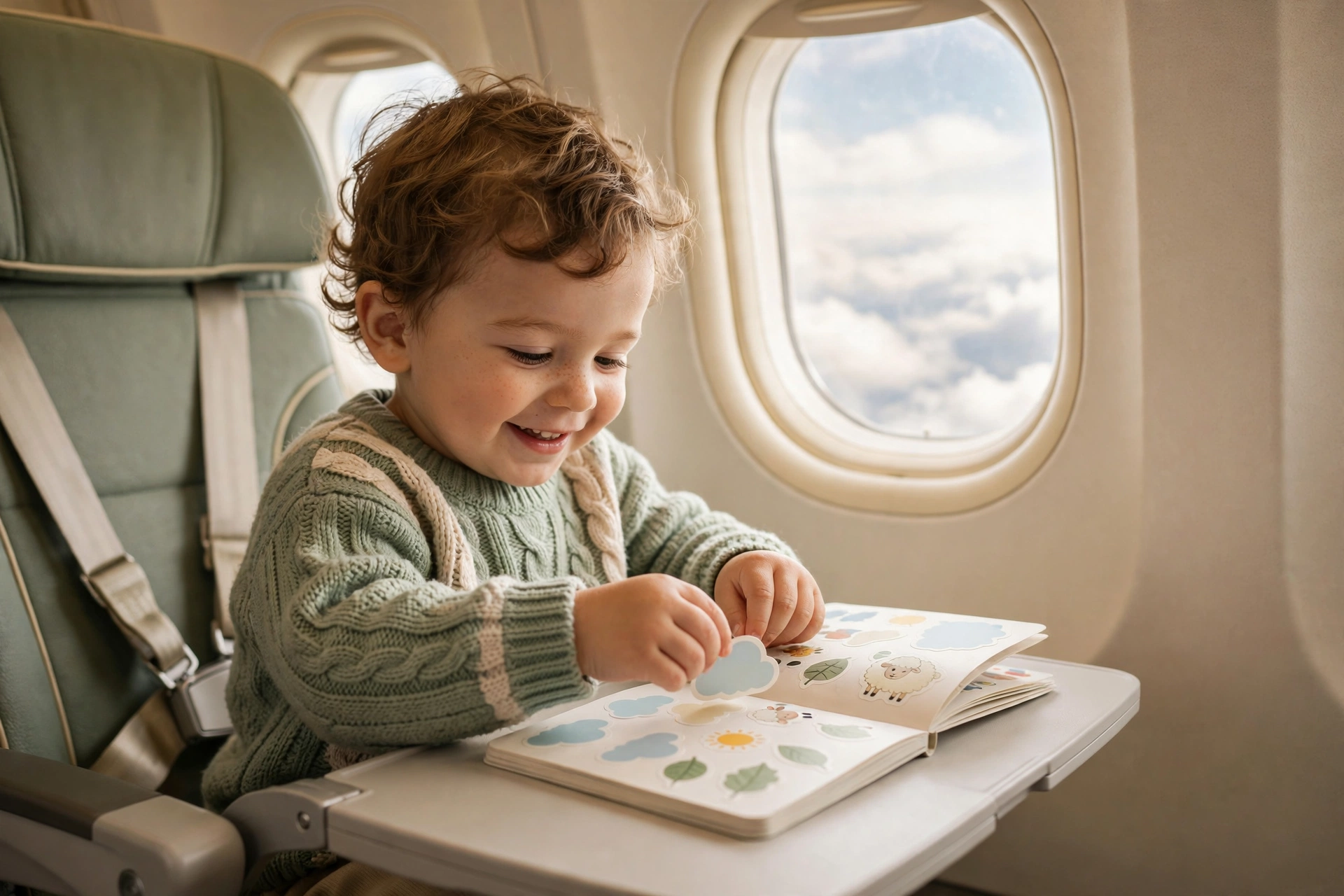
The Seat Test
Every idea on this page passes three questions. If an activity fails even one, it is not on this page.
1. Does it fit on a tray table? The whole activity, supplies and all, must fit in the space of one tray table or one lap. If it needs the floor, the empty seat, or the aisle, it fails.
2. Does it make zero mess? No paint, no glue, no crumbs that scatter, nothing that stains a seat. If cleanup needs more than one wipe, it fails.
3. Does it make zero noise? No beeps, no songs with sound, no banging. A quiet cabin is full of people who paid for their seats too. If an activity needs volume, it fails.
The test matters because flying fails most often at packing, not at playing. A parent packs a big toy, the toddler plays with it for three minutes, and then it is on the floor, under a stranger's foot, and the flight has three hours left. These 20 ideas skip that trap. Pack small, pack quiet, and pack more than you think you need, because a toddler on a plane goes through activities the way they go through snacks, one after another, and the next one is always the favorite. For the car and train version of this day, the toddler travel activities page has the wider trip plan.
20 airplane activities for toddlers for every kind of flight
Every one of these airplane activities for toddlers passes the Seat Test. Pick one group for takeoff and ignore the rest until you need them. Repeat the favorite on the way home instead of hunting for a new one. A toddler learns more from the fifth time they peel a sticker than from the first time they try five new things.
Quiet hands on the tray table
These five ideas keep little hands busy without a sound, which makes them the best place to start, especially on an early morning flight when the cabin is still half asleep.
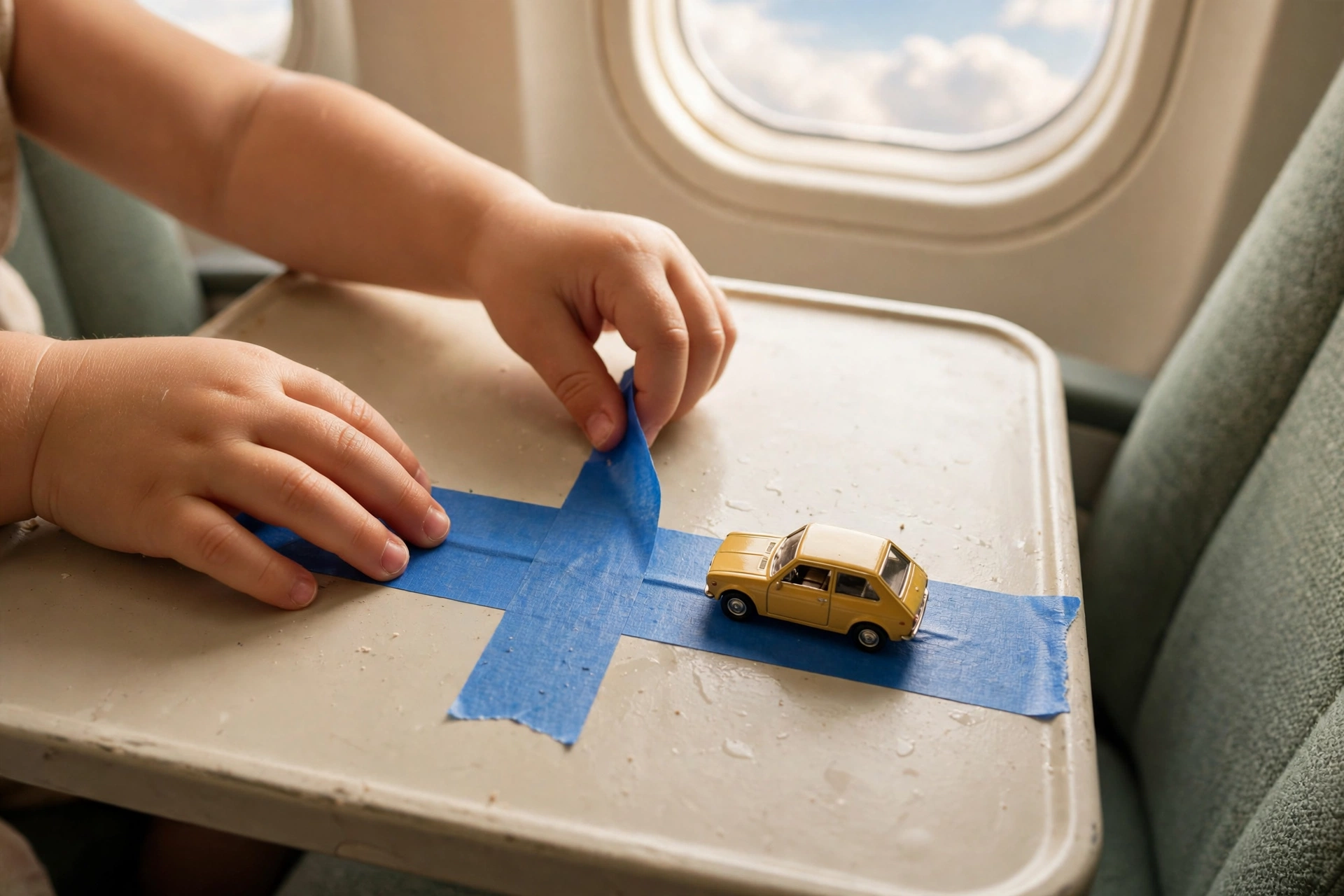
1. Painter's tape roads
A small roll of painter's tape and one toy car turn the tray table into a road. Stick two strips down as a road, add a turn, and let your toddler drive the car along it. The tape peels off clean and leaves nothing behind. Age 2: one straight road and one car, and they push it back and forth. Age 3 to 4: add a parking space and a stop sign drawn on a sticky note, and they stop at every sign. Age 5: they build the road themselves, with a roundabout and a petrol station, and they tell you the traffic rules.
2. Sticker scenes
A reusable sticker book with a background scene, a farm, a beach, or a town, and a sheet of stickers to place on it. Your toddler peels, places, peels again, and rearranges the whole scene. It is quiet, it is contained, and one book can last half an hour. Age 2: big puffy stickers and one scene, and they place them wherever they like. Age 3 to 4: they build a scene with a story, and they tell you what each sticker character is doing. Age 5: give them two scenes and let them move the characters between them, like a play in two acts.
3. Water Wow book
A water reveal book and its refillable pen turn white pages into colors with water alone. No paint, no mess, and the pages dry and reset, so the same book works again on the way home. Age 2: a fat pen and big shapes, and they watch the color appear. Age 3 to 4: they color a whole page and name every color as it shows up. Age 5: they race the drying, finishing one page before the first one fades.
4. Gel window clings
Soft gel shapes that stick to the window or the tray table, peel off, and stick again. Animals, letters, or shapes, all reusable and all silent. Age 2: five big shapes to stick and peel, over and over. Age 3 to 4: sort them by color on the tray table, then stick them on the window in a row. Age 5: they make a picture on the window and tell you the story of it.
5. Post-it peekaboo
A pad of sticky notes and a pen. Draw a shape, a face, or a letter on the tray table, cover it with a sticky note, and let your toddler lift it to find what is hiding. Then they draw the next one for you to find. Age 2: you draw, they lift, and they laugh every time. Age 3 to 4: they draw the hiding picture and you guess what it is before you lift the note. Age 5: they write a letter or a number under each note and you guess it before you peek.
Paper, stickers and drawing
Paper is the lightest thing you can pack, and it does the most work. These five ideas need nothing more than a small pad, a pencil, and a sticker sheet, and they all fit in one zip bag.
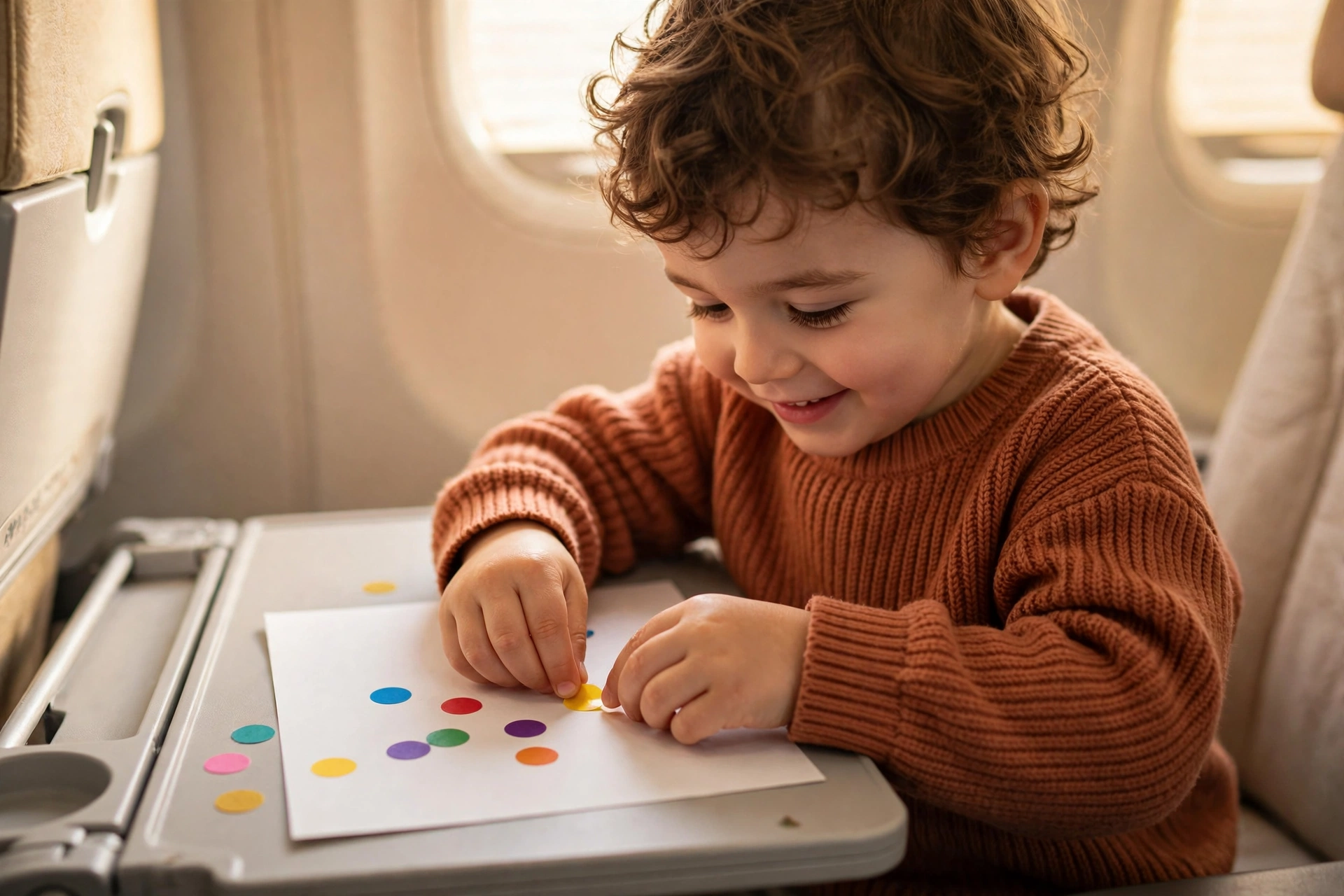
6. Dot sticker counting
A sheet of dot stickers and a piece of paper with five circles drawn on it. Your toddler sticks one dot in each circle, then counts them out loud. Then you draw a new sheet, with more circles, and they do it again. Age 2: three big circles and three dots, and you count together. Age 3 to 4: ten circles in two rows, and they count to ten on their own. Age 5: draw a simple shape, like a star or a house, and they fill it with dots of one color each.
7. Doodle board
A small magnetic doodle board or an LCD drawing tablet lets your toddler draw, erase, and draw again with one button. No paper, no mess, and nothing to drop except the pen, so tie it to the board with a short string. Age 2: scribbles and big circles, and you name what they drew. Age 3 to 4: they draw their family, one person at a time, and tell you each name. Age 5: you start a drawing and they finish it, then they start one and you finish it.
8. Paper finger puppets
Cut five small finger puppets from paper before the flight, one for each finger, and let your toddler put on a show on the tray table. A cat, a dog, a bird, a fish, and a bear are enough for any story. Age 2: you wear two puppets and they wear one, and the puppets say hello to each other. Age 3 to 4: they wear all five and make each one talk in a different voice. Age 5: they invent a whole story with a problem and an ending, and the puppets act it out.
9. Lacing cards
A stiff card with holes punched around the edge and a short shoelace with a taped end. Your toddler threads the lace in and out of the holes, which builds finger strength and buys ten quiet minutes. Age 2: a card with four big holes and a thick lace, and you hold the card steady. Age 3 to 4: a card with ten holes in a shape, and they lace all the way around. Age 5: they lace a pattern, over one hole and under the next, and they try to keep it even.
10. Fold and guess
A sheet of paper, folded in half, with half a drawing on one side. Your toddler guesses what the whole picture is, then opens the paper to check. A butterfly, a house, or a face all work. Age 2: you draw half a circle and they guess it is a sun or a ball. Age 3 to 4: half an animal, and they guess which animal before you open it. Age 5: they draw the half picture for you, and you have to guess.
Twenty ideas are a start, the kit is the whole trip
The No-Screen Toddler Rescue Kit sorts 115 activities by the moment you need them, including travel, waiting rooms, and quiet time, so the hours after the flight are covered too. 89 pages, 28 printable activity cards, ages 2 to 5.
Instant download. Print it once, use it every day.
Snacks that double as activities
On a plane, a snack is never just a snack. It is ten minutes of sorting, building, and tasting, and it works twice as well when you slow it down on purpose.
11. Snack sorting cups
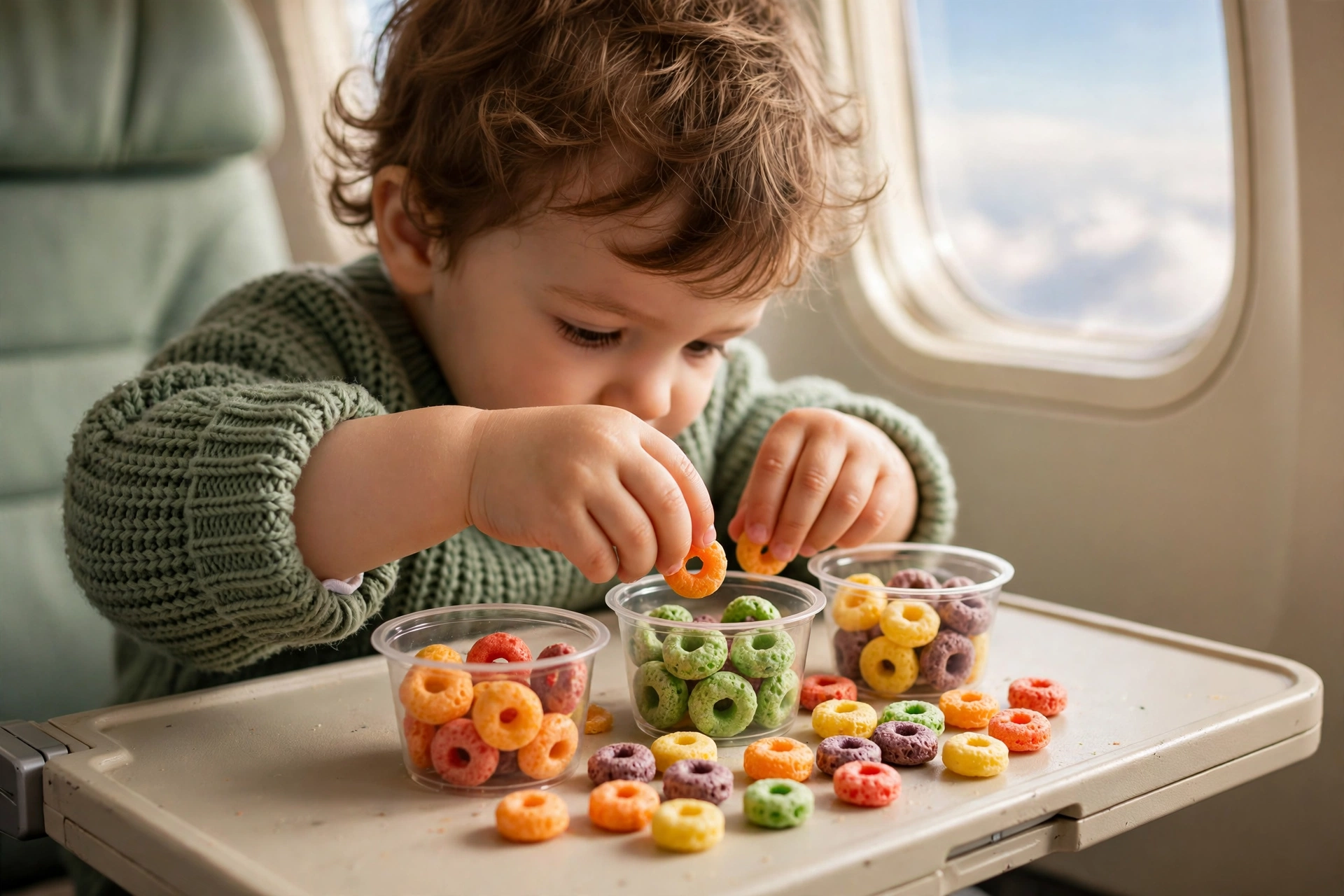
Three small cups and a handful of mixed snacks, like cereal pieces in three colors. Your toddler sorts them by color, one cup per color, and eats the sorting when they finish. Age 2: two cups and two colors, and you sort the first few together. Age 3 to 4: three colors and they count each cup when they finish. Age 5: they sort by color and then by shape, and they tell you which cup has the most.
12. Cereal threading
A piece of string with a knot at the end and a small bowl of ring-shaped cereal. Your toddler threads the rings onto the string to make a necklace, then eats it one ring at a time. Age 2: a thick pipe cleaner instead of string, and five rings only. Age 3 to 4: a real string and ten rings, and they count as they thread. Age 5: they make a pattern, two of one color and one of another, and they keep it going.
13. Pretzel stick building
Thin pretzel sticks and soft cheese cubes make building blocks you can eat. Stack them into a tower, a bridge, or a house, then eat the building. Age 2: they push the sticks into the cheese and make a spiky ball. Age 3 to 4: they build a tower three sticks high and try to keep it standing. Age 5: they build a bridge between two cups and test it with one more cheese cube on top.
14. The slow snack box
A small pill box or a container with seven little compartments, each with one tiny snack inside. Your toddler opens one compartment at a time, and each one is a surprise. Seven compartments buy seven small moments, which is longer than one big bag of crackers. Age 2: three compartments with big pieces they can grab easily. Age 3 to 4: all seven, and they guess what is inside before they open each one. Age 5: they fill the box themselves the night before, and they decide the order.
15. Snack guessing game
Three snacks in small cups, and your toddler closes their eyes, tastes one, and guesses what it is. A cracker, a piece of cheese, and a dried fruit slice are different enough to guess and similar enough to be fun. Age 2: two snacks and you tell them the names first, then they guess. Age 3 to 4: three snacks and they guess without any hints. Age 5: they feed you one with your eyes closed, and you have to guess.
Pretend play and stories
When the tray table ideas run out, the best activities need nothing at all. These five use voices, hands, and imagination, and they work in the seat, in the aisle, and in the queue at the gate.
16. Wrapped surprises
Wrap four or five tiny toys in paper before the flight, one per layer, and hand your toddler one when the energy dips. Unwrapping is the activity, and the toy inside is the bonus. Age 2: one layer of tissue paper and a soft toy they already love. Age 3 to 4: two layers and a small new toy, like a tiny car or a finger puppet. Age 5: three layers with a tiny note inside each one, and they read the note before the next layer.
17. Finger rhymes and songs
Rhymes with hand movements keep hands busy and voices quiet. Itsy Bitsy Spider, Pat-a-Cake, and Five Little Ducks all work in a seat, and they calm a tired toddler better than any toy. Age 2: you do the movements and they copy one hand at a time. Age 3 to 4: they do the whole rhyme on their own and pick the next one. Age 5: they make up a new verse, and you have to learn it on the spot.
18. Aisle walk game
When the seatbelt sign is off, take a slow walk down the aisle and turn it into a game. Count the blue seats, find a window with clouds, and wave at the crew. One walk buys fifteen minutes, and the movement resets a restless toddler. Age 2: you carry them and point at things together. Age 3 to 4: they walk holding your hand and count the seats out loud. Age 5: they lead the walk and tell you what they can see.
19. Window spotting bingo
A small card with nine squares, each with a simple picture: a cloud, a wing, a sun, a river, a road, a field, another plane, a town, and a mountain. Your toddler marks each one as they spot it out the window. Age 2: three squares and you point at the first one. Age 3 to 4: the full card and they mark each find with a sticker. Age 5: they make their own card before the flight and race you to finish it.
20. Story sack
Five tiny objects in a small cloth bag: a toy animal, a spoon, a shell, a key, and a button. Your toddler pulls one out at a time, and each object starts a new part of the story. The animal meets the shell, the key opens a door, and the story grows. Age 2: you pull the objects out and tell the story while they hold each one. Age 3 to 4: they pull the objects out and tell you what happens next. Age 5: they tell the whole story from start to finish, with a problem in the middle and a happy ending.
The flight lands, the kit keeps the day going
The No-Screen Toddler Rescue Kit gives you a full day of screen-free play for ages 2 to 5, with 115 activities and 28 printable cards, so the hours after you land are covered too.
Instant download. Print it once, use it every day.
Airplane activities for toddlers on a long flight
No single activity survives a long flight, so the plan is rotation, not one big toy. Work through the flight in blocks, and change the activity before your toddler gets bored, not after.
| Flight phase | What to do |
|---|---|
| Boarding | Let them look out the window and find the wing. One new sticker book, still sealed, keeps them still while everyone boards. |
| Takeoff | Drink or snack in hand for ear pressure. A quiet activity like gel clings, nothing new, nothing exciting, just something to hold. |
| Cruising, first hour | Quiet hands on the tray table: tape roads, sticker scenes, Water Wow. Change every ten minutes. |
| Cruising, middle | Paper and snacks: dot stickers, then the slow snack box. This is the hardest hour, so save one wrapped surprise for it. |
| Cruising, last hour | Pretend play and stories: finger rhymes, story sack, window bingo. A walk down the aisle when the sign is off. |
| Descent and landing | Drink or snack again for ears. Pack everything away together, one job each, so landing feels like the end of the game. |
On a flight under two hours, you only need the first three blocks. On a flight over four hours, run the whole plan twice, with a nap in the middle if you are lucky.
What to pack: the flight bag
Pack the night before, in one small backpack, and keep it under the seat in front of you. The overhead bin is too far away when you need the next activity in ten seconds.
| Bag pocket | What goes in it |
|---|---|
| Front pocket | Wipes, one plastic bag for rubbish, and the comfort toy. |
| Main pocket | Eight to twelve small activities in separate zip bags, one per idea, so you open one at a time. |
| Side pocket | Water bottle and two small snack containers, already filled. |
| Bottom of the bag | One change of clothes and two spare nappies or pants, in case of spills or accidents. |
| Your bag | Extra snacks, extra wipes, and one brand-new toy, still wrapped, for the hardest hour. |
Pack more snacks than you think you need, and fewer toys than you want to. Snacks always get used. Toys get dropped under seats.
Waiting at the gate? The kit has the airport half
The No-Screen Toddler Rescue Kit covers the whole travel day, with 115 screen-free activities for ages 2 to 5, including waiting rooms, queues, and calm wind-downs, plus 28 printable activity cards.
Instant download. Print it once, use it every day.
Ear pressure: the takeoff and landing fix
Changes in air pressure during takeoff and landing can make a toddler's ears hurt, and a hurting toddler cries. Swallowing eases the pressure, so the fix is simple: offer a drink, a snack, or a dummy during takeoff and landing. A toddler who is chewing or sipping is usually a comfortable toddler. If your child had an ear infection in the two weeks before the trip, ask your doctor if it is safe to fly, and never give medicine to make them sleepy without asking your doctor first. The American Academy of Pediatrics also warns that turbulence is the leading cause of children's injuries on planes, so keep your toddler buckled in their own seat whenever the seatbelt sign is on, and use an approved car seat or harness if they have their own seat.
Flight safety rules for ages 2 to 5
Small parts. No beads, buttons, or tiny pieces for under-threes. If it fits through a toilet paper tube, it is too small, and a plane is the worst place to lose it. The CDC lists the foods and objects that most often cause choking in young children, and it is worth a quick read before you pack the snack bag.
Nothing that rolls. Balls, marbles, and round toys roll down the aisle and under seats. If it can roll, leave it at home.
Nothing noisy. No toys with sound, no banging on the tray table, no shouting games. A quiet cabin is shared space.
Nothing sticky. No glue, no slime, no markers that stain. If it leaves a mark on a seat, it does not fly.
Seatbelt on. Keep the seatbelt fastened whenever the sign is on, even if your toddler wants to stand. Turbulence arrives without warning.
Watch them while they eat. Never let a toddler eat while lying down or walking in the aisle. Sit them up, watch them the whole time, and keep meals calm.
When the flight goes wrong
They refuse to sit down. Start with the window and one new activity, not a lecture about sitting still. Let them stand on your lap for a minute and look out, then sit them down with the sticker book.
They cry at takeoff. Offer a drink or a snack straight away, for the ears, and hold them close. Most takeoff tears stop within minutes once the pressure evens out.
They drop everything on the floor. That is why the activities are in zip bags. Pick up one bag, not fifty pieces, and carry on.
They want the tablet. Offer the wrapped surprise instead. Unwrapping is an activity of its own, and it buys the ten minutes the tablet would have bought.
A meltdown starts mid-flight. Stay calm, lower your voice, and take a slow walk down the aisle when the sign is off. Offer a snack or the comfort toy first. Most meltdowns on planes come from tiredness, ear pressure, or boredom, and all three pass.
Frequently Asked Questions
How do I keep a 2-year-old busy on a plane?
Give them one small job at a time and change it every five to ten minutes. A 2-year-old will not sit with one toy for half an hour, and that is normal. Sticker peeling, tape pulling, snack sorting, and a wrapped surprise each buy a few calm minutes, and four or five of those in a row cover a whole hour. Keep the next activity hidden until the current one ends, or they will drop it and ask for the new one.
How long will one activity keep a toddler busy on a flight?
Most toddlers stay with one activity for five to ten minutes, and a favorite can stretch to fifteen. Plan for that, not for an hour. A two-hour flight needs eight to twelve small activities, not two big ones. That is why this page has twenty ideas instead of five, and why the flight plan below rotates them in short blocks.
What should I pack in a toddler flight bag?
One small backpack per child, with eight to twelve small activities in separate zip bags, a water bottle, snacks in small containers, a change of clothes, wipes, a comfort toy, and a plastic bag for rubbish. Pack it the night before and keep it under the seat in front of you, not in the overhead bin, or you will be standing up every ten minutes. The full checklist is in the packing table below.
How do I help my toddler's ears on takeoff and landing?
Swallowing eases the pressure, so offer a drink, a snack, or a dummy during takeoff and landing. A toddler who is chewing or sipping is usually a comfortable toddler. If your child had an ear infection in the two weeks before the trip, ask your doctor if it is safe to fly. Do not give medicine to make them sleepy without asking your doctor first.
Can I bring snacks and milk through airport security?
Yes. Formula, breast milk, and water for mixing powder are exempt from the normal liquid limit in reasonable quantities, and you can ask for them to be screened separately. Toddler snacks in solid form, like crackers, fruit, and cheese, go through in your bag as normal. Pack them separately and tell the security staff what you have, so the check takes seconds instead of minutes.
What are the best airplane activities for toddlers on a long flight?
The ones that rotate. No single activity survives a long flight, so the best plan is a mix: quiet hands on the tray table first, then paper and stickers, then a snack activity, then pretend play, then a walk down the aisle, then start again with something new. Wrapped surprises help most on long flights, because unwrapping is an activity of its own. Save one brand-new toy for the hardest hour, usually the middle of the flight.
What do I do if my toddler cries the whole flight?
Stay calm and lower your voice, because your calm is contagious and your panic is too. Offer a snack or a comfort toy first, then try a short walk down the aisle when the seatbelt sign is off. Most crying on planes comes from tiredness, ear pressure, or boredom, and all three pass. Ignore the stares. Every parent on that plane has been the one with the crying child, and the flight ends whether you worry about it or not.
Sources and further reading
The American Academy of Pediatrics answers the questions parents ask most about flying with little ones, including ear pressure, car seats and harnesses, liquids through security, and why turbulence is the leading cause of children's injuries on planes. Read the American Academy of Pediatrics on flying with a baby. For the snack bag, the CDC lists the foods and objects that most often cause choking in young children, with simple preparation rules that lower the risk. Read the CDC guide to choking hazards.
If the flight works, the rest of the trip gets easier. Start with one idea on the way out, repeat the favorite on the way home, and let airplane activities for toddlers do the heavy lifting while you sit back and breathe. For the car and train version of this day, the toddler travel activities page has the wider trip plan, and the independent play activities for toddlers and quiet activities for toddlers pages have the calm ideas for the hotel room after you land. For the younger ones, the activities for 2 year olds at home page has the at-home version of this day, and the 15-minute toddler activities page has the short plans for the days when you only have a few minutes.