Toddler Learning Activities at Home: 20 Easy Ideas That Actually Teach Something
Updated November 11, 2026
Toddler learning activities at home work when they look nothing like school. No worksheets, no flashcards, no apps, no lessons to sit through. A toddler learns by doing, guessing, and repeating: counting snacks onto a plate, sorting laundry by colour, naming everything on a walk, and testing what sinks or floats. Every idea on this page is built on that rule, sorted into four groups of five by the skill it teaches: language, numbers, sorting and thinking, and science and discovery. Every idea uses things already in your house, takes 5 to 15 minutes, and comes with the version for age 2, the version for ages 3 to 4, and the stretch for age 5. The heart of this page is a simple test: if an activity has no doing in it, it is not a learning activity, it is a lecture.
Learning activities for toddlers: what the research says
Before the ideas, here is what the research actually says, in plain words, so you know why this page is built the way it is.
| What the research says | What it means for you |
|---|---|
| Play equals learning | Over 40 years of research shows that play is learning. When children have choices, follow their interests, and have fun, learning takes place best. Direct instruction teaches less than play at this age. |
| Experiencing beats memorizing | When children learn something by experiencing it, they learn it faster and more meaningfully. A child who counts three blocks understands three. A child who memorizes a flashcard that says 3 has memorized a shape. |
| Talk back and forth | The Harvard Center on the Developing Child calls it serve and return: your child serves with a look, a point, or a word, and you return it with attention and words. Those everyday exchanges build the brain connections that support communication. |
| Describe more, quiz less | Instead of asking what colour something is, say what your child is doing. Comments give words without pressure and leave the next turn open. Quizzing turns play into a test. |
| Learning in context is real learning | Rectangles in buildings, hexagons in stop signs, one napkin for every person at the table. That is one-to-one correspondence, and it is maths, learned at the dinner table. |
Read the table as permission, not homework. You do not need to teach. You need to talk, set up a few things, and let your child do the rest. For the age-by-age version of this page, the activities for 2 year olds at home page has the age 2 day, and the activities for 5 year olds at home page has the kindergarten year.
20 toddler learning activities at home for every kind of day
Every one of these toddler learning activities at home is built for an ordinary day, with ordinary things, in 5 to 15 minutes. Pick one group for the morning and one for the afternoon, and ignore the rest until you need them. Repeat the favorite tomorrow instead of hunting for a new one. A toddler learns more from the third time they sort the same laundry than from the first time they try ten new things.
Language: words and stories
Language is the first skill, and it grows by talking, not by drilling. These five ideas give your child words by using them, in games that feel like play.
1. Point and name walk
Walk around the house or the garden and name everything you see, out loud, in full sentences. The big brown dog is running. The red car is parked. Your child points, you name it, and they repeat the word. Age 2: one word at a time, and they point. Ages 3 to 4: full sentences, and they name it first. Age 5: they describe it themselves, and you ask one more question about it.
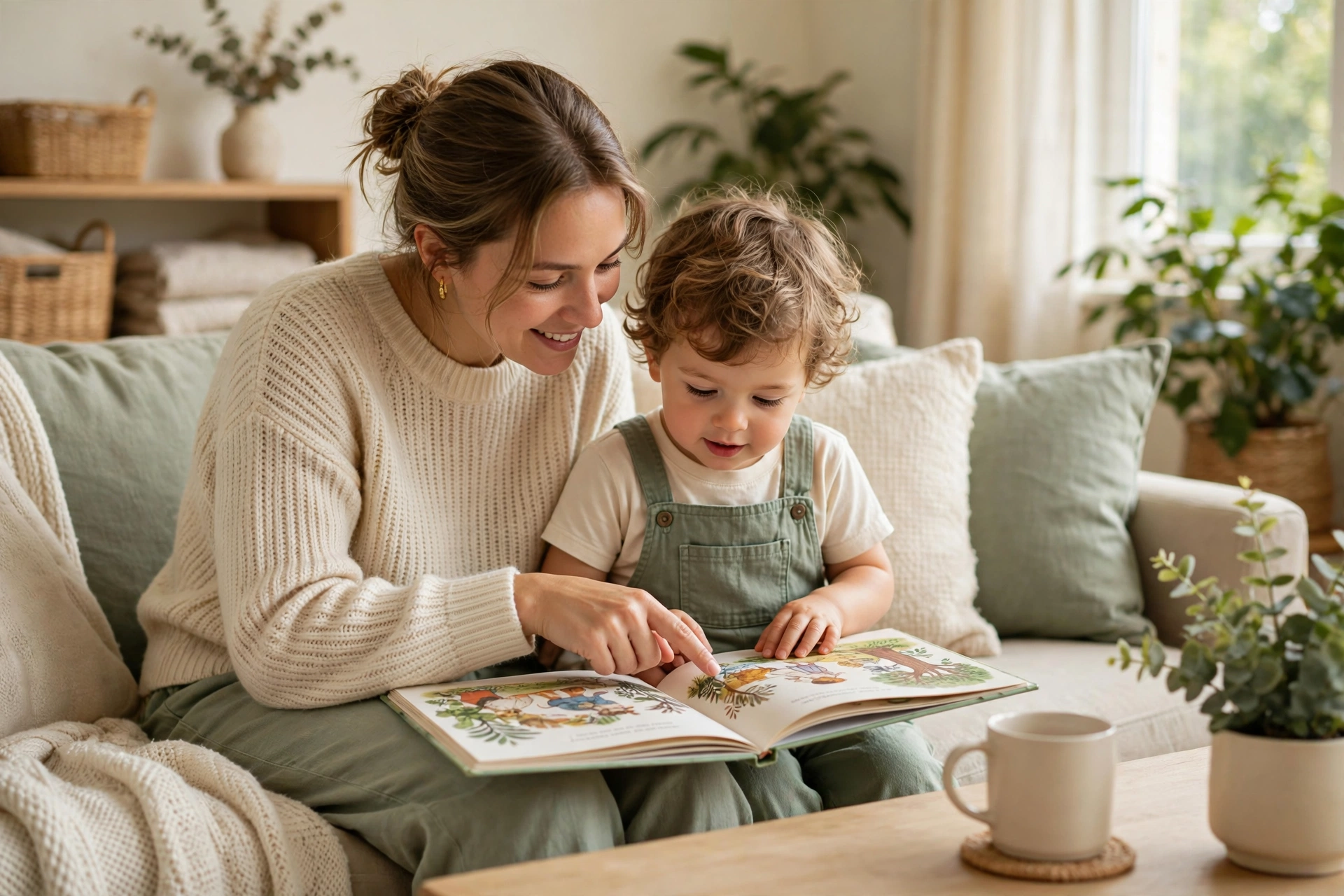
2. Picture book treasure hunt
Open a favorite picture book and hunt for things in it. Can you find the dog? Where is the moon? Pointing and naming builds understanding before speech catches up. Age 2: point at the dog, and you name it. Ages 3 to 4: they find it and say the word. Age 5: they find it, say the word, and tell you what the dog is doing.
3. Rhyme fill-in
Sing a nursery rhyme and clap along, pausing before the last word so your child fills it in. Twinkle twinkle little, and they say star. Age 2: they fill in one word, and you clap. Ages 3 to 4: they fill in the last word of every line. Age 5: they sing the whole rhyme, and you fill in the word they leave out.
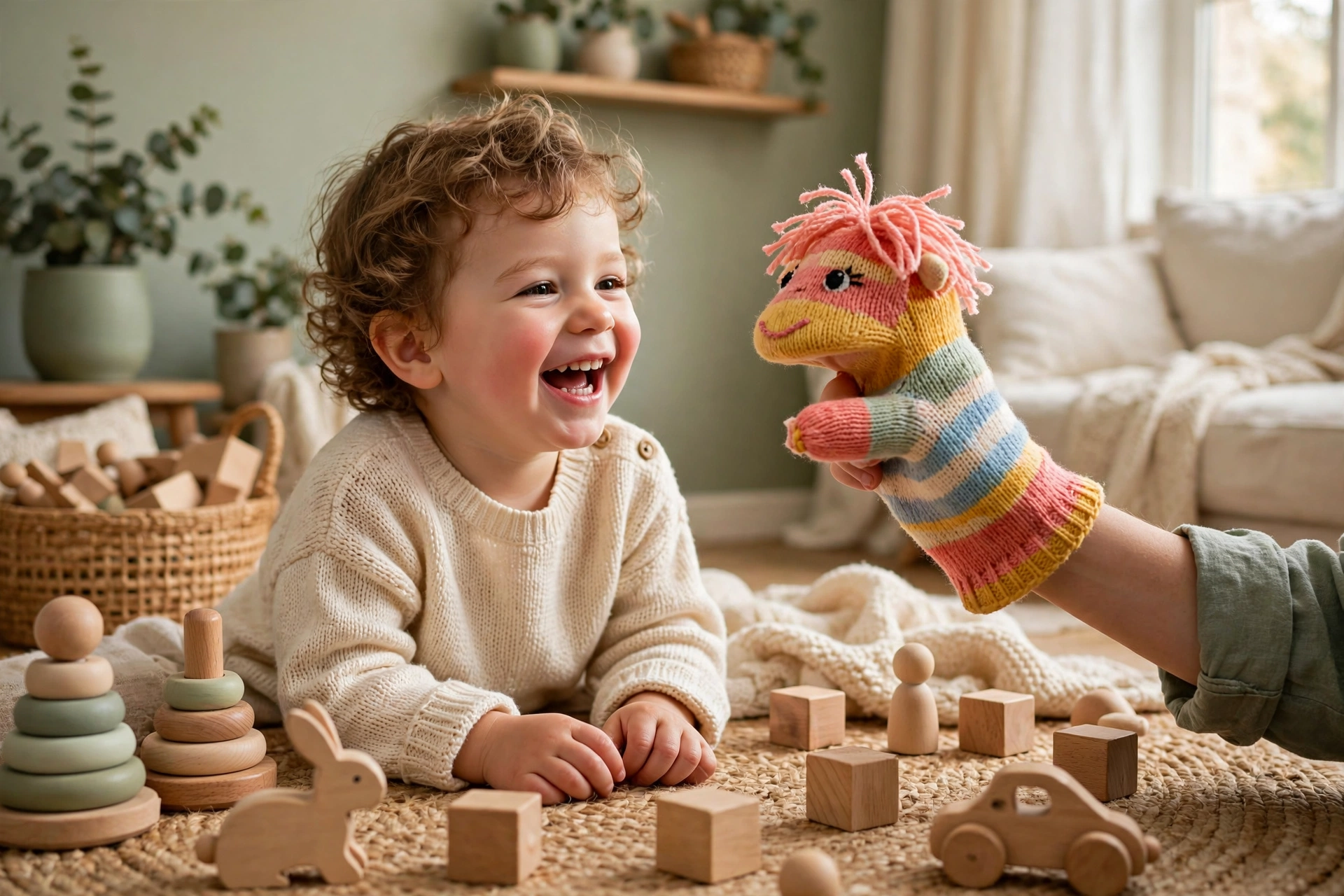
4. Sock puppet chat
A clean sock on your hand becomes a puppet that asks questions. What did you eat today? Where is your nose? Your child answers the puppet, and the puppet answers back. Age 2: the puppet asks one question, and they point. Ages 3 to 4: the puppet asks three questions, and they answer in words. Age 5: they wear the puppet and ask you the questions.
5. Story retelling
Read a favorite picture book together, then close it and ask your child to tell the story back to you, in their own words, with toys acting it out. Age 2: they retell the beginning, and you help with the rest. Ages 3 to 4: they retell the whole story, beginning, middle, and end. Age 5: they change the ending and tell you their version instead.
Numbers: counting and measuring
Numbers are everywhere, and a toddler learns them by touching and counting, not by looking at them on a screen. These five ideas turn the house into a maths lesson nobody notices.
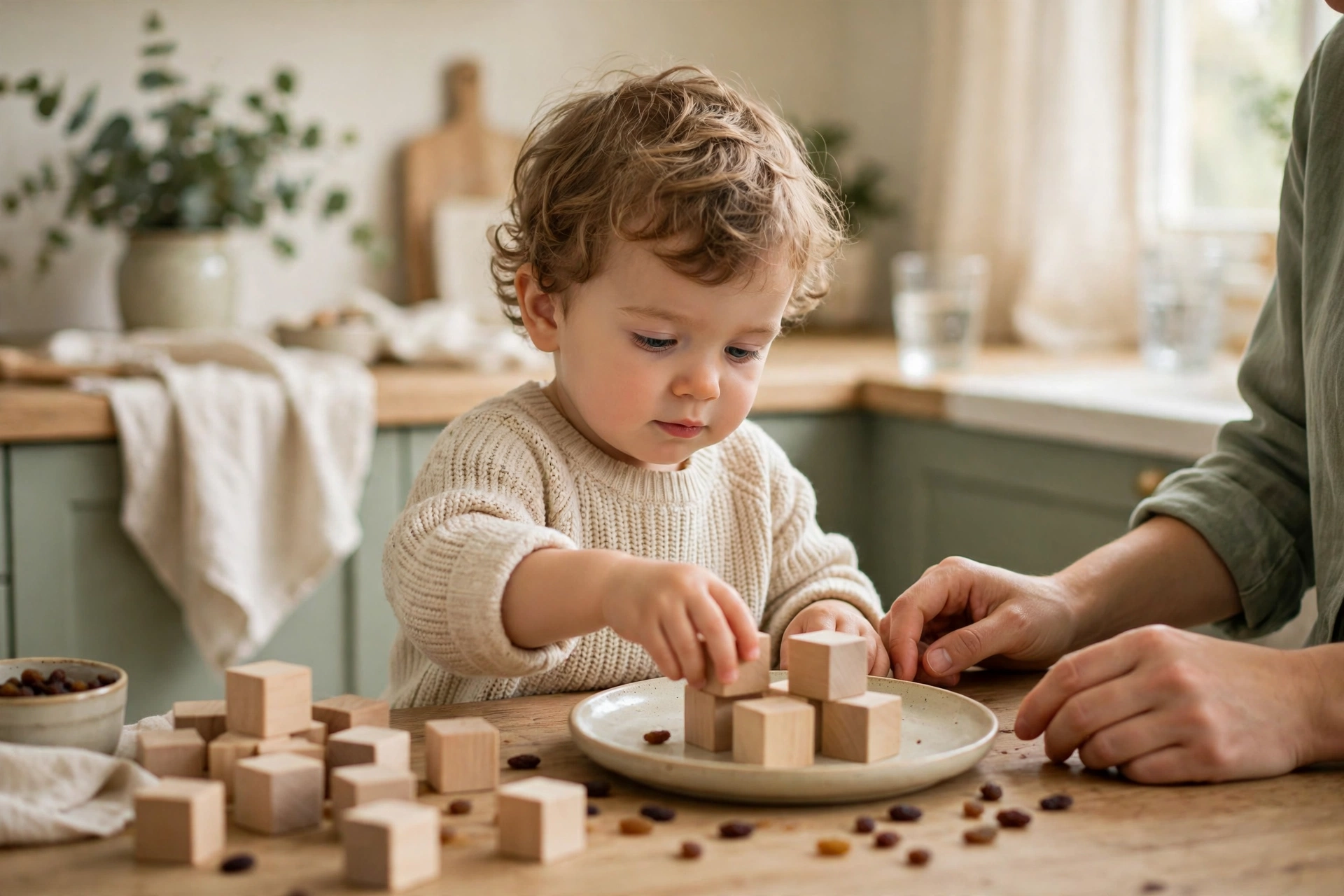
6. Count the snacks
Count raisins onto a plate together, then count them into mouths. One, two, three. Age 2: count to three, and they eat the evidence. Ages 3 to 4: count to five, and they count the raisins back onto the plate. Age 5: count to ten, and they tell you how many are left after eating two.
7. Count the stairs
Count each stair as you climb, touching it as you go. Touching and saying is the real maths skill, not just saying the words. Age 2: count three stairs, and you carry them the rest of the way. Ages 3 to 4: count all the stairs, and they touch each one. Age 5: count the stairs going up, then count them backwards coming down.
8. Give me three blocks
Ask your child to give you three blocks. Then two cars. Then five crayons. This connects number words with actual quantities, which is the whole point of counting. Age 2: give me one block, and they hand it over. Ages 3 to 4: give me three blocks, and they count them out. Age 5: give me three blocks and two cars, and they bring both.
9. Cupcake tin counting
A cupcake tin and small objects: buttons, beads, or pasta shapes. Your child counts them into the tin, one per cup, then counts them back out. Age 2: three cups, and they drop the objects in. Ages 3 to 4: six cups, and they count as they go. Age 5: twelve cups, and they count backwards as they take them out.
10. Measuring while cooking
A recipe that needs measuring: a cup of flour, half a cup of sugar, two spoonfuls of oil. Your child measures, pours, and stirs, and learns what a half means by doing it. Age 2: they pour the cup you measured, and they stir. Ages 3 to 4: they measure the cup themselves, and they count the spoonfuls. Age 5: they read the recipe and tell you what to measure next.
Twenty ideas are a start, the kit covers the whole year
The No-Screen Toddler Rescue Kit sorts 115 activities by the moment you need them, including quiet time, travel, and rainy days, so the next skill is always covered too. 89 pages, 28 printable activity cards, ages 2 to 5.
Instant download. Print it once, use it every day.
Sorting and thinking
Sorting is early maths and early logic in one game. These five ideas teach your child to notice differences and similarities, which is the thinking skill underneath all the others.
11. Sort the laundry by colour
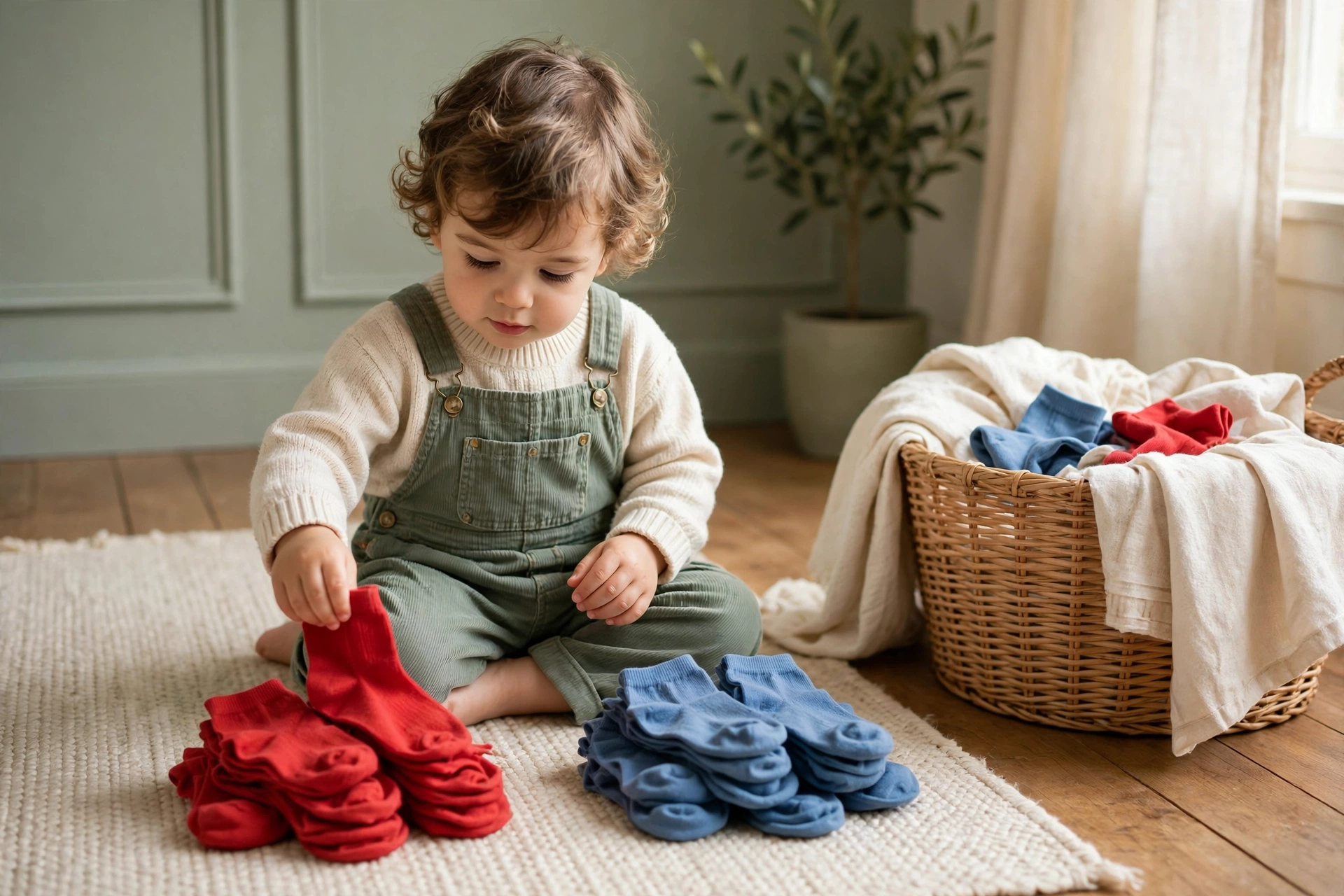
Tip the clean laundry onto the floor and sort it into piles by colour. Red pile, blue pile, white pile. Age 2: two piles, red and not red, and they drop the clothes in. Ages 3 to 4: four piles, and they name each colour. Age 5: sort by colour first, then sort the red pile by size.
12. Sort by size
A pile of toy cars, or blocks, or shoes. Sort them into small, medium, and large. Age 2: two piles, big and little, and they point. Ages 3 to 4: three piles, and they name the sizes. Age 5: sort by size, then count how many are in each pile, and tell you which pile has the most.
13. Match the shapes
A shape sorter, or matching pairs of cards, or two sets of blocks. Your child matches the shape to its hole, or the card to its pair. Age 2: two shapes, circle and square, and they try each hole. Ages 3 to 4: five shapes, and they name each one as they match it. Age 5: match the pairs face down, like a memory game, and they remember where each one is.
14. Puzzle mix up
Take two simple puzzles and mix the pieces together. Your child sorts the pieces into two piles, then finishes both puzzles. Age 2: two puzzles with three pieces each, and you sort the pieces first. Ages 3 to 4: they sort the pieces themselves, then finish both puzzles. Age 5: three puzzles mixed together, and they sort and finish all three.
15. Colour scavenger hunt
Pick a colour and hunt for everything that colour in the house. Let us find everything red. Then swap colours. Age 2: one colour, and they point at red things. Ages 3 to 4: three colours in a row, and they bring you one thing for each. Age 5: they pick the colour, and they make a list of everything they found.
Science and discovery
Science at this age is not a lesson. It is a question, a guess, and a wow moment, all in ten minutes, using things from the kitchen.
16. Sink or float
A tub of water and a pile of household objects: a spoon, a cork, a rock, a leaf, a toy car, an orange. Your child guesses sink or float for each one, tests it, and records the answer. Age 2: three objects, and they guess by pointing. Ages 3 to 4: ten objects, and they write S or F on a piece of paper. Age 5: they sort the results into two columns and tell you the rule.
17. Baking soda volcano
A small plastic bottle on a tray, a few spoonfuls of baking soda inside, and vinegar poured in slowly. The fizz erupts, and your child watches a chemical reaction happen in front of them. Age 2: you pour the vinegar, they watch the fizz and shout. Ages 3 to 4: they pour the vinegar themselves, slowly, and they tell you what will happen first. Age 5: they add food coloring to the vinegar first, and they explain why the bubbles rise.
18. Magnet hunt
A fridge magnet on a string, dragged around the house to find what sticks. Your child tests the fridge, the door handle, the table leg, the coins, the keys, and the toys, and sorts them into sticks and does not stick. Age 2: you hold the magnet, they point at what to test. Ages 3 to 4: they hold the magnet and test ten things on their own. Age 5: they predict before they test, and they explain why the magnet sticks to the fridge but not to the wooden table.
19. Growing seeds in a jar
A clear jar, a damp paper towel, and a few bean seeds pressed against the glass. Put the jar on a sunny windowsill and watch the seeds sprout over the week. Age 2: you set up the jar, they check it every morning. Ages 3 to 4: they set it up themselves and draw what they see each day. Age 5: they keep a simple record, day 1, day 3, day 5, and they tell you what the plant needs: water, light, and time.
20. Water pouring
Two cups and a jug of water, on a tray, with a towel underneath. Your child pours the water from one cup to the other, and back again. Pouring water between cups is early science and maths, and it builds hand control at the same time. Age 2: one pour, with you holding the jug. Ages 3 to 4: pour back and forth, and they count the pours. Age 5: pour without spilling, and they tell you which cup has more water in it.
The next skill is already in the kit
The No-Screen Toddler Rescue Kit gives you 115 screen-free activities for ages 2 to 5, with 28 printable cards, so when your toddler outgrows these ideas, the next ones are already waiting.
Instant download. Print it once, use it every day.
How toddler learning activities at home actually work
Learning at this age has three parts, and every idea on this page has all three. If an activity is missing one of them, it is probably not a learning activity.
Doing. Your child learns by pouring the water, rolling the dice, and sorting the laundry. The doing is the lesson. If an activity has no doing in it, it is not an activity, it is a lecture.
Guessing. Ask what will happen before it happens. Will it sink or float? What colour will red and yellow make? What comes next in the pattern? A guess is a hypothesis, and a toddler who guesses is a scientist.
Repeating. Learning happens through repetition, not through variety. The same activity, done three days in a row, teaches more than three new activities done once each. Repeat the favorite, and let the learning build.
The four skills to cover are language, numbers, sorting and thinking, and science and discovery, and the four groups on this page cover all four. If you do one idea from each group across the week, your child has had a full week of learning, and you have not taught a single lesson. What not to buy: workbooks, flashcards, and apps that promise to teach your child. A counting game with snacks and a sorting game with laundry teach more than any screen ever will. Parents searching for learning activities for toddlers will find the same truth here: the learning is in the doing, not in the worksheet. For the age-by-age version, the activities for 2 year olds at home page has the age 2 day, the activities for 3 year olds at home page has the age 3 day, and the activities for 5 year olds at home page has the kindergarten year.
The learning day at home
A toddler does not need a schedule. They need a rhythm: a short window in the morning, a short window in the afternoon, and free play in between. This table is a rhythm, not a timetable, and it bends around naps, moods, and the weather.
| Time of day | What to do |
|---|---|
| After breakfast | One language idea, 5 to 15 minutes: point and name on a walk, or a picture book treasure hunt. Then free play until lunch. |
| Before lunch | One numbers idea, 5 to 15 minutes: count the snacks, or count the stairs. Then lunch, and a nap for the younger ones. |
| After nap | One sorting idea, 5 to 15 minutes: sort the laundry, or a colour scavenger hunt. Then free play until dinner. |
| Before dinner | One science idea, 5 to 15 minutes: sink or float, or water pouring. Then dinner, and a story before bed. |
| Weekend | The big project: the baking soda volcano, or growing seeds in a jar. Two hours, no rush, and the result stays up all week. |
Two short windows on a school day are enough. Each one lasts 5 to 15 minutes of focused play, and the rest of the day is free movement, eating, napping, and following you around the house watching you work. That is not wasted time. Watching you cook, fold laundry, and talk on the phone is how a toddler learns what grown-ups do, and it counts as much as any activity on this page.
One kit, every age from two to five
The No-Screen Toddler Rescue Kit covers the whole toddler years, with 115 screen-free activities for ages 2 to 5, including quiet time, travel, and rainy days, plus 28 printable activity cards.
Instant download. Print it once, use it every day.
Safety rules for learning play
Small parts are for big kids only. Buttons, beads, and coins are choking hazards for under-3s. Play with small parts at the table, with you right there, and put them away in a high box when you finish.
Water means watching. A tub of water for sink or float, and a jug for pouring, both happen with you right there, every time. Never leave a toddler alone with water, not even for a minute.
Kitchen rules. Your child can stir, pour, and spread, but the stove, the oven, and sharp knives are still yours. Stand on a chair to reach the counter, never climb on it.
Screens are not learning tools at this age. The apps in the ads promise to teach your child, but a toddler learns more from a real object in their hand than from any screen. Keep recreational screen time short, and keep screens out of meals and bedtime.
Mess is part of learning. Sorting laundry, pouring water, and mixing colours all make a mess. Put a towel down first, wear old clothes, and let the mess happen. Cleaning up together is a learning activity too.
When learning goes wrong
They will not sit still. Do not make them sit. Learning happens while moving: count the stairs while climbing, sort the laundry while tidying, name things on a walk. Sitting still is not learning, and a child who cannot sit still is not a child who cannot learn.
They only want the answer. Do not give it straight away. Ask what they think first, and let them guess. A wrong guess is not a failure, it is the learning itself.
They get it wrong. Describe, do not correct. Say the block is red and put it in the red pile, instead of saying no, that is wrong. The correction happens inside the play, not as a lecture.
They get bored in two minutes. Boredom is not a problem to fix, it is a signal. Your child has finished the easy version and needs the harder one. Add a rule, add a step, or add a friend.
You compare them to other children. Stop. Milestones vary widely, and one child talking at 18 months while another talks at 2 years is normal. What matters is the direction, not the speed: is your child learning new words, trying new things, and playing a little longer each month?
Frequently Asked Questions
What are toddler learning activities?
Play that teaches. A toddler learning activity builds language, numbers, sorting, or science through doing, not through a lesson. Counting snacks, sorting laundry by colour, naming everything on a walk, and testing what sinks or floats are all learning activities. Each one takes 5 to 15 minutes, uses things already in your house, and ends with something your child can see or say. A worksheet is not a learning activity. A flashcard is not a learning activity. A game your child chooses to play again is.
Do toddlers need flashcards or worksheets to learn?
No. Learning happens through play, talk, and repetition, not through drills. Flashcards drill memory, not understanding. A child who can point at a flashcard that says 3 has memorized a shape. A child who counts three blocks onto a plate understands what three means. Magnetic letters, counting snacks, and sorting laundry teach more than any worksheet, and they teach it without a fight. Save the worksheets for school, years from now.
How long should a learning activity last?
Five to fifteen minutes. That is the honest answer for ages 2 to 5, and it is enough. A short activity done well, then repeated tomorrow, teaches more than a long session that ends in tears. Plan for one short window after breakfast and one in the afternoon, and let your child stop while they are still happy. Two or three short windows a day, five days a week, add up to more learning than any single long lesson.
What if my toddler will not sit still for a learning activity?
Do not make them sit. Learning happens while moving: count the stairs while climbing, sort the laundry while tidying, name things on a walk, and hunt for colours around the house. Sitting still is not learning, and a child who cannot sit still is not a child who cannot learn. The ideas on this page are built for moving children, and the ones that need sitting, like the cupcake tin counting, take five minutes at a table, not twenty.
Should I correct my toddler when they get it wrong?
Do not correct, describe. When your child says the red block is blue, say the block is red and put it in the red pile, instead of saying no, that is wrong. Wrong answers are guesses, and guessing is how they learn. A child who is corrected every time stops guessing, and a child who stops guessing stops learning. Describe what you see, show the right answer by doing it, and let them try again. The correction happens inside the play, not as a lecture.
What are the best toddler learning activities at home?
The ones with a clear result and a thing to do, not a thing to memorize. Point and name on a walk, count the snacks onto a plate, sort the laundry by colour, test what sinks or floats, and retell a story with toys. A toddler learns by doing, guessing, and repeating, and the best activities give them all three. The four groups on this page cover all of it: language, numbers, sorting and thinking, and science and discovery.
When should I worry about my toddler's learning?
Milestones vary widely, and one child talking at 18 months while another talks at 2 years is normal. If you are worried, talk to your pediatrician, not the internet. This page builds skills, it does not diagnose anything. What matters is the direction, not the speed: is your child learning new words, trying new things, and playing a little longer each month? If yes, they are learning. If you have a real concern, your doctor can check it in minutes.
Sources and further reading
UNICEF has 21 learning activities for babies and toddlers, with ideas by age from 2 months to 2 years, built with the LEGO Foundation. Read UNICEF on 21 learning activities for babies and toddlers. For the science behind play-based learning, the Mount Sinai Parenting Center explains why play equals learning, why memorizing is not real learning, and how sorting laundry and setting one napkin per person are real maths. Read Mount Sinai on learning through play.
Start with one idea this morning, the point and name walk or the count the snacks game, and repeat the favorite tomorrow. That is the whole method. A toddler does not need a new activity every day, they need the same good one, with you next to them, and let toddler learning activities at home do the teaching while you watch them learn. For the age-by-age version, the activities for 2 year olds at home page has the age 2 day, the activities for 3 year olds at home page has the age 3 day, the activities for 4 year olds at home page has preschool readiness, and the activities for 5 year olds at home page has the kindergarten year. For the short version of this day, the 15-minute toddler activities page has the quick plans, and the sensory activities for toddlers at home page has the sensory side of learning.