
Montessori Practical Life Activities: 20 Real Jobs for Toddlers at Home
Updated November 11, 2026
Montessori practical life activities are real jobs, done at a child's size. Not fake play, not a toy version of a job, but the real thing: pouring water from a small jug, washing hands step by step, sweeping crumbs with a small broom, setting the table, and peeling a banana. Maria Montessori called them family work, and she built the whole method around them, because children want to do what you do. Every idea on this page is a real job, sorted into four groups of five: pouring and transferring, care of self, care of the home, and food preparation. Every idea uses things already in your house, takes 5 to 15 minutes, and comes with the version for age 2, the version for ages 3 to 4, and the stretch for age 5. No special toys needed, no Montessori materials to buy. The heart of this page is a simple test: if the job is real, and the tool is real, and your child can do it themselves, it is practical life.
Practical life montessori activities: the short version
Before the ideas, here is what practical life means, in plain words, so you know why this page is built the way it is.
| What it is | What it teaches |
|---|---|
| Pouring and transferring | Hand-eye coordination, control of movement, concentration. The classic first activity: a small jug, two cups, and a tray. |
| Care of self | Independence and order. Dressing, washing hands, brushing hair, putting on shoes. The child learns to care for their own body. |
| Care of the home | Responsibility and belonging. Sweeping, dusting, wiping the table, watering plants. The child learns the house is theirs to care for. |
| Food preparation | Patience and pride. Washing fruit, peeling a banana, spreading butter, cracking eggs. The child eats what they made. |
| The prepared environment | Order and choice. A low shelf, a tray for each job, a place for everything. When each thing has a home, your child can find it and put it back. |
Read the table as permission, not homework. You do not need to buy anything. You need a low shelf, a small jug, a stool at the counter, and time to let your child do the job slowly. For the age-by-age version of this page, the activities for 2 year olds at home page has the age 2 day, and the activities for 5 year olds at home page has the kindergarten year.
20 montessori practical life activities for every kind of day
Every one of these montessori practical life activities is built for an ordinary day, with ordinary things, in 5 to 15 minutes. Pick one group for the morning and one for the afternoon, and ignore the rest until you need them. Repeat the favorite tomorrow instead of hunting for a new one. A toddler learns more from the third time they pour the same water than from the first time they try ten new jobs.
Pouring and transferring
Pouring is the classic first practical life activity, and it is the foundation of everything else. Start with dry materials, then move to water, and keep a sponge on the tray for the spills.
1. Dry pouring
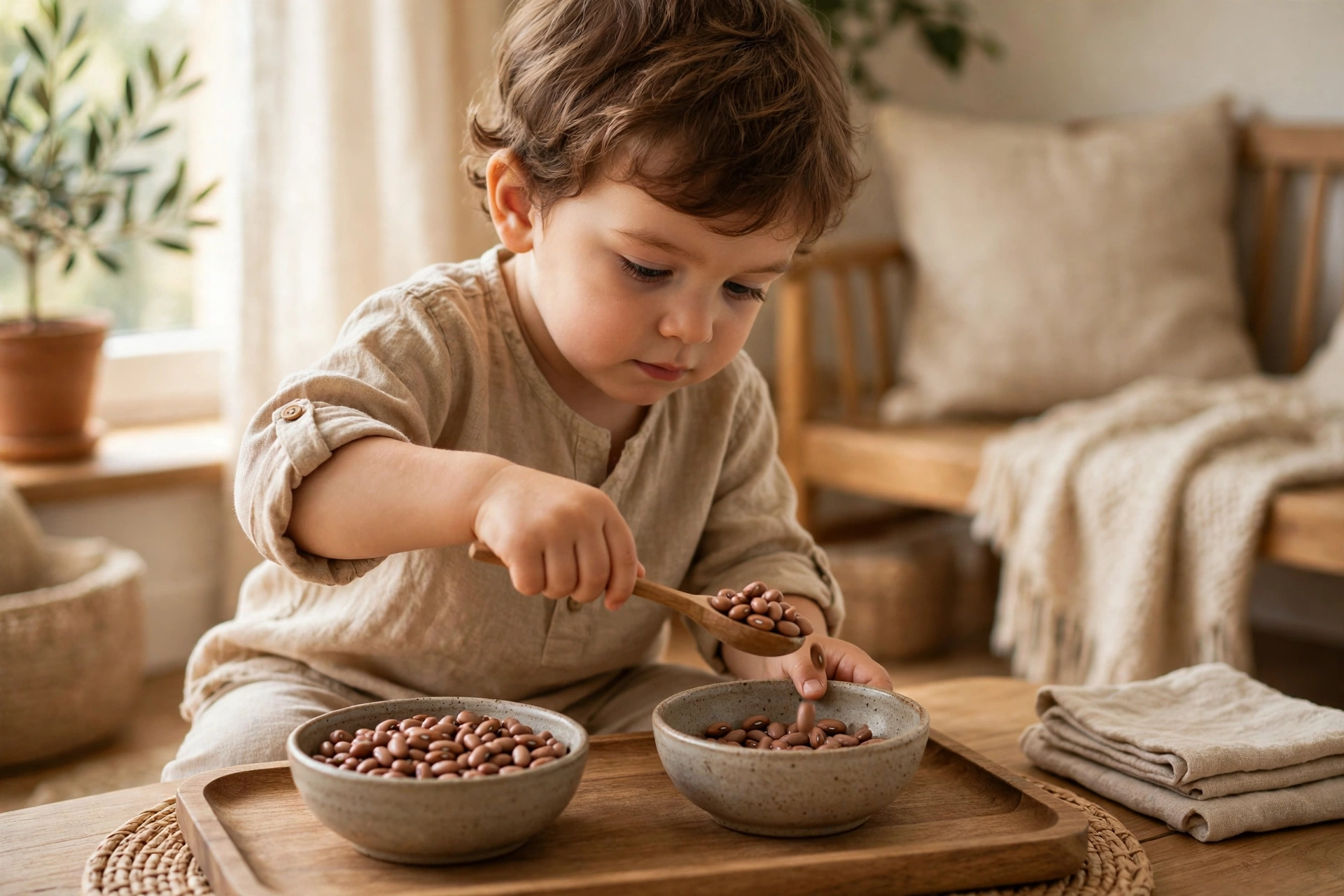
Two small bowls and a small jug of dry rice or beans. Your child pours from one bowl into the other, slowly, without spilling. Start with dry materials because a spill of rice is easier to clean up than a spill of water. Age 2: pour dry rice from a jug into a bowl, and you clean up together. Ages 3 to 4: pour from one pitcher into another, and they clean up the spills themselves. Age 5: pour from a larger pitcher into a smaller glass, and they measure how much fits.
2. Wet pouring
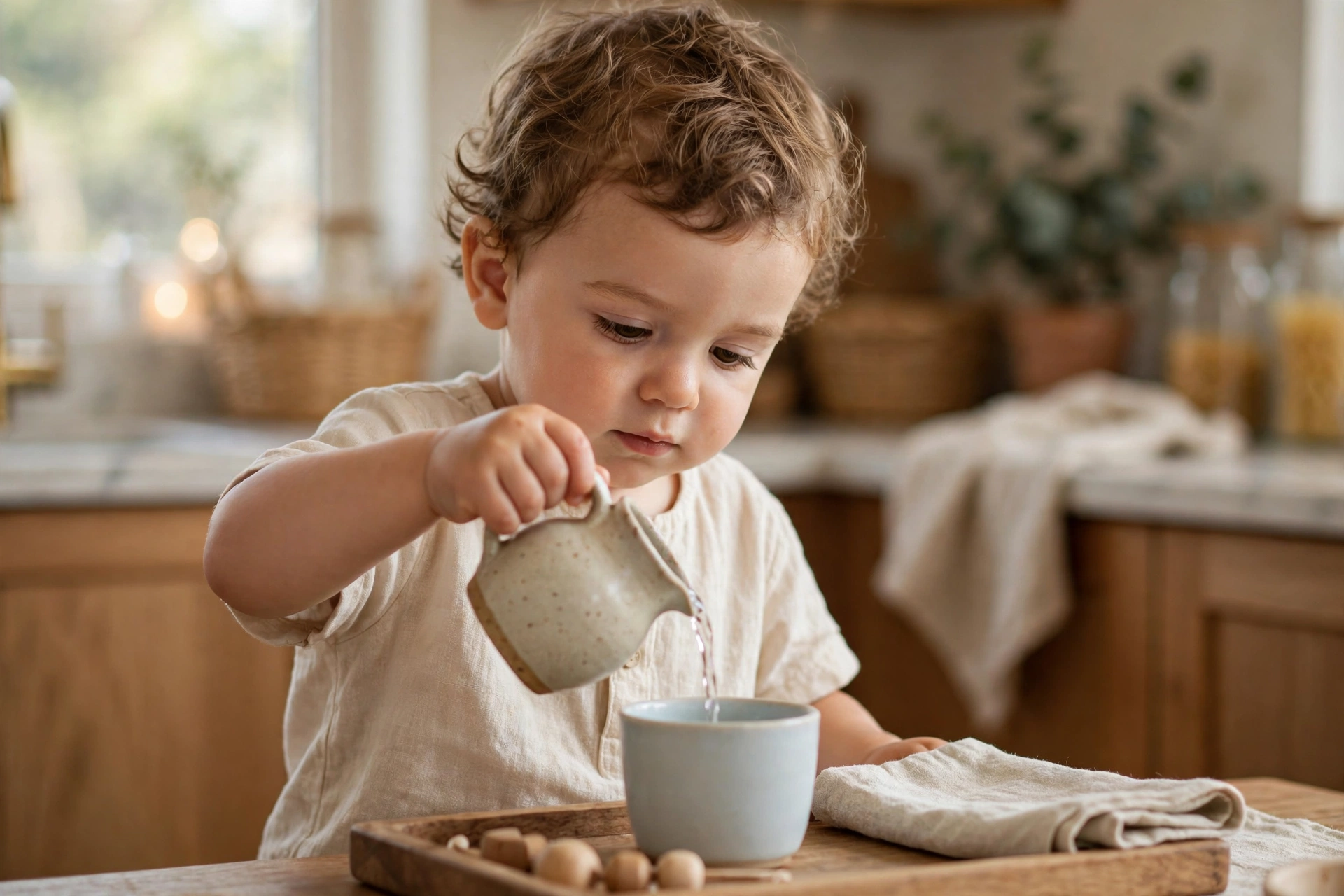
A small jug of water and a cup, on a tray. Your child pours the water from the jug into the cup, slowly, watching the level rise. Age 2: pour water between two equal-sized pitchers on a tray, with you right there. Ages 3 to 4: pour their own drink from a small jug at mealtimes. Age 5: pour water into a funnel, and they tell you what happens to the level.
3. Spooning
Two bowls, a spoon, and dried beans or pasta. Your child moves the beans from one bowl to the other, one spoonful at a time. Age 2: a large spoon and big beans, and they scoop with both hands. Ages 3 to 4: a tablespoon, then a teaspoon, and they count the spoonfuls. Age 5: they spoon the cereal into their own bowl at breakfast, and they clean up the spills.
4. Sponge transfer
A bowl of water, an empty bowl, and a sponge. Your child soaks the sponge in the full bowl, carries it to the empty bowl, and squeezes the water out. Age 2: squeeze the sponge with both hands, and you hold the bowls. Ages 3 to 4: carry the full sponge without dripping, and they squeeze it out themselves. Age 5: they transfer the water until the first bowl is empty, and they tell you how many squeezes it took.
5. Pour your own drink
A small jug on the table at mealtimes, and your child pours their own drink. Age 2: you hold the jug together, and they pour a little. Ages 3 to 4: they pour their own drink from a small jug, and they wipe up the spills. Age 5: they pour a drink for you too, and they carry both cups to the table without spilling.
Care of self
Care of self is the child learning to look after their own body: dressing, washing, brushing. Give them time, and let them do it themselves, even when it takes longer.
6. Washing hands
A low sink, a stool, soap, and their own towel. Your child rolls up their sleeves, wets their hands, applies the soap, scrubs, rinses, and dries, one step at a time. Age 2: wash hands with support, and you do the soap. Ages 3 to 4: they do all five steps themselves, and they hang up their own towel. Age 5: they wash their hands before every meal without being asked, and they teach a younger sibling the steps.
7. Dressing practice
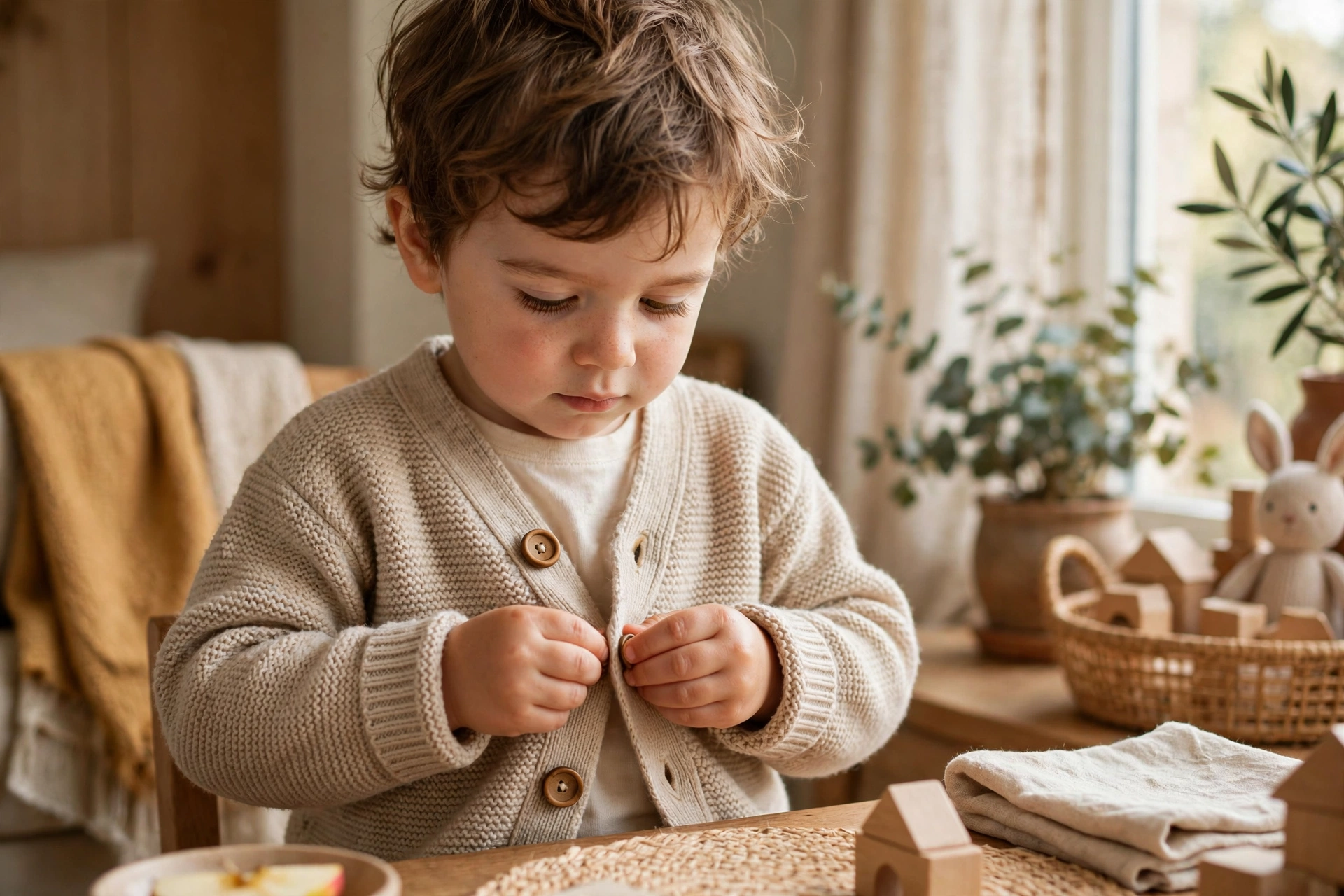
Big buttons, zippers, and Velcro on an old cardigan or coat. Lay the clothes out in a predictable sequence, and let your child practice the fasteners. Age 2: take off their own socks and hat, and they put on Velcro shoes. Ages 3 to 4: button and unbutton a cardigan, and they zip their own jacket. Age 5: they get dressed without assistance, and they pick out their own clothes the night before.
8. Putting on shoes
Shoes with simple fastenings, laid out in an orderly way by the door. Your child puts on their own shoes, and puts them away on the low rack when they come home. Age 2: put on Velcro shoes, and they carry them to the door. Ages 3 to 4: put on their own shoes and hang up their coat on a hook they can reach. Age 5: they put on their own shoes, tie the laces with help, and they put their shoes away every time.
9. Brushing hair
A soft brush and a low mirror. Your child brushes their own hair, from the top of their head down, then brushes the hair of a doll. Age 2: hold the brush and brush their own hair, with you guiding their hand. Ages 3 to 4: brush their own hair and teeth with supervision, and they hang up their own towel. Age 5: they brush their own hair and teeth every morning, and they put the brush back in its place.
10. Hanging up their coat
A hook at their height by the door, and a basket for their bag. Your child hangs up their own coat when they come home, and takes it down when they go out. Age 2: hang their coat on a low hook, and you help with the zipper. Ages 3 to 4: hang up their coat and put their shoes on the rack, every time. Age 5: they hang up their coat, put their bag in the basket, and they put their shoes away without being asked.

Twenty jobs are a start, the kit covers the whole year
The No-Screen Toddler Rescue Kit sorts 115 activities by the moment you need them, including quiet time, travel, and rainy days, so the next skill is always covered too. 89 pages, 28 printable activity cards, ages 2 to 5.
Instant download. Print it once, use it every day.
Care of the home
Care of the home is the child learning that the house is theirs to look after. Give them real tools, child-sized, and let them do the real work.
11. Sweeping crumbs
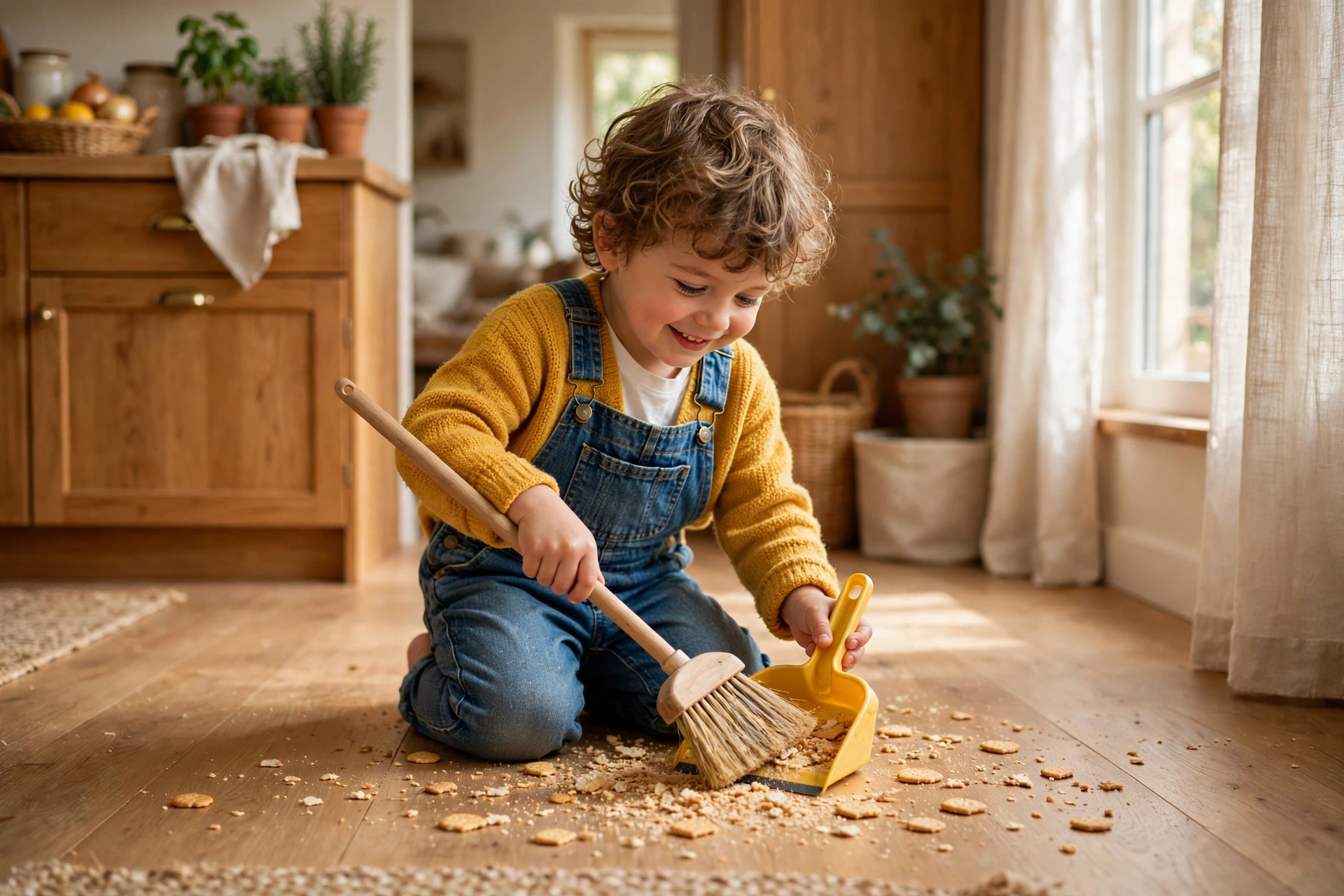
A small broom and dustpan, and a square taped on the floor to sweep into. Your child sweeps the crumbs from snack time into the square, then into the dustpan. Age 2: sweep large cracker crumbs, and you hold the dustpan. Ages 3 to 4: sweep fine crumbs, and they use the dustpan themselves. Age 5: they sweep the whole kitchen floor after dinner, and they put the broom back in its place.
12. Wiping the table
A damp cloth and a table to wipe after meals. Your child wipes the table clean, then wrings out the cloth and hangs it up. Age 2: wipe up spills with their own cloth, and you do the table. Ages 3 to 4: wipe the table after every meal, and they wring out the cloth themselves. Age 5: they wipe the table, wash the cloth, and hang it up to dry, all without being asked.
13. Dusting a low shelf
A cloth and a low shelf to dust. Your child dusts the shelf, one object at a time, putting each one back in its place. Age 2: dust one shelf, and you move the objects. Ages 3 to 4: dust the shelf and put the objects back in order, left to right. Age 5: they dust the whole room, and they tell you which shelf needs dusting next.
14. Folding washcloths
A pile of washcloths, napkins, or socks, and a small surface to fold on. Your child folds each one into quarters, then stacks them neatly. Age 2: fold a washcloth in half, and you do the rest. Ages 3 to 4: fold a napkin into quarters, and they stack the pile. Age 5: they fold the laundry and put it away in the drawer, and they match the socks from the basket.
15. Watering plants
A small watering can and a plant that needs water. Your child waters the plant every morning, and watches it grow. Age 2: water one plant each morning, and you hold the can together. Ages 3 to 4: water the plants and wipe the leaves, and they tell you which plant is thirsty. Age 5: they care for a plant every day, and they plant seeds in a pot and watch them sprout.
Food preparation
Food preparation is the child learning to feed themselves and others. Start with the safest jobs, and add the sharper tools slowly, with you right there.
16. Washing fruit
A bowl of water, a brush, and some potatoes or apples. Your child washes the fruit, one piece at a time, and dries it on a towel. Age 2: wash vegetables in a bowl of water, and you do the drying. Ages 3 to 4: wash and dry the fruit themselves, and they put it in the bowl. Age 5: they wash the fruit, cut it with a child-safe knife, and serve it to the family.
17. Peeling a banana
A banana, and a small knife to cut off the top. Your child peels the banana, then chops it into pieces with a butter knife. Age 2: peel a banana with you starting the peel, and they eat the pieces. Ages 3 to 4: peel and slice a banana themselves, and they put the peel in the compost bin. Age 5: they peel, slice, and serve the banana, and they clean up the peel and the board.
18. Spreading butter
Butter or cream cheese, and crackers or toast. Your child spreads the butter evenly, then eats what they made. Age 2: spread butter on a rice cake, and you hold the cracker. Ages 3 to 4: spread butter on toast, and they cut the toast in half. Age 5: they spread the butter, make a sandwich, and serve it to the family.
19. Stirring and mixing
A bowl, a spoon, and something to stir: yogurt and oats, pancake batter, or cake mix. Your child stirs until it is mixed, then pours it into the pan. Age 2: stir yogurt and oats in a bowl, and you hold the bowl. Ages 3 to 4: stir the pancake batter, and they pour it into the pan with help. Age 5: they read the recipe, measure the ingredients, stir, and cook the pancakes from start to clean-up.
20. Cracking eggs
An egg, a bowl, and a small plate for the shell. Your child cracks the egg into the bowl, then fishes out the shell with a spoon. Age 2: crack an egg with you holding their hand, and they stir it. Ages 3 to 4: crack the eggs into a bowl themselves, and they wipe up the drips. Age 5: they crack the eggs, whisk them, and cook scrambled eggs for breakfast, all without help.
The next skill is already in the kit
The No-Screen Toddler Rescue Kit gives you 115 screen-free activities for ages 2 to 5, with 28 printable cards, so when your toddler outgrows these jobs, the next ones are already waiting.
Instant download. Print it once, use it every day.
How montessori practical life activities actually work
Practical life works because the work is real, and the child can see the result. There are four rules, and every idea on this page follows all four.
Real tools, child-sized. A small jug, a little broom, a cloth for spills, a butter knife. Real things, at a child's size, that actually work. A toy broom that does not sweep teaches nothing. A real broom, small enough to hold, teaches everything.
Show slowly, with few words. Let your hands do the talking. Pour slowly so they can see how. Do it the same way each time, because children learn from repetition. Then hand it over: now it is your turn.
Step back. Resist fixing, helping, or praising every pour. Let them try, spill, and try again. If they are absorbed, do not interrupt. Concentration is the skill, and interrupting it breaks it.
Clean up is part of the work. A small cloth and a spill is part of the activity, not a failure. When the activity is finished, your child helps pack it away. That simple step supports independence, responsibility, and respect for their surroundings.
The five areas of practical life are preliminary exercises, care of self, care of the environment, grace and courtesy, and control of movement, and the four groups on this page cover the first three, which are the ones that matter most at home. Grace and courtesy, saying please, taking turns, and showing respect, grows out of the same work: a child who sets the table for the family is already practicing it. For the age-by-age version, the activities for 2 year olds at home page has the age 2 day, the activities for 3 year olds at home page has the age 3 day, and the activities for 5 year olds at home page has the kindergarten year.
The practical life day at home
A toddler does not need a schedule. They need a rhythm: a short job in the morning, a short job in the afternoon, and free play in between. This table is a rhythm, not a timetable, and it bends around naps, moods, and the weather.
| Time of day | What to do |
|---|---|
| After breakfast | One pouring job, 5 to 15 minutes: dry pouring, or spooning. Then free play until lunch. |
| Before lunch | One care of self job, 5 to 15 minutes: washing hands, or dressing practice. Then lunch, and a nap for the younger ones. |
| After nap | One care of the home job, 5 to 15 minutes: sweeping crumbs, or wiping the table. Then free play until dinner. |
| Before dinner | One food preparation job, 5 to 15 minutes: washing fruit, or spreading butter. Then dinner, and a story before bed. |
| Weekend | The big job: cracking eggs for breakfast, or planting seeds in a pot. Two hours, no rush, and the result stays up all week. |
Two short jobs on a school day are enough. Each one lasts 5 to 15 minutes of focused work, and the rest of the day is free movement, eating, napping, and following you around the house watching you work. That is not wasted time. Watching you cook, fold laundry, and sweep the floor is how a toddler learns what grown-ups do, and it counts as much as any job on this page.
One kit, every age from two to five
The No-Screen Toddler Rescue Kit covers the whole toddler years, with 115 screen-free activities for ages 2 to 5, including quiet time, travel, and rainy days, plus 28 printable activity cards.
Instant download. Print it once, use it every day.
Safety rules for practical life
Small parts are for big kids only. Beans, beads, and coins are choking hazards for under-3s. Play with small parts at the table, with you right there, and put them away in a high box when you finish.
Water means watching. A jug of water for pouring, and a bowl for washing, both happen with you right there, every time. Never leave a toddler alone with water, not even for a minute.
Real tools, real rules. A butter knife and a child-safe crinkle cutter are for soft food only, and you stay close. The stove, the oven, and sharp knives are still yours. Stand on a chair to reach the counter, never climb on it.
Glass breaks. Use unbreakable cups and bowls for pouring work, and keep the real glass for mealtimes. A broken cup is a cut, and a cut ends the job.
Mess is part of the work. Pouring, sweeping, and mixing all make a mess. Put a towel down first, wear old clothes, and let the mess happen. Cleaning up together is a practical life activity too.
When practical life goes wrong
They will not do the job. Do the job yourself nearby and let them watch. If they get frustrated, make it easier: a smaller jug, bigger beans, fewer steps. If they use it wrong, pouring beans on the floor, calmly show it again, and if it keeps happening, put it away and try another day.
They only want to play with the tools. That is fine. A broom is a toy until it is a tool, and the child who sweeps the floor with a broom is doing the job, even if they are pretending. Let them play, and the work will follow.
They get it wrong. Show, do not correct. Pour slowly so they can see how, then hand it over. The work teaches itself through repetition, and a child who is corrected every time stops trying.
They get bored in two minutes. Boredom is not a problem to fix, it is a signal. Your child has finished the easy version and needs the harder one. Add a step, add a tool, or add a friend.
You compare them to other children. Stop. Ages are guides, not deadlines, and some children start earlier, some later, and both are normal. What matters is the direction, not the speed: is your child doing more for themselves each month?
Frequently Asked Questions
What are Montessori practical life activities?
Real jobs, done at a child's size. Pouring water, washing hands, sweeping crumbs, setting the table, and peeling a banana are practical life activities. They build independence, concentration, coordination, and order, and they teach a child that they can do real work that matters. Maria Montessori called them family work, and she built the whole method around them. A fake toy version of a job is not practical life. A real job, with a real tool, at a child's size, is.
What age can my child start practical life?
As early as 18 months to 2 years, with the simplest jobs: pouring dry rice from a jug, wiping a spill with a cloth, carrying a cup to the sink. At age 2, keep every job to one clear step, and let your child finish it. At age 3, add more steps: wash hands with soap, scrub, rinse, and dry. At age 4 and 5, hand over whole jobs: set the table, crack the eggs, fold the laundry. The ages on this page are guides, not deadlines. Some children start earlier, some later, and both are normal.
Do I need special Montessori materials?
No. A small jug, two cups, a tray, a child-sized broom, a sponge, and a butter knife will get you most of the way. Real tools from your kitchen, child-sized where possible, are the materials. Dressing frames, the wooden boards with buttons and zippers, are useful but optional, and your child's own cardigan teaches the same skill. What matters is not what you buy, it is how you set it up: a low shelf, a tray, a place for everything, and time to concentrate.
What if my toddler makes a mess?
Mess is the point. Spills are expected, and cleaning them up is a practical life activity too. Put the work on a tray to catch the spills, put a towel underneath, and keep a small sponge on the tray. When the water spills, hand your child the sponge and say let us wipe it up together. A child who is allowed to spill and clean it up learns more than a child who is never allowed to pour. Let go of perfection: a spill that is wiped up, even badly, is progress.
Should I correct my toddler when they do it wrong?
Show, do not correct. Demonstrate the job slowly, with few words, and let your hands do the talking. Pour slowly so they can see how. Then hand it over and step back. Resist fixing, helping, or praising every pour. Let them try, spill, and try again. The work teaches itself through repetition. If they use it wrong, show it again calmly, and if it keeps happening, put it away and try another day. A child who is corrected every time stops trying, and a child who stops trying stops learning.
What are the best montessori practical life activities?
The ones with a clear result and a real purpose. Pouring water from a jug, washing hands step by step, sweeping crumbs with a small broom, spreading butter on toast, and setting the table. A toddler does real work best when the work is real: the water really needs pouring, the table really needs wiping, the plant really needs watering. The four groups on this page cover all of it: pouring and transferring, care of self, care of the home, and food preparation.
Is Montessori practical life only for Montessori schools?
No. Practical life is home life. The classroom version uses the same jobs: pouring, sweeping, dressing, cooking. Any home can do it with real tools and a low shelf. Montessori is about how you set up and step back, not what you buy. One low shelf, one hook, and one stool are enough, and the rest is time, patience, and letting your child do the job themselves. Pretend play, messy play, and stories all matter too, and many families borrow the practical life ideas for the kitchen and play freely the rest of the time.
Sources and further reading
Montessori Academy has the age-appropriate practical life lists for 12 to 24 months, 2 to 3 years, and 3 to 6 years, plus a 7-day plan of jobs to try at home. Read Montessori Academy on age appropriate practical life activities. For the home setup with no special toys, Otter Play Ideas has 25 activities, a low shelf setup, and the show slowly method. Read Otter Play Ideas on Montessori at home.
Start with one job this morning, the dry pouring or the wiping the table, and repeat the favorite tomorrow. That is the whole method. A toddler does not need a new job every day, they need the same good one, with you next to them, and let the real jobs do the teaching while you watch them work. For the age-by-age version, the activities for 2 year olds at home page has the age 2 day, the activities for 3 year olds at home page has the age 3 day, the activities for 4 year olds at home page has preschool readiness, and the activities for 5 year olds at home page has the kindergarten year. For the learning side of this work, the toddler learning activities at home page has the four skills, and the sensory activities for toddlers at home page has the sensory side of play.