
Car Activities for Toddlers: 20 Easy Ideas for Long Rides
Updated November 12, 2026
Car activities for toddlers work when they pass a simple test: everything fits on a lap, makes no mess, makes no noise, and has no loose parts that roll under the seat. Your toddler just dropped their last snack under the seat, and you still have two hours to go. The tablet is dead, the crayons rolled away at the last gas station, and you are running out of ideas fast. Every idea on this page is built for that moment, sorted into four groups of five: talk games that need no props, quiet lap play, snacks and sips that double as games, and rest and reset for the last hour. Every idea works in a car seat, takes 15 to 20 minutes, and comes with the version for age 2, the version for ages 3 to 4, and the stretch for age 5. No screens, no mess, no loose parts. The heart of this page is a simple rule: rotate every 15 to 20 minutes, because no single activity will entertain a toddler for a full hour.
Car ride activities for toddlers: the short version
Before the ideas, here is how a long ride actually works, in plain words, so you know why this page is built the way it is.
| What it is | What it does |
|---|---|
| Talk games | Zero props, zero setup, zero lost pieces. I Spy with colors, counting the red cars, animal sounds, and a story chain. Start instantly, stop instantly. |
| Quiet lap play | Hands busy, voice quiet. A magnetic drawing board, window clings, a sticker book, a quiet book, and a Water Wow book. One thing at a time. |
| Snacks and sips | Food that takes time to eat. A snack box that doubles as a sorting game, string cheese that needs peeling, and a water bottle with a straw. |
| Rest and reset | The last hour. A window color hunt, a narrated scenery game, an audiobook through the car speakers, and a real break every 90 minutes. |
| The rotation rule | Switch every 15 to 20 minutes. When one stops working, do not push it, move on immediately. Fighting a bored toddler is harder than just pivoting. |
Read the table as permission, not homework. You do not need to buy anything new. You need a small bag, packed the night before, with 4 to 6 activities for a trip under 4 hours, and 6 to 8 for an all-day drive. For the flight version of this page, the airplane activities for toddlers page has the same test for a tray table, and for general travel, the toddler travel activities page has the whole trip.
20 car activities for toddlers for every kind of ride
Every one of these car activities for toddlers is built for a real car, with a real toddler, in a real car seat. Pick one group for the first hour and one for the second, and ignore the rest until you need them. Keep a mental list of 8 to 10 activities and cycle through them. When one stops working, do not push it. Move on immediately.
Talk games
Talk games are the best long car ride activities for toddlers because they start instantly with zero props. No setup, no lost pieces, no dropped it under the seat.
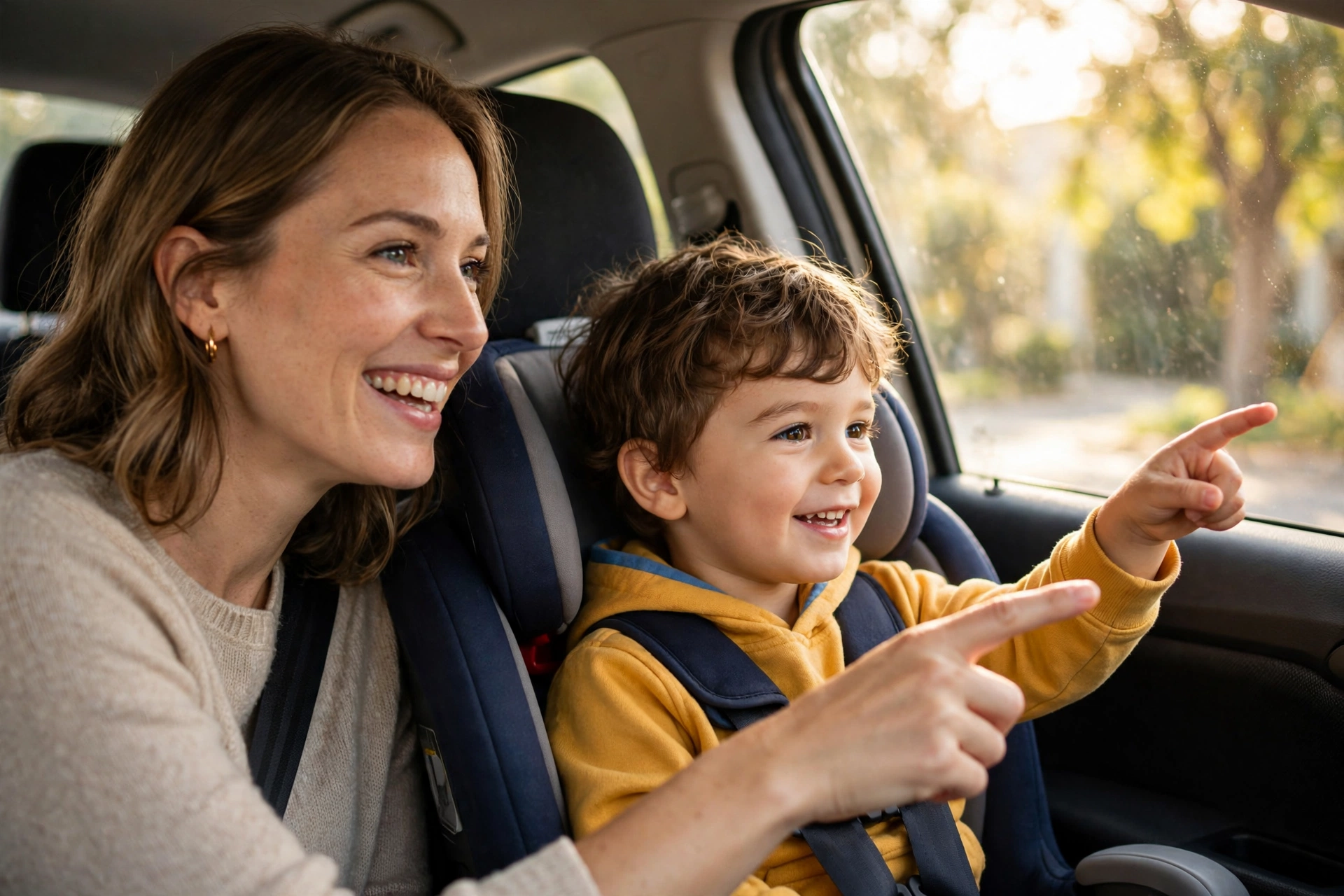
1. I Spy with colors
Keep it concrete and immediate. Say I spy something blue, and your child points out trucks, cows, or signs as you pass them. Age 2: I Spy with colors only, and you point together. Ages 3 to 4: I Spy with a color and a shape, and they pick the next color. Age 5: I Spy with first letters, if they are learning the alphabet, and they ask the questions.
2. Count the red cars
Pick a category and count together out loud. Count every red car, every truck, every yellow car, or every tree with no leaves. Age 2: count the red cars together, and you keep the tally. Ages 3 to 4: they count on their own, and you start over when you lose track around 30. Age 5: they count motorcycles or trucks with trailers, and they keep a loose tally on paper.
3. Animal sounds
You say moo, they guess cow. Then they make the sound, and you guess. Age 2: farm animals only, and you do the sounds together. Ages 3 to 4: add wild animals, and they name every animal they know. Age 5: they make the sound of an animal, and you have to guess it in three tries.
4. Call-and-response songs
Sing the same song on repeat. Yes, it will drive you nuts, but repetition is soothing for this age. Age 2: the wheels on the bus, on repeat, and you do the actions together. Ages 3 to 4: call-and-response songs, where you sing a line and they sing it back. Age 5: they make up a new verse, and the whole car sings it.
5. Story chain
You start a story with one sentence, they add the next, back and forth. Age 2: you tell the story, and they add one word. Ages 3 to 4: they add a whole sentence, and the story gets silly fast. Age 5: they start the story, and you add the next sentence, and the goal is not the ending, it is burning time.
Quiet lap play
Quiet lap play is hands busy and voice quiet. Everything fits on a lap, and nothing rolls under the seat.
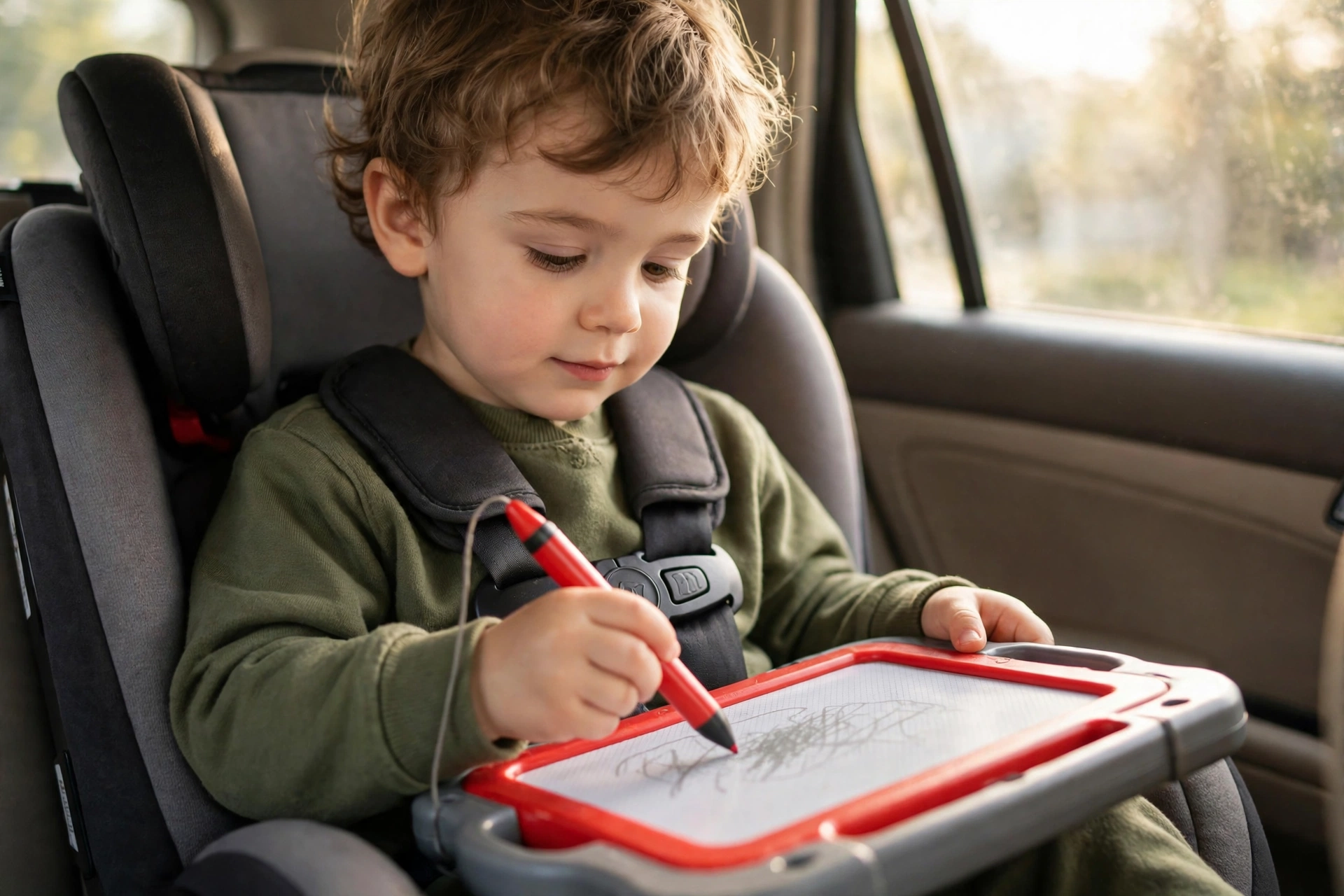
6. Magnetic drawing board
A small, lap-sized magnetic drawing board with a magnetic pen. No loose pieces, no mess, and it works for a 2-year-old and a 5-year-old. Age 2: scribble freely, and you draw a circle for them to fill in. Ages 3 to 4: draw a house, a sun, and a car, and they copy you. Age 5: they draw a map of the trip, and they add the towns as you pass them.
7. Window clings
Reusable vinyl stickers that press onto the car window. Peel them off and stick them on again. Age 2: stick a few clings on the window, and they move them around. Ages 3 to 4: make up a story about the clings, and they add plot twists. Age 5: they build a whole scene on the window, and they tell you the story of it.
8. Sticker book
A reusable sticker book with vinyl cling stickers that stick to laminated backgrounds. Your toddler can peel and reposition the same five farm animals 900 times, which is somehow exactly what they want to do. Age 2: peel and stick, and you remove the outer part of the sticker paper to make it easier for little hands. Ages 3 to 4: they build a scene, and they tell you the story. Age 5: they make a sticker story, and they save it for the hotel.
9. Quiet book
A Montessori-style quiet book packed with interactive elements like zippers, buttons, and Velcro pieces for hands-on learning. Age 2: open and close the flaps, and feel the textures. Ages 3 to 4: practice the zippers and buttons, and they learn the fasteners. Age 5: they do the whole book on their own, and they teach a younger sibling the pages.
10. Water Wow book
A reusable paint-with-water book. Fill the chunky pen with water, your toddler colors the page, and the color appears. No paint to spill, keeping car seats clean. Age 2: color freely, and you hold the pen together. Ages 3 to 4: they fill the pen themselves, and they color the whole page. Age 5: they color the page, and they tell you the story of what they colored.

Twenty ideas are a start, the kit covers the whole year
The No-Screen Toddler Rescue Kit sorts 115 activities by the moment you need them, including quiet time, travel, and rainy days, so the next trip is always covered too. 89 pages, 28 printable activity cards, ages 2 to 5.
Instant download. Print it once, use it every day.
Snacks and sips
Snacks are a given on road trips, but you can stretch their entertainment value if you are strategic. A toddler chewing slowly is a toddler not whining.
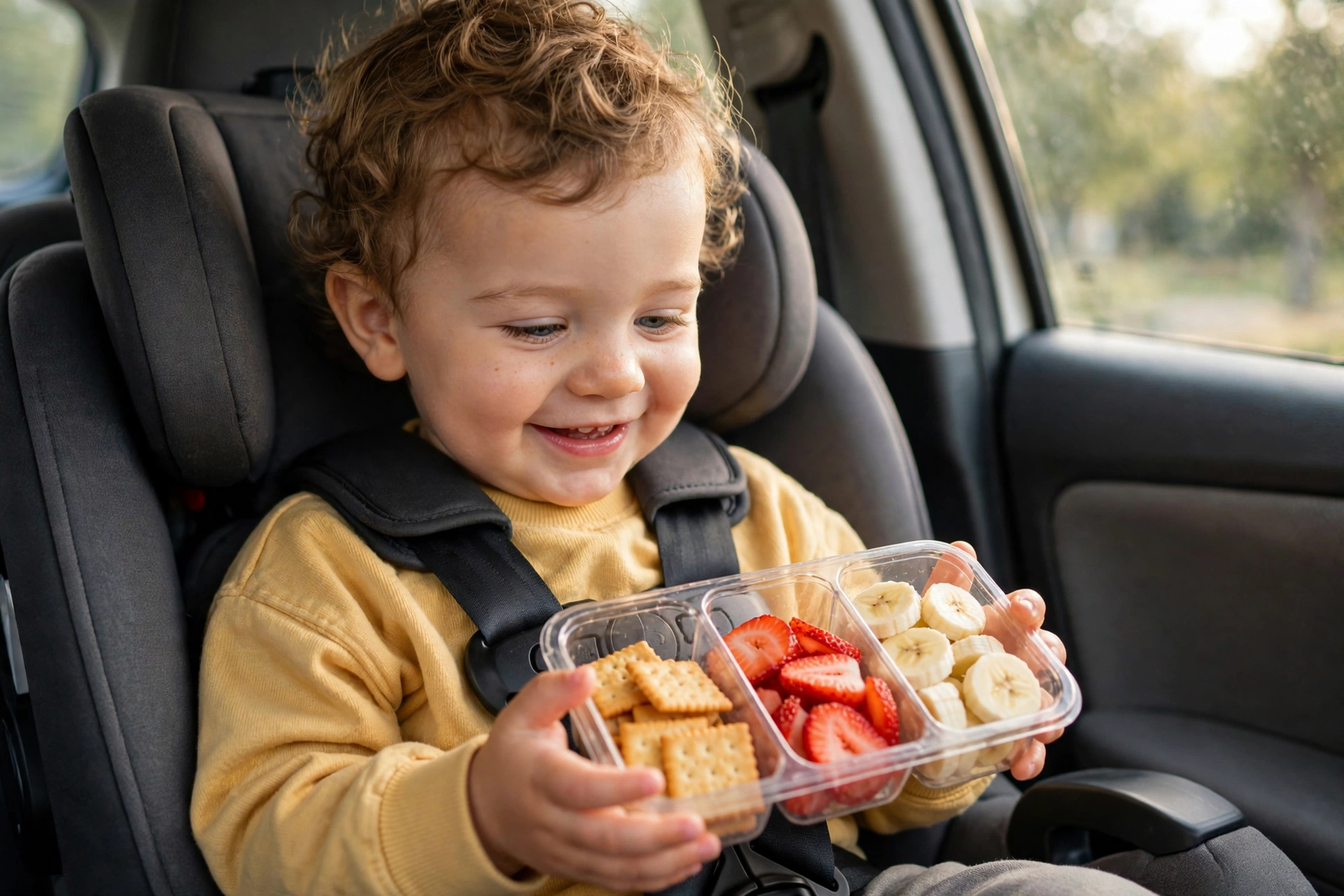
11. Snack box sorting
A small container of Cheerios and two cups. Put the round ones here, the broken ones here. Yes, they are all round. Your toddler will not notice for a solid five minutes. Age 2: sort the crackers into two cups, and you do the counting. Ages 3 to 4: they sort by color, and they tell you which cup has more. Age 5: they sort by size, and they count the total.
12. Build a face snack
Pretzels for eyes, raisins for a nose, and crackers for a mouth, all arranged on a napkin in their lap. They eat it when they are done. Zero cleanup. Age 2: arrange the pieces, and you help with the eyes. Ages 3 to 4: they build the face themselves, and they name it. Age 5: they build a face for each person in the car, and they eat them one at a time.
13. Slow snacks
Pack snacks that take time to eat: string cheese that needs peeling, clementines they have to unwrap, and grapes they eat one at a time while counting. The slower, the better. Age 2: peel a clementine together, and they eat one segment at a time. Ages 3 to 4: they peel the string cheese themselves, and they count the pieces. Age 5: they unwrap the clementine, peel the cheese, and count the grapes, all on their own.
14. Fruit pouch
A fruit pouch they squeeze themselves, one slow squeeze at a time. Age 2: squeeze the pouch, and you hold it together. Ages 3 to 4: they squeeze it themselves, and they tell you the flavor. Age 5: they squeeze the pouch, and they save half for later.
15. Water bottle with a straw
A water bottle with a straw, in the cup holder, where they can reach it. Age 2: drink from the bottle, and you hold it steady. Ages 3 to 4: they drink on their own, and they put it back in the cup holder. Age 5: they drink when they are thirsty, and they remind you to drink too.
Rest and reset
Rest and reset is the last hour. The games are quieter, the pace is slower, and the goal is survival, not learning.
16. Window color hunt
Call out a color, and they find it outside. Find something red. Barns, cars, and signs all count. When they spot it, call out a new color. Age 2: find one color, and you point together. Ages 3 to 4: they pick the next color, and you take turns. Age 5: they find a color and a letter, and they keep score.
17. Narrated scenery game
You narrate what you see like a nature documentary. Oh, look at that red barn. I wonder if they have chickens. Do you think chickens like to swim? Age 2: you narrate, and they point at the things you name. Ages 3 to 4: they narrate with you, and they add the animals. Age 5: they narrate the whole scene, and you ask the questions.
18. Audiobook through the car speakers
An audiobook played through the car speakers, so everyone hears the same story. Age 2: a short picture book story, and you pause to talk about it. Ages 3 to 4: a longer story, and they ask questions about it. Age 5: they pick the story, and they tell you what happens next.
19. Car nap routine
A small blanket, a favorite soft toy, and a quiet song. Age 2: the blanket and the toy, and you sing the song. Ages 3 to 4: they hold the toy, and they close their eyes. Age 5: they rest with the blanket, even if they do not sleep, and they wake up ready for the next stop.
20. Stretch stop plan
A 10-minute break every 90 minutes where they get out and actually move. Rest stops, gas stations, and empty parking lots, it does not matter. Age 2: run in circles, and you hold their hand. Ages 3 to 4: jump, climb on a curb, or kick a ball if you brought one. Age 5: they run, they stretch, and they tell you what they saw on the road.
The next trip is already in the kit
The No-Screen Toddler Rescue Kit gives you 115 screen-free activities for ages 2 to 5, with 28 printable cards, so when your toddler outgrows these games, the next ones are already waiting.
Instant download. Print it once, use it every day.
How car activities for toddlers actually work
Car activities work because they respect the car. There are four rules, and every idea on this page follows all four.
Everything fits on a lap. A magnetic board, a sticker book, a snack box, and a water bottle. If it needs a table, it does not work in a car. If it needs two hands and a flat surface, it does not work in a car seat.
No loose parts. Anything that rolls under a car seat is gone for good, and you cannot reach it while you are driving. Magnetic pieces on a board, a lace tied to the card, and books with a strap. One thing at a time, and the bag stays in the front passenger seat.
Rotate every 15 to 20 minutes. No single activity will entertain a toddler for a full hour. Their brains are not wired that way yet. Plan to switch gears every 15 minutes. Do a round of I Spy, then switch to a snack activity, then a movement game, then back to window watching. Rotation prevents burnout, theirs and yours.
Build in real breaks. Toddlers and preschoolers cannot white-knuckle a four-hour drive. Plan a 10-minute break every 90 minutes where they get out and actually move. Yes, it adds 20 to 30 minutes to your total drive time. But the alternative is a meltdown at hour three that derails everything anyway.
For the flight version of this page, the airplane activities for toddlers page has the same test for a tray table, and for general travel, the toddler travel activities page has the whole trip. For the age-by-age version, the activities for 2 year olds at home page has the age 2 day, the activities for 3 year olds at home page has the age 3 day, and the activities for 5 year olds at home page has the kindergarten year.
The long ride plan
A toddler does not need a schedule. They need a rhythm: a talk game, a quiet activity, a snack, and a break, in that order, and repeat. This table is a rhythm, not a timetable, and it bends around naps, moods, and the weather.
| Ride length | What to do |
|---|---|
| Under 2 hours | One talk game, one quiet lap activity, and one snack. That is enough. Pack 4 to 6 activities, and you will use 3 of them. |
| 2 to 4 hours | Talk game, quiet lap play, snack, window game, then a 10-minute break. Repeat the cycle once. Pack 6 activities, and rotate every 15 to 20 minutes. |
| 4 to 6 hours | Two full cycles, with a 10-minute break every 90 minutes. Add an audiobook for the last hour, and a car nap routine. Pack 6 to 8 activities. |
| All day, 6 hours plus | Three cycles, with a long lunch stop in the middle. Add a physical map so your 5-year-old can track the route, and a sticker for every stop they stayed mostly calm. Pack 8 activities, and a spare of the favorite. |
| Multi-day with overnight stops | The same bag, plus a hotel plan. The magnetic board and the window clings work in the hotel room too, and the quiet book is a bedtime activity while you unpack. |
Two short cycles on a 4-hour drive are enough. Each activity lasts 15 to 20 minutes of focused play, and the rest of the time is looking out the window, eating, napping, and talking to you. That is not wasted time. Watching the road, counting the trucks, and asking are we there yet is how a toddler learns what a journey is, and it counts as much as any game on this page.
One kit, every age from two to five
The No-Screen Toddler Rescue Kit covers the whole toddler years, with 115 screen-free activities for ages 2 to 5, including quiet time, travel, and rainy days, plus 28 printable activity cards.
Instant download. Print it once, use it every day.
Safety rules for long car rides
Car seat first, always. Every activity on this page works in a car seat, with the straps on. Never unbuckle a toddler to reach a dropped toy, and never let them climb out of the seat while the car is moving.
Small parts are for big kids only. Beads, coins, and small magnets are choking hazards for under-3s, and swallowed magnets can cause serious internal injuries. Play with small parts at a stop, with you right there, and put them away in a high bag when you drive on.
Never hand things from the front seat while driving. The bag stays in the front passenger seat, and the front passenger hands out the next activity. If you are driving alone, wait for a stop. Reaching back while driving is how accidents happen.
Car sickness is real. Screens and books can make it worse, because the eyes and the inner ear disagree. Looking out the window helps. If your child feels queasy, stop, get out, stretch, and let them look at the horizon.
Food in a moving car. Only soft foods while the car is moving, and nothing that needs chewing hard or biting off big pieces. Hard foods, whole grapes, and nuts are choking hazards in a moving car, because a bump can make your child gasp. Save the hard snacks for a stop.
When the long ride goes wrong
They will not play with anything. Just talk. Narrate what you see outside like you are recording a podcast. Oh, look at that red barn. I wonder if they have chickens. It sounds absurd, but preschoolers find your voice soothing even when they are overstimulated. The content barely matters. You are just filling the silence with something other than whining.
They drop everything under the seat. Tie it down next time, and pack a spare of the favorite. For now, pull over at the next safe stop and fish it out. Do not reach back while you are driving.
They get car sick. Stop, get out, stretch, and let them look at the horizon. Open a window for fresh air. If it keeps happening on every trip, ask your pediatrician about it.
They ask are we there yet seventeen times in ten minutes. Give them a job: count the trucks, find a red car, or track the route on a map. A child with a job stops asking, because they are busy.
You compare this trip to other families. Stop. Every toddler is different, and every trip is different. What matters is the direction, not the speed: did you get there, and did everyone survive?
Frequently Asked Questions
How long can a toddler stay busy in the car?
About 15 to 20 minutes per activity, then rotate. A 2-year-old has about a 12-minute attention span on a good day. No single activity will entertain a toddler for a full hour, and their brains are not wired that way yet. Plan 8 to 10 activities for a 4-hour drive and switch before boredom hits. When one stops working, do not push it, move on immediately. Fighting a bored toddler is harder than just pivoting to the next thing.
How do I keep my toddler busy on a long car ride without a screen?
Rotate every 15 to 20 minutes, bring out one thing at a time, mix quiet and active options, and plan a real break every 90 minutes. Start with a talk game, then a quiet lap activity, then a snack, then a window game, then back to talking. Pack 4 to 6 activities for a trip under 4 hours, and 6 to 8 for an all-day drive. Each activity should buy you 20 to 40 minutes of focus, and the breaks between them matter as much as the activities. A 10-minute stop where your child gets out and actually moves resets everything.
What should I pack for a long car ride with a toddler?
A small bag, packed the night before, with 4 to 6 activities for a trip under 4 hours and 6 to 8 for an all-day drive. A magnetic drawing board, window clings, a sticker book, a quiet book, a snack box, and a water bottle will get you most of the way. Keep everything out of sight and bring out one thing at a time, putting each one away before the next appears. A well-chosen kit beats a bag stuffed with toys, because children tire of a pile of options quickly, but a handful of versatile items can stretch across a whole day.
What age can toddlers do car activities?
From age 2, with the simplest games: I Spy with colors only, songs on repeat, and a sticker book. At age 3, add counting games, a magnetic board, and a story chain. At age 4, add 20 Questions with a narrow category, like an animal, and let them name every food they hate or every toy they own. At age 5, add a physical map so they can track the route, and let them spot letters they know on signs and license plates. The ages on this page are guides, not deadlines. Some children start earlier, some later, and both are normal.
Do car activities cause car sickness?
Screens and books can make it worse, because staring at a fixed screen or page while the car is moving creates a mismatch between the inner ear and the eyes, and that frequently triggers nausea and dizziness. Looking out the window helps. If your child feels queasy, stop, get out, stretch, and let them look at the horizon. On a long trip it is worth making frequent short stops, which helps children who feel queasy and gives everyone a chance to stretch. If the sickness keeps happening on every trip, ask your pediatrician about it.
What are the best car activities for toddlers?
The ones that fit on a lap, make no mess, and need no loose parts. A magnetic drawing board, window clings, a sticker book, a quiet book, and a snack box that doubles as a sorting game. Talk games cost nothing and work instantly: I Spy with colors, counting the red cars, animal sounds, and a story chain. The four groups on this page cover all of it: talk games, quiet lap play, snacks and sips, and rest and reset. Pack the ones your child already likes, not the ones a list told you to buy.
What if my toddler drops everything under the seat?
Tie it down before you leave. Lacing cards with the lace tied to the card so it cannot disappear, magnetic pieces on a board, books with a strap, and one thing at a time. Anything that rolls under a car seat is gone for good, and you cannot reach it while you are driving. Pack a spare of the favorite, a second sticker book or a second snack box, so a dropped one does not end the trip. And keep the bag in the front passenger seat, not in the trunk, so you can hand out the next activity without stopping.
Sources and further reading
Treehouse Schoolhouse has the road trip list for toddlers and children, with Water Wow books, pipe cleaner lacing, magnetic boards, and audiobooks through the car speakers. Read Treehouse Schoolhouse on screen-free road trip ideas. For the rotation rule and the talk games by age, Kids Road Kit has the long car ride guide for ages 2 to 6. Read Kids Road Kit on screen-free car rides for toddlers.
Start with one talk game on the next drive, the I Spy with colors or the count the red cars, and rotate to a quiet lap activity after 15 minutes. That is the whole method. A toddler does not need a new game every mile, they need the same good ones, with you next to them, and let car activities for toddlers do the work while you drive. For the flight version, the airplane activities for toddlers page has the same test for a tray table, and for general travel, the toddler travel activities page has the whole trip. For the age-by-age version, the activities for 2 year olds at home page has the age 2 day, the activities for 3 year olds at home page has the age 3 day, the activities for 4 year olds at home page has preschool readiness, and the activities for 5 year olds at home page has the kindergarten year. For the learning side of this work, the toddler learning activities at home page has the four skills, and the montessori practical life activities page has the real jobs.