
Toddler Crafts: 20 Easy Crafts for Ages 2 to 5
Updated November 15, 2026
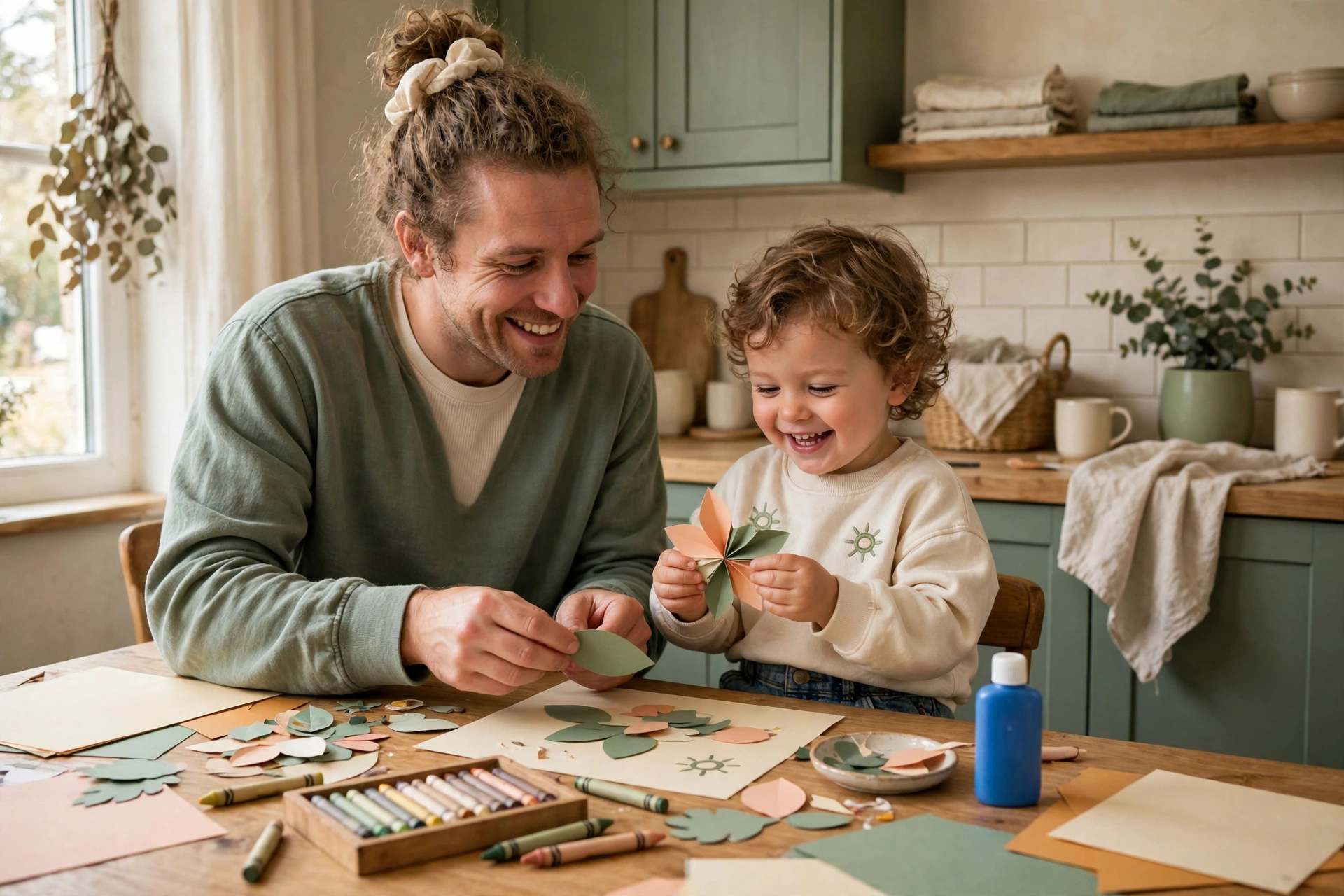
Toddler crafts work when they pass a simple test: everything you need is already in the house, setup takes 5 minutes or less, and your toddler can finish the thing in 10 to 15 minutes. You open a drawer, find paper and crayons, and start. No craft store trip, no special kit, no 40-step tutorial with a perfect photo at the end. Every idea on this page is built for that moment, sorted into four groups of five: paper, paint and print, nature and kitchen, and seasonal. Every idea works at the kitchen table, takes 10 to 15 minutes, and comes with the version for age 2, the version for ages 3 to 4, and the stretch for age 5. The heart of this page is a simple rule: the doing matters more than the finished picture, because tearing, dabbing, smearing, and sticking build the small muscles in their hands, and those muscles are what they need for holding a pencil later.
Toddler arts and crafts: the short version
Before the ideas, here is how a craft afternoon actually works, in plain words, so you know why this page is built the way it is.
| What it is | What it does |
|---|---|
| Paper crafts | Torn paper, paper plates, toilet rolls. No scissors needed for the youngest, and the mess stays on one tray. |
| Paint and print crafts | Finger paint, sponge stamps, potato prints. Washable paint only, smock on, and the table covered first. |
| Nature and kitchen crafts | Leaves, pinecones, dry pasta, egg cartons. Free materials from the house and the garden. |
| Seasonal crafts | One craft per season, including Christmas, Halloween, Valentine's Day, fall and spring. |
| The No-Trip Test | Every craft uses things already in the house. No craft store trip, setup in 5 minutes or less. |
Read the table as permission, not homework. You do not need to buy anything new. You need paper, crayons, washable paint, a glue stick, and whatever is already in your kitchen drawer. For the Christmas version of this page, the toddler christmas crafts page has 15 no-mess ideas sorted by mess level, and for the messy play side, the sensory activities for toddlers at home page has the full sensory day.
20 toddler crafts for every kind of day
Every one of these toddler crafts is built for a real kitchen table, with a real toddler, and things already in the house. Pick one group for today and one for tomorrow, and ignore the rest until you need them. Keep the setup to 5 minutes, the making to 10 to 15 minutes, and the cleanup to 5 minutes, and stop while it is still fun. When one stops working, do not push it. Move on immediately.
Paper crafts
Paper is the easiest material to start with. It tears, it folds, it sticks, and it costs almost nothing. Start here if your child has never crafted before.
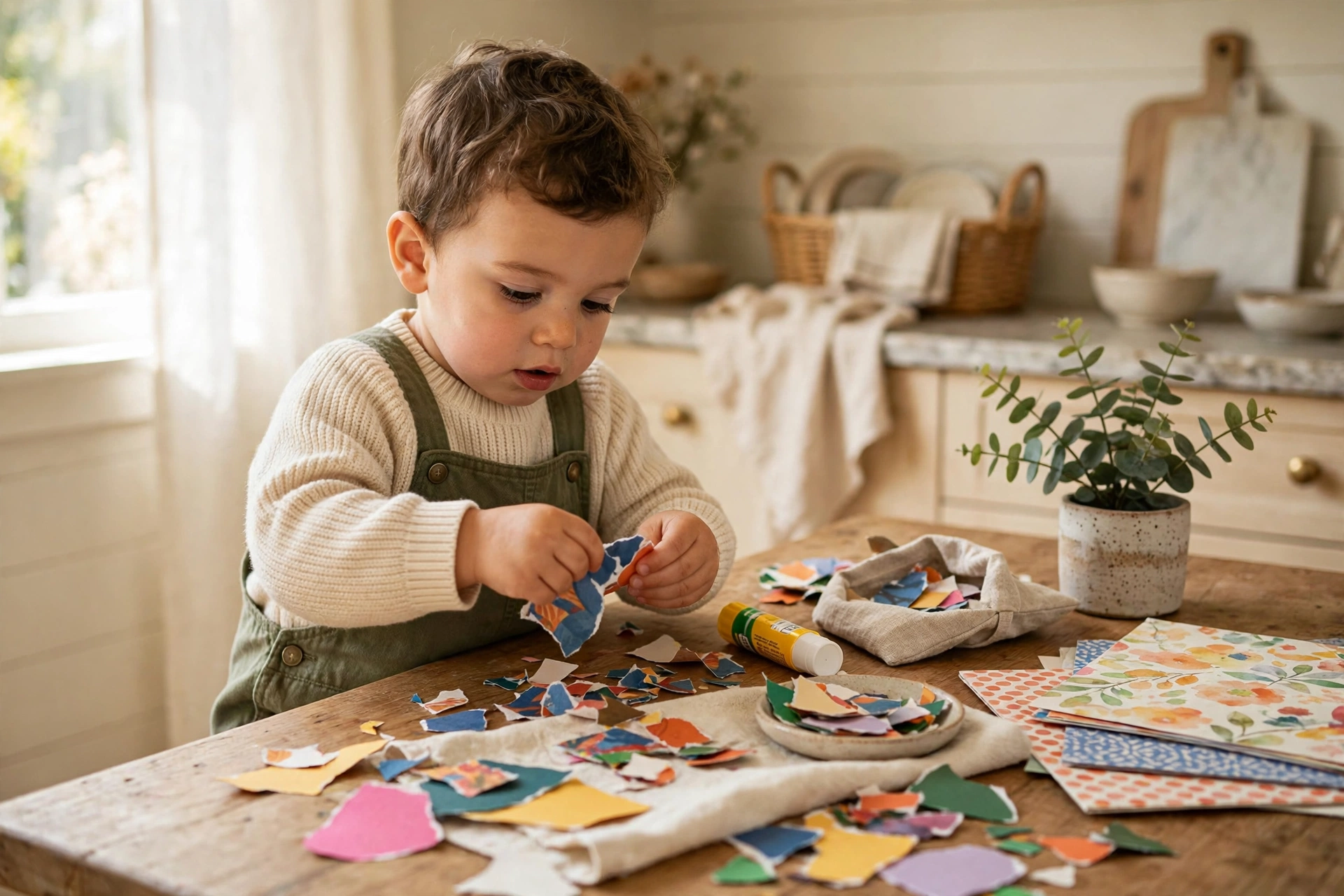
1. Torn paper collage
Tear colored paper into pieces and stick them on a big sheet with a glue stick. No scissors, no rules, just tearing and sticking. Age 2: tear the paper together, and they stick the pieces wherever they like. Ages 3 to 4: they tear their own pieces, and they sort them by color first. Age 5: they make a picture on purpose, like a house or a tree, and they tell you the story of it.
2. Paper plate animals
Paint a paper plate, then add ears, eyes, and a nose cut from colored paper, and you have an animal. A lion, a bear, a fish, or a turtle, it does not matter, because your toddler chose it. Age 2: paint the plate, and you add the ears and eyes. Ages 3 to 4: they paint and stick, and you cut the small pieces. Age 5: they plan the animal first, and they cut the pieces themselves with blunt scissors.
3. Toilet roll binoculars
Tape two toilet rolls together, paint them, and tie a string through each side so your toddler can wear them around their neck. Then go look out the window. Age 2: paint the rolls, and you tape them together. Ages 3 to 4: they paint and decorate, and they choose the string color. Age 5: they build the binoculars, and they go on a bird watch around the house.
4. Handprint flowerpot
Cover their hand in green paint and press it on paper, then add fingerprint flowers at the end of each finger, and cut a flowerpot shape from another color and stick it below. Grandparents keep this one. Age 2: one handprint, and you add the flowers. Ages 3 to 4: they make the handprint and the fingerprints, and they choose the flower colors. Age 5: they make a whole garden of handprints, and they write their name on the pot.
5. Paper chain garland
Cut paper into strips, loop them into rings, and tape each ring to the next until you have a chain long enough to hang across a doorway. Age 2: they hand you the strips, and you loop them. Ages 3 to 4: they loop the rings, and you tape them. Age 5: they make the whole chain themselves, and they count the rings as they go.
Paint and print crafts
Paint is where the mess lives, and where the fun lives too. Washable paint only, smock on, table covered, and the mess stays where you can wipe it in two minutes.
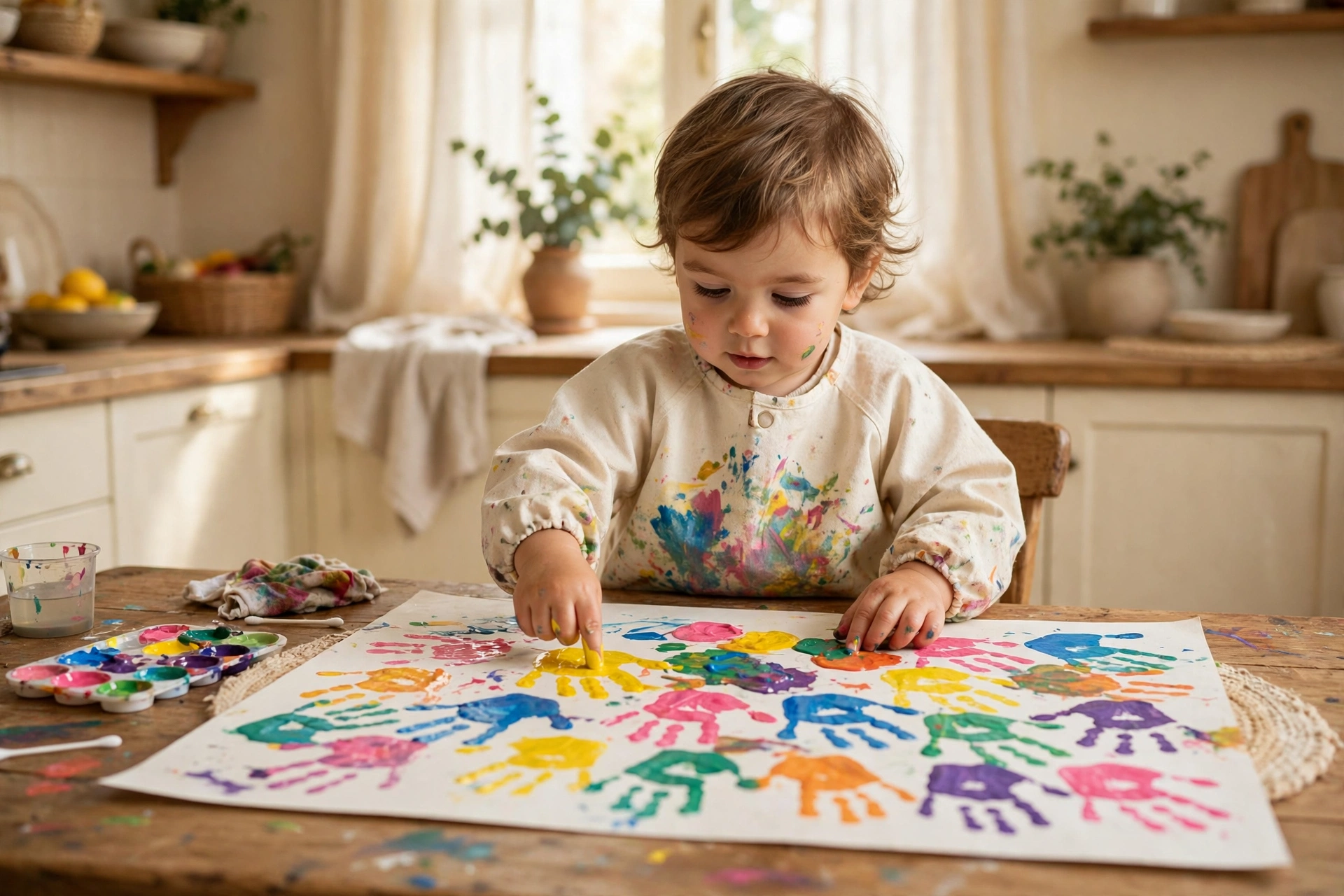
6. Finger painting
Put washable paint in shallow dishes, spread a big sheet of paper on the table, and let them paint with their fingers. No brushes, no rules. Age 2: one color at a time, and you paint alongside them. Ages 3 to 4: two or three colors, and they mix them to find new ones. Age 5: they paint a picture on purpose, and they wash their hands themselves when they are done.
7. Sponge stamping
Cut a kitchen sponge into shapes, dip it in washable paint, and stamp it on paper. Stars, circles, squares, or just blobs, it all counts. Age 2: stamp freely, and you hold the paper steady. Ages 3 to 4: they stamp a pattern, like a row of stars, and they name the shapes. Age 5: they stamp a border around a picture, and they make a card for someone.
8. Potato printing
Cut a potato in half, carve a simple shape into the flat side, dip it in paint, and press it on paper. The shape appears, and your toddler will want to do it again immediately. Age 2: you hold the potato, and they press it down. Ages 3 to 4: they hold it themselves, and they choose the paint color. Age 5: they carve the shape with you watching, and they print a whole row of them.
9. Handprint crabs
Cover each hand in red paint and press them on paper, thumbs up and palms touching, and you have a crab. Add eyes from white paper and color in the eyeballs, and cut out some scenery to stick around it. Age 2: one hand at a time, and you add the eyes. Ages 3 to 4: they do both hands, and they name the crab. Age 5: they make a whole crab family, and they tell you the story of each one.
10. Bubble wrap printing
Paint a sheet of bubble wrap, press paper on top, and peel it off to find the bumpy print underneath. The popping is half the fun, and the print is the other half. Age 2: paint the bubbles together, and they press the paper down. Ages 3 to 4: they paint and press on their own, and they choose the colors. Age 5: they print two sheets and compare them, and they pick their favorite to hang up.
Twenty crafts are a start, the kit covers the whole year
The No-Screen Toddler Rescue Kit sorts 115 activities by the moment you need them, including quiet time, rainy days, and travel, so the next afternoon is always covered too. 89 pages, 28 printable activity cards, ages 2 to 5.
Instant download. Print it once, use it every day.
Nature and kitchen crafts
Nature and kitchen crafts cost nothing, because the materials are already in the house or the garden. Leaves, pinecones, dry pasta, and egg cartons are all free, and they are all worth keeping in a box by the door.
11. Leaf rubbing art
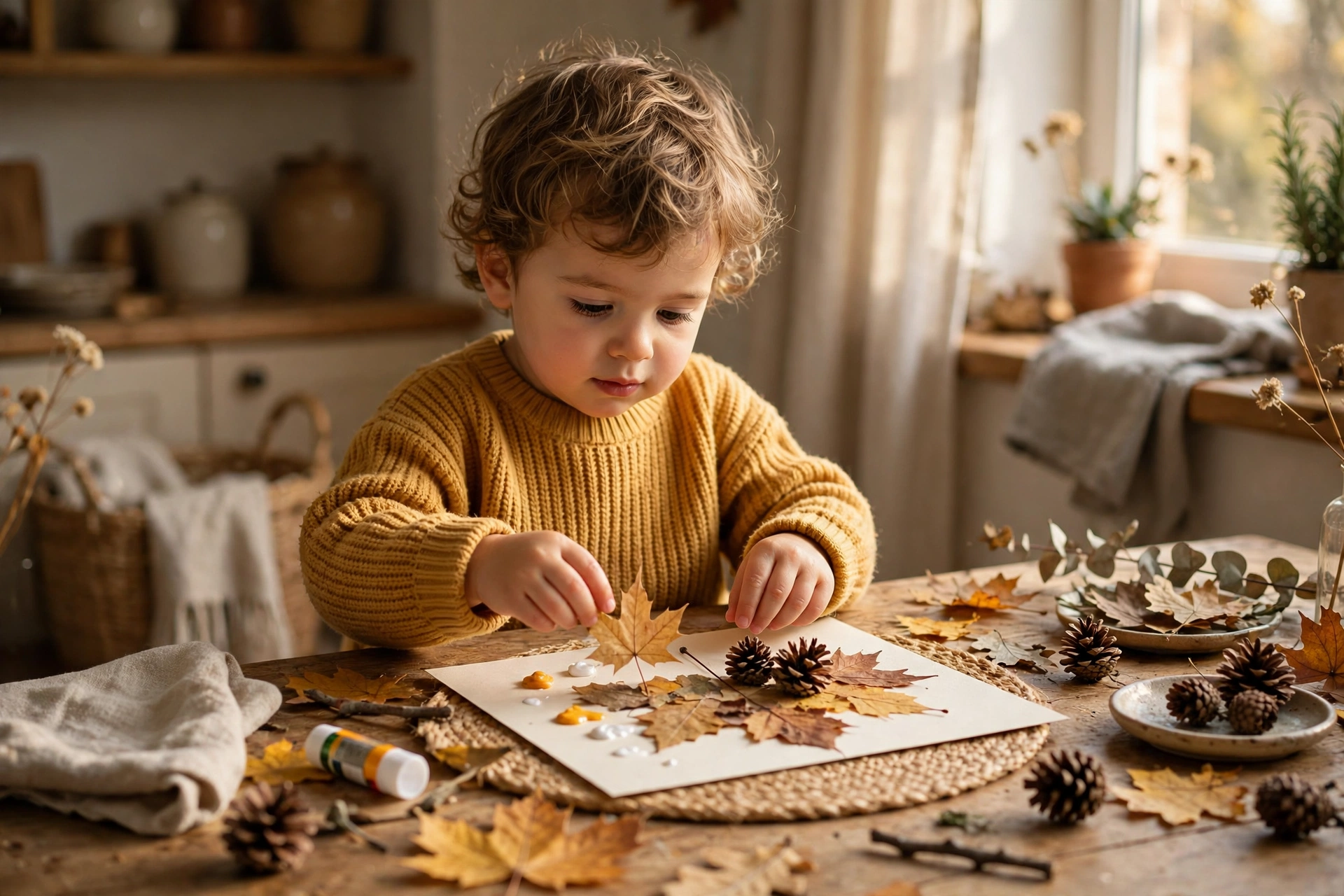
Put a dry leaf under a sheet of paper and rub a crayon across it, and the leaf appears like magic. Collect five different leaves first, and rub each one in a different color. Age 2: you hold the paper, and they rub with a chunky crayon. Ages 3 to 4: they hold the paper themselves, and they name the leaf shapes. Age 5: they collect the leaves, sort them by size, and label each rubbing.
12. Nature collage
Go outside and collect leaves, sticks, petals, and stones, then come back in and stick them on a big sheet with a glue stick. The walk is half the craft. Age 2: collect three things, and stick them wherever they like. Ages 3 to 4: they collect a whole basket, and they sort it by color before sticking. Age 5: they make a scene on purpose, like a tree or a garden, and they tell you the story of it.
13. Pasta necklaces
Thread dry penne or rigatoni onto a piece of string, and you have a necklace. Paint the pasta first if you want color, or leave it plain and paint it after. Age 2: thread three pieces, and you hold the string steady. Ages 3 to 4: they thread a whole necklace, and they count the pieces as they go. Age 5: they paint the pasta, thread it in a pattern, and wear it to show someone.
14. Egg carton caterpillar
Cut an egg carton into a strip of cups, paint each cup a different color, and tape them together in a row. Draw eyes on the first cup and poke a pipe cleaner through for the antennae. Age 2: paint the cups, and you tape them together. Ages 3 to 4: they paint and count the cups, and they choose the colors. Age 5: they build the whole caterpillar, and they make a leaf for it to sit on.
15. Pinecone bird feeder
Roll a pinecone in peanut butter, then roll it in birdseed, and hang it from a tree with a piece of string. Then watch from the window to see who comes. Age 2: roll the pinecone with you, and they sprinkle the seeds. Ages 3 to 4: they do the rolling themselves, and they pick the tree. Age 5: they make two feeders, and they keep a list of the birds they see. If anyone in the house has a nut allergy, use sunflower seed butter instead of peanut butter, and wash hands right after.
Seasonal crafts
One craft per season keeps the year interesting, and each one doubles as a gift or a decoration. Pick the season you are in, and save the rest for when it comes around.
16. Christmas handprint reindeer
Press a brown handprint on paper, add antlers with finger paint, and stick on googly eyes and a red pom-pom nose, and you have a reindeer. For the full Christmas set, the toddler christmas crafts page has 15 no-mess ideas sorted by mess level. Age 2: one handprint, and you add the antlers and eyes. Ages 3 to 4: they make the reindeer and choose the nose color. Age 5: they make a whole reindeer family, and they turn it into a card for someone.
17. Halloween handprint spiders
Press a black handprint on orange paper, draw eight legs with a marker, and stick on googly eyes, and you have a spider. Age 2: one handprint, and you draw the legs. Ages 3 to 4: they make the spider and count the legs. Age 5: they make a whole web of spiders, and they name each one.
18. Valentine's heart cards
Fold a piece of paper in half, cut a heart shape, and let your toddler decorate it with crayons, stickers, and fingerprint hearts. One card for each grandparent. Age 2: they scribble on the heart, and you fold and cut it. Ages 3 to 4: they decorate the heart themselves, and they choose who gets it. Age 5: they make a card for everyone in the family, and they write their name on each one.
19. Fall leaf letters
Collect fall leaves in different colors, stick them on a big sheet, and write the first letter of your child's name in the middle with a crayon. Age 2: stick the leaves anywhere, and you write the letter. Ages 3 to 4: they stick the leaves around the letter, and they say the letter sound. Age 5: they write the whole name in leaves, and they spell it out loud.
20. Spring paper cup flowers
Cut slits around a paper cup to form petals, paint the petals, and push a green pipe cleaner through the bottom for the stem. A whole garden takes ten minutes. Age 2: paint the cup, and you cut the slits. Ages 3 to 4: they paint and bend the petals, and they choose the stem color. Age 5: they make a bouquet of five flowers, and they give it to someone.
The next craft is already in the kit
The No-Screen Toddler Rescue Kit gives you 115 screen-free activities for ages 2 to 5, with 28 printable cards, so when your toddler outgrows these crafts, the next ones are already waiting.
Instant download. Print it once, use it every day.
How toddler crafts actually work
Crafts work because they respect the toddler. There are four rules, and every idea on this page follows all four.
The No-Trip Test. Everything already in the house. Paper, crayons, washable paint, toilet rolls, egg cartons, dry pasta, leaves, and pinecones. If a craft needs a special purchase, it is not on this page. A craft store trip is not the start of a craft, it is a delay, and by the time you get home, the mood is gone.
Process over product. The doing matters more than the finished picture. Tearing, dabbing, smearing, and sticking build the small muscles in their hands, and those muscles are what they need for holding a pencil later. If the paper ends up a brown smear, hang it anyway, and say what you saw them do. A child who hears their effort described will try again tomorrow.
Ten to fifteen minutes. A 2-year-old has about a 10-minute attention span on a good day, and a 5-year-old can stretch to 20 minutes when they care about the result. Set up in 5 minutes, make for 10 to 15 minutes, and clean up together for 5 minutes. Stop while it is still fun, not when they are bored and crying.
Mess has a place. A tray under the paper, a smock on the child, and washable paint in the dish. The mess stays where you can wipe it in two minutes. If the mess is the problem, shrink the craft: one color, one sheet, one tray, and a wet cloth ready before you start.
For the Christmas version, the toddler christmas crafts page has 15 no-mess ideas sorted by mess level, and for the messy play side, the sensory activities for toddlers at home page has the full sensory day. For the age-by-age version, the activities for 2 year olds at home page has the age 2 day, and the activities for 5 year olds at home page has the kindergarten year.
The craft plan
A toddler does not need a schedule. They need a rhythm: one craft, one snack, and one tidy-up, in that order, and repeat. This table is a rhythm, not a timetable, and it bends around naps, moods, and the weather.
| When it is | What to do |
|---|---|
| Rainy afternoon | Two paper crafts and one paint craft, back to back, with a snack in between. About an hour, and the table is the whole world. |
| A quiet morning | One nature craft after breakfast, slow and calm. Collect the leaves first, then sit down to stick them. |
| A playdate | One big shared craft, like a paper chain garland or a group collage. Two toddlers, one roll of paper, no rules. |
| A gift for grandparents | A handprint flowerpot or a handprint reindeer. Grandparents keep these, and your toddler made it themselves. |
| A whole week of crafts | One craft a day, Monday to Friday, one group per day. Paper on Monday, paint on Tuesday, nature on Wednesday, seasonal on Thursday, free choice on Friday. |
Two crafts on a rainy afternoon are enough. Each one lasts 10 to 15 minutes of focused making, and the rest of the time is choosing colors, washing hands, and showing someone what they made. That is not wasted time. Choosing, showing, and telling you about it is how a toddler learns that making things matters, and it counts as much as any craft on this page.
One kit, every age from two to five
The No-Screen Toddler Rescue Kit covers the whole toddler years, with 115 screen-free activities for ages 2 to 5, including quiet time, rainy days, and travel, plus 28 printable activity cards.
Instant download. Print it once, use it every day.
Safety rules for crafting with toddlers
Washable, non-toxic paint only. Washable means it comes off hands, clothes, and the table with soap and water. Non-toxic means a taste will not hurt them, and toddlers will taste it. Avoid acrylics, oil paints, and spray paint, which are not made for little hands or little lungs.
Scissors stay with you. Blunt-tipped scissors only, and you hold them with your child for age 2. At age 3, they cut with you watching, and at age 5, they cut on their own, sitting down, with the scissors pointing away from everyone.
Small parts are for big kids only. Beads, buttons, and googly eyes are choking hazards for under-3s. For age 2, glue paper shapes instead of small parts, and save the beads and buttons for age 4 and up, with you right there.
Taste-safe for the youngest. Under-2s mouth everything, so the paint, the glue, and the playdough all need to be safe to taste. Yogurt mixed with a drop of food coloring works as edible paint. No glitter for toddlers, because it gets in eyes and stays on clothes for weeks.
Never leave them alone with paint, glue, or water. A toddler with a paint bottle and no adult will paint the table, the wall, and the dog in under a minute. Stay at the table, even if you are only watching, and keep the paint in a shallow dish, not the bottle, so a spill stays small.
When crafts go wrong
They eat the paint. Stay calm. Washable, non-toxic paint will not hurt them, and that is why the rule exists. Wipe their mouth, give them water, and switch to yogurt paint next time. Do not make a big deal of it, or they will do it again for the reaction.
They paint the table, the wall, and the dog. That is what the tray and the smock are for, and what washable paint is for. Wipe it now, and shrink the craft next time: one color, one sheet, one tray, and a wet cloth ready before you start.
They will not follow the steps. Good. The steps are for you, not for them. A toddler who tears the paper instead of cutting it is still crafting, and a toddler who paints the whole page blue is still learning. Follow their lead, and save the steps for age 5.
They finish in 30 seconds. That is normal for age 2. Put out a second sheet, or a second color, and let them go again. Three 30-second crafts are a fine afternoon, and they will last longer next week.
You compare your child's craft to Pinterest. Stop. The photos on Pinterest are made by adults, styled by adults, and photographed by adults. Your toddler's brown smear is real, and it is theirs. Hang it anyway.
Frequently Asked Questions
What age can toddlers start doing crafts?
From age 2, with the simplest crafts: tearing paper, finger painting, and sticking shapes on a page. At age 2, keep it to one step and one material, and expect them to explore it rather than finish a picture. At age 3, add gluing and simple cutting with blunt scissors, and let them choose the colors. At age 4, add folding and simple shapes, and let them tell you what they are making. At age 5, add a plan, like a card for someone, and let them carry it through. The first desire for creativity often shows up around age 3, starting with coloring and drawing, but a 2-year-old can already enjoy the doing, and that is the part that matters.
What kind of paint is safe for toddlers?
Washable, non-toxic, water-based finger paint, with a label that says AP non-toxic. That is the whole rule. Washable means it comes off hands, clothes, and the table with soap and water. Non-toxic means a taste will not hurt them, and toddlers will taste it. Avoid acrylics, oil paints, and spray paint, which are not made for little hands or little lungs. For the youngest, yogurt mixed with a drop of food coloring works as edible paint, and it washes off just as easily. Put the paint in a shallow dish, not the bottle, so a spill stays small.
What are the easiest crafts for toddlers?
The easiest ones use a few large, safe materials and simple actions: tearing paper, stamping, dabbing paint, and sticking shapes. Keep the activity short, about 10 to 20 minutes, and value the exploring over a picture-perfect result. A torn paper collage, a sponge stamp, and a handprint flower are all easy, and they all work with things already in the house. If a craft needs more than 5 minutes of setup or more than 3 steps to explain, it is not an easy one, and your toddler will lose interest before it starts. Start with the paper group on this page, and add paint once your child is comfortable with the mess.
How long should a toddler craft session last?
About 10 to 20 minutes of focused making, and that is enough. A 2-year-old has about a 10-minute attention span on a good day, and a 5-year-old can stretch to 20 minutes when they care about the result. Stop while it is still fun, not when they are bored and crying, because a short happy session makes them want to craft again tomorrow, and a long forced one makes them avoid the table. Set up in 5 minutes, make for 10 to 15 minutes, and clean up together for 5 minutes. The cleanup is part of the craft, not a punishment after it, and toddlers who wipe their own table learn that making things includes tidying up.
Do I need to buy special craft supplies?
No. Every craft on this page uses things already in the house: paper, crayons, washable paint, toilet rolls, egg cartons, dry pasta, leaves, and pinecones. That is the whole point of the No-Trip Test. The only things worth buying, if you do not already have them, are washable finger paint, a glue stick, and blunt-tipped scissors, and those three cost less than one craft kit. A craft store trip is not the start of a craft, it is a delay. Open a drawer, find paper and crayons, and start. If your child asks for glitter, say no kindly, because glitter gets in eyes, stays on clothes for weeks, and adds nothing a toddler can actually do.
What are the best toddler crafts?
The ones your child can finish themselves, with things already in the house, in 10 to 15 minutes. A torn paper collage, a sponge stamp, a handprint flower, a leaf rubbing, and a pasta necklace are the five to start with, because each one uses one material, one action, and no special skill. The four groups on this page cover all of it: paper, paint and print, nature and kitchen, and seasonal. Pick the group that matches what you already have in the house, not the one a list told you to buy, and let your child choose the colors, because a craft they chose is a craft they finish.
What if my toddler just makes a mess and nothing else?
Then the craft worked. At ages 2 to 5, the doing is the learning, and the finished picture is a bonus, not the goal. Tearing, dabbing, smearing, and sticking build the small muscles in their hands, and those muscles are what they need for holding a pencil later. If the paper ends up a brown smear, hang it anyway, and say what you saw them do: you tore the paper, you pressed the sponge, you chose the blue. A child who hears their effort described will try again tomorrow. If the mess is the problem, put a tray under the paper, a smock on the child, and washable paint in the dish, and the mess stays where you can wipe it in two minutes.
Sources and further reading
How Wee Learn has the 50-craft list for 2 year olds, and its whole point is the process, not the finished product, with the crafts divided by season so you can find the one that fits today. Read 50 crafts for 2 year olds from How Wee Learn. Memphis Moms has the 20-craft list that tops the search results, built around a make-things box of odds and ends from around the house. Read 20 easy crafts from Memphis Moms.
Start with one paper craft today, the torn paper collage or the paper plate animal, and let toddler crafts do the work while you watch them make something real. For the Christmas version, the toddler christmas crafts page has 15 no-mess ideas sorted by mess level. For the learning side, the toddler learning activities at home page has the four skills, and the sensory activities for toddlers at home page has the messy play. For the age-by-age version, the activities for 2 year olds at home page has the age 2 day, the activities for 3 year olds at home page has the age 3 day, and the activities for 5 year olds at home page has the kindergarten year.